India@79: Confident, Free and Responsible
NewsBharati 15-Aug-2026 07:00:00 AM
Total Views |


On August 15, 1947, India achieved what generations had struggled and sacrificed for: political freedom. The Union Jack came down and the Tricolour rose over a free India. It was not merely a transfer of power. It was the restoration of a nation's soul. Seventy-nine years later, India stands at a very different point in its journey. The country that inherited poverty, illiteracy, weak industrial capacity and the enormous burden of Partition has emerged as a confident and consequential nation. It is no longer a country merely asking the world to listen. Increasingly, it is a country whose voice matters.
That transformation deserves recognition.India today possesses an expanding economy, formidable technological capabilities, a stronger defence profile and a growing diplomatic footprint. Its achievements in space, digital technology, pharmaceuticals, infrastructure and financial inclusion have demonstrated that India can solve problems at a scale few countries can match. But perhaps the more significant transformation is psychological.
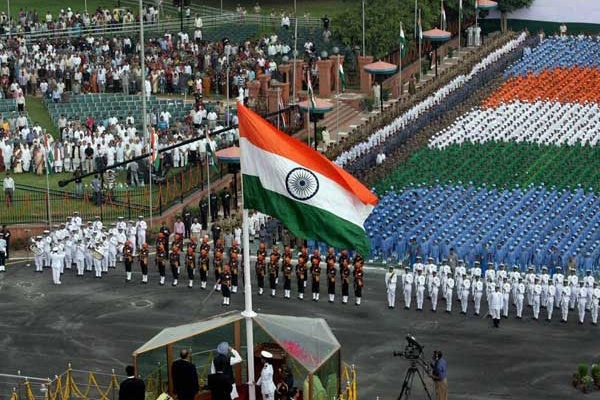
India is gradually shedding the hesitation that often accompanied its post-Independence identity. There is greater willingness to look at India's civilisational inheritance not as an embarrassment to be explained away, but as a source of confidence. Its ancient knowledge, traditions, languages, philosophy, art, literature and social institutions are increasingly being discussed as part of a living civilization rather than merely as museum pieces from the past. That is civilisational confidence. It does not mean rejecting everything that came from outside. Nor does it mean romanticising history. A confident civilization has no need to distort its past. It can acknowledge its failures, learn from them and still take legitimate pride in its achievements.
India's journey since 1947 is therefore not simply a story of economic or technological advancement. It is also a story of a civilisation rediscovering the confidence to speak in its own voice. But Independence Day also demands a more uncomfortable question: What do we do with freedom once we have it?
Freedom is not a licence. Freedom of expression is not a licence to spread deliberate falsehoods. The right to protest is not a licence to intimidate ordinary citizens or paralyse public life. Political opposition is not a licence to obstruct every institution of the State. Parliamentary democracy is not a licence to prevent Parliament from functioning. Dissent is essential to democracy; deliberate disruption is not. There is a growing tendency in contemporary politics to confuse the right to disagree with the right to derail. That distinction cannot be allowed to disappear.
When a political party disrupts legislative proceedings merely to prevent debate, it may claim the language of democracy, but it weakens the institution through which democracy is supposed to function.
When protest crosses the line into intimidation, public inconvenience becomes a weapon. When political rhetoric deliberately inflames social divisions, freedom of expression is reduced to a convenient shield. When every disagreement is portrayed as an assault on democracy, the word itself begins to lose meaning. A mature democracy cannot operate on the principle that one's own freedom ends only when somebody else forces it to end.
There is another danger. The culture of permanent outrage can make disruption appear virtuous. Television cameras reward spectacle. Social media rewards provocation. Political actors discover that creating noise can sometimes be easier than presenting an argument. But a nation cannot be governed through noise.
ALSO READ:Partition horrors remembrance day: PM Modi pays tribute to survivors, calls for unity
Civilisational confidence should produce maturity. That is perhaps the real message of Independence Day in 2026. India has travelled a remarkable distance from the uncertainty of 1947. It has demonstrated resilience, ambition and an extraordinary capacity for renewal. The next stage of national development, however, will require something more than economic growth and technological achievement. It will require civic maturity. The India that once fought to win freedom must now demonstrate that it knows how to preserve, exercise and respect freedom. Political independence gave India the right to choose its destiny. Civilisational confidence gives it the courage to define that destiny in its own voice.

Editor's Desk
Editor's Desk