The Warning Europe Was Given and What the Security Numbers Actually Show
The 2017 Warning Europe Ignored Now Backed by Hard Europol Terrorism Numbers and Official Actions
Total Views |


In 2017, at a public forum in Riyadh, the UAE's foreign minister Sheikh Abdullah bin Zayed Al-Nahyan issued a blunt prediction, almost like a warning. Europe, he said, would one day “see far more radicals, extremists and terrorists coming from Europe because of a lack of decision-making, and trying to be politically correct”, naming London, Germany, Spain and Italy as places where dangerous voices operated freely. He went further, warning that countries failing to act could be labelled “incubators of terror.” At the time, the remark was dismissed by many as undiplomatic. Years later, it is quoted across European debate.
The interesting part is that some of Europe's own governments, including centrist and liberal ones, have since acted on very similar reasoning. This is where the causal link is not merely an outsider's claim but something European officials themselves have drawn.

The clearest example is France. After schoolteacher Samuel Paty was beheaded in 2020 by an Islamist attacker, President Emmanuel Macron, no one's idea of a right-wing hardliner, launched a direct crackdown. His government ordered the closure of mosques suspected of inciting hatred and pushed through the 2021 “separatism law.” Reuters reported that French officials were “increasingly worried by broader signs of radicalisation, often non-violent within Muslim communities”. Macron himself said the aim was to “free Islam in France from foreign influences,” and the law made it far harder for mosques to receive foreign funding and ended the practice of training imams overseas. In other words, a European government publicly connected certain mosques, foreign money and radicalisation and legislated on it.
So what do the hard security numbers say? One of the most authoritative sources is Europol's annual Terrorism Situation and Trend Report (TE-SAT), compiled from data supplied by EU member states. Its 2025 edition, covering 2024, reported 58 terrorist attacks across 14 EU countries, of which 24 were jihadist. Crucially, jihadist attacks were the most lethal category, killing 5 people and injuring 18. Of 449 people arrested for terrorism offences that year, the largest share, 289 were linked to jihadist terrorism.
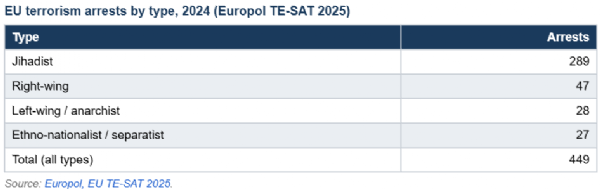
These figures need to be read honestly, in both directions. On one hand, they confirm that jihadist violence remains, in Europol's own words, the deadliest terrorist threat the EU faces, and that it draws by far the most arrests. On the other, jihadist arrests actually fell from 334 in 2023 to 289 in 2024.
This is also relevant in India, as the Indian state only looks at violent extremism and there is no law or policy towards Non-Violent extremism or preaching or indulging in Islamism openly. Not only that, the Indian state doesn’t have a policy towards demographic shift and how to stop it. Only recently did the Indian Government form a committee on demographic change. Many issues are synonymous when it comes to tackling Political Islam and radicalism between the European and Indian democracies.
The fair conclusion is this. The demographic change is real and measured. The security concern is also real, backed by Europol's own casualty and arrest figures and taken seriously enough that even a liberal French president closed mosques and rewrote the law. What the numbers do not support is any claim that ordinary mosques or ordinary Muslims are the threat; the extremists are a tiny fraction. The honest position, and the one increasing numbers of European officials now hold, is that a fast-growing community requires serious integration policy and serious counter-radicalisation work at the same time. Ignoring either half is the real risk.