Vande Mataram: Congress Has Lost Its Emotional Connect With India
Total Views |


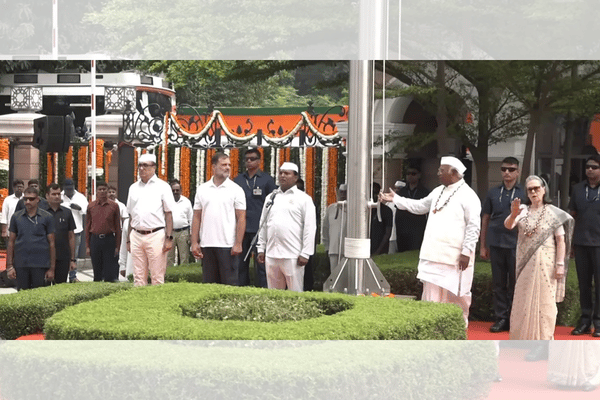
The scene at the Congress headquarters on Independence Day should disturb every Indian who believes that nationalism is more than a political slogan. As Vande Mataram was being rendered, Sonia Gandhi, Rahul Gandhi and Congress president Mallikarjun Kharge were seen making gestures and interacting instead of standing in solemn attention. Three were seen highly agitated, irked and restless. Their body language was more vocal. The Congress has offered its explanation that Sonia Gandhi was asking for a chair for Kharge, not asking that the song be stopped. But this lame explanation does not erase the larger question raised by the episode. Why does the Congress repeatedly appear uncomfortable with the emotional vocabulary of Indian nationalism?
Vande Mataram is not merely a song. It was a cry of resistance, a cultural expression of the freedom movement and an invocation of the motherland. It was sung at the Congress session in 1896 by Rabindranath Tagore and became a powerful nationalist salutation during the anti-colonial struggle. The Constituent Assembly later accorded it equal honour with Jana Gana Mana as the National Song. Yet the journey of Vande Mataram within the Congress also reveals how political calculation gradually came to compete with national sentiment.
The turning point came in 1937. After objections to portions of the song that contained references to Hindu deities, the Congress decided that only its first two stanzas would be used at national gatherings. There were historical reasons for seeking accommodation in a deeply divided political environment. But accommodation soon became a political habit. The larger lesson was that India's cultural inheritance could be negotiated whenever a section of society objected to it.
The Congress that had once used Vande Mataram to awaken national consciousness increasingly became cautious about the civilisational vocabulary of India. Its politics gradually developed a distinction between nationalism that could be presented as secular and cultural nationalism that had to be treated with suspicion. The result was a peculiar political inversion: a party born in the freedom movement increasingly seemed embarrassed by some of the symbols that had emotionally united that movement.
India is a memory. It is Bharat Mata. It is the Ganga, the Himalayas and the sacred geography that has bound communities together for centuries. There are countless unnamed freedom fighters. It is the tricolour in the hands of an ordinary citizen. It is the voice that rises instinctively with Vande Mataram.
The Congress's difficulty is that this disconnect did not end with Independence. It survived in different forms through subsequent decades. The party often appeared more comfortable with the politics of minority reassurance than with openly celebrating the civilisational majority's cultural inheritance. Symbols associated with Hindu civilisation were repeatedly subjected to political qualification, while expressions of identity politics were often defended in the name of secularism. This is why the Sonia-Rahul-Kharge episode matters beyond the immediate controversy.
Congress can say that no one intended to insult Vande Mataram. It can argue that the gestures were misunderstood. It can point to its own historical role in the freedom struggle. But political parties are judged not only by explanations for one video. They are judged by the accumulated impression created over decades. And the accumulated impression is damaging. This behaviour deserves scrutiny because it exposes not an awkward moment alone, but a widening distance between Congress and India's national sentiment.
The contrast with the country's changing mood could hardly be sharper. Vande Mataram is today being reclaimed with confidence by a generation that sees no contradiction between constitutional patriotism and civilisational pride. Young Indians are increasingly comfortable celebrating the Constitution, the tricolour, Vande Mataram and India's civilisational heritage simultaneously. Congress appears to have missed this transformation.
Its leadership still seems trapped in an old political grammar in which cultural nationalism must constantly be explained, qualified or defended against accusations of majoritarianism. But nationalism does not become less inclusive merely because it is emotionally rooted in the civilisation of India. The freedom movement itself demonstrated the mobilising power of cultural symbols against colonial rule.
The irony is profound. Congress wants the legacy of the freedom struggle, but the freedom struggle cannot be separated from its emotional symbols. It wants Gandhi, Nehru, Patel, Bose and the national movement, but it cannot selectively inherit their history while distancing itself from the cultural expressions through which millions experienced that struggle.
The Congress therefore faces a question much larger than what happened at its headquarters: Does it still emotionally identify with the India that Vande Mataram represents? If the answer is yes, there should be no hesitation, no awkwardness and no political calculation. A national song should be received with respect, regardless of which party sings it. If the answer is no, then the problem is much deeper than one Independence Day video. A political party can lose elections and recover. It can lose seats and rebuild. It can change leaders, slogans and campaign strategies. But losing emotional connection with a civilisation is far more difficult to repair. That is the real message of the Vande Mataram episode.
The Congress did not merely inherit the political legacy of India's freedom struggle but it began treating inheritance as negotiable due to appeasement politics. India has changed. Its citizens are increasingly comfortable expressing national pride without seeking ideological permission. They are rediscovering the confidence to say that Bharat's civilisational identity is not an embarrassment, a concession or a political liability. The Congress can continue to debate gestures, explanations and technicalities. But the country is asking a simpler question: When India says Vande Mataram, does the Congress feel it—or merely hear it?