Congress long and complicated relationship with Vande Mataram has returned to the political centre-stage, from the 1937 decision to restrict its public rendition to two stanzas, to Rahul Gandhi’s 2018 rally episode, the 2025 Parliament debate, the Kerala government’s repeated controversies over the song and now the Sonia Gandhi video from the Congress headquarters. With a new law extending statutory protection to Vande Mataram, the latest row has also acquired a legal dimension.
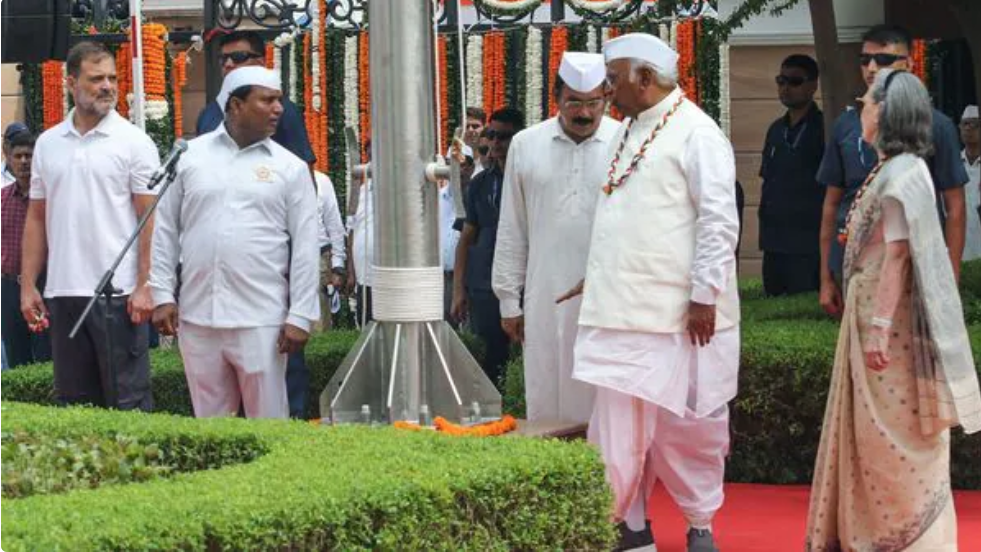
The latest flashpoint came on August 15, 2026, during the Congress Independence Day programme at the AICC headquarters in New Delhi.
A video from the event showed Congress Parliamentary Party chairperson Sonia Gandhi interacting with Congress president Mallikarjun Kharge and making gestures while Vande Mataram was being rendered. Rahul Gandhi was also present and the exchange was visible on camera. A later transcription of the video showed Rahul Gandhi telling the volunteer, “This is not our Vande Matram, we don’t sing this” and more. The visuals quickly circulated on social media, with BJP leaders alleging that Sonia Gandhi was signalling for the rendition to be stopped after the first two stanzas.
Union Home Minister Amit Shah accused Sonia Gandhi of asking the Congress president to stop the song midway and demanded an apology.
At a public programme in Rajasthan, Shah said Congress leaders should be ashamed of leaving Vande Mataram incomplete and argued that generations of freedom fighters had faced imprisonment, bullets and lathi charges while carrying the song on their lips. He said the people of India would not forgive the Congress leadership over the incident.
The Congress, however, rejected the allegation.
Congress leaders said Sonia Gandhi was not asking anyone to stop Vande Mataram. Their explanation was that she was gesturing to arrangements for a chair for Mallikarjun Kharge, who had been standing for a prolonged period.
Congress general secretary Jairam Ramesh and other leaders described the controversy as a misreading of the visuals.
KC Venugopal called it a “communication issue” and said that Congress respected Vande Mataram.
The controversy moved beyond political accusations when a complaint was filed with the Delhi Police against Sonia Gandhi and Rahul Gandhi, seeking registration of an FIR over the disruption of Vande Mataram.
The complaint specifically asks the police to examine the applicability of the newly amended Prevention of Insults to National Honour law and conduct an impartial investigation. Delhi Police have begun examining the complaint.
This is important because the legal position surrounding Vande Mataram changed only days before the Independence Day controversy.
Until the amendment, the Prevention of Insults to National Honour Act, 1971 specifically protected the National Anthem against intentional prevention or disturbance. The 2026 amendment extends that protection to the National Song.
Under the amended provision, a person who intentionally prevents the singing of the National Anthem or National Song, or causes disturbance to an assembly engaged in such singing, can face imprisonment of up to three years, a fine, or both. A subsequent conviction attracts a minimum one-year jail term.
The important word in the provision is “intentionally.”
Therefore, merely being silent, failing to sing along or making an ambiguous gesture cannot automatically be equated with the statutory offence. Any criminal case would have to establish that the conduct amounted to intentional prevention or disturbance within the meaning of the law.
That distinction could become important if the Sonia Gandhi complaint advances.
The historical controversy
The current dispute cannot be understood without going back nearly nine decades.
Vande Mataram was written by Bankim Chandra Chattopadhyay and first published in Bangadarshan in 1875. It was later incorporated into his novel Anandamath, published in 1882.
Its political journey was closely intertwined with the Indian freedom movement.
Rabindranath Tagore famously sang Vande Mataram at the 1896 session of the Indian National Congress in Calcutta. During the anti-partition and Swadeshi movement of 1905, the song became a powerful rallying cry. The government’s official historical account records that the song was adopted for all-India occasions at the 1905 Varanasi Congress session.
The song consequently became associated not merely with the Congress but with the broader nationalist movement.
The official Azadi Ka Amrit Mahotsav archive notes that the first two stanzas subsequently became routine at Congress meetings and that Vande Mataram became an anthem for freedom fighters.
This is why the song has remained politically sensitive.
The 1937 decision
The most important historical issue concerns the Congress Working Committee’s decision of October 1937.
The complete composition contains six stanzas. The later portions contain religious imagery, including references associated with Hindu deities. Muslim political leaders objected to these portions, arguing that they could create discomfort in a religiously diverse country.
The Congress Working Committee subsequently decided that only the first two stanzas should be used at national gatherings.
Congress defence of the decision is that the first two stanzas celebrate the motherland without the religious imagery that appears in the later portions. Congress leaders have repeatedly argued that the decision was influenced by Rabindranath Tagore’s advice and was intended to preserve the song’s unifying character.
The 1937 CWC statement itself recognised objections raised by Muslim leaders to portions of the song while maintaining that the first two stanzas had an established place in the national movement.
The BJP interpretation is very different.
Prime Minister Narendra Modi, during the 150th anniversary debate in Parliament in 2025, argued that Congress had compromised on Vande Mataram under pressure from the Muslim League and that the decision to divide the song reflected the politics of appeasement.
Congress rejected that interpretation.
Jairam Ramesh argued that the 1937 CWC decision followed Tagore’s advice and accused the BJP of selectively presenting history. Congress leaders pointed to the presence of Gandhi, Nehru, Sardar Patel, Subhas Chandra Bose, Rajendra Prasad, Maulana Abul Kalam Azad and other major national leaders at the CWC discussions.
This disagreement over 1937 remains at the heart of today's political battle.
What happened in 1950?
The Constituent Assembly formally settled the question of the status of Vande Mataram in January 1950.
On January 24, 1950, Constituent Assembly President Dr Rajendra Prasad declared that Jana Gana Mana would be the National Anthem and that Vande Mataram, because of its historic role in the freedom struggle, would be honoured equally and have equal status with it.
The official historical record of the government preserves this declaration.
Importantly, Vande Mataram remained the National Song, not the National Anthem. Jana Gana Mana retained the status of National Anthem.
The distinction matters because the present legal amendment does not turn Vande Mataram into the National Anthem. It gives the National Song statutory protection under the same national-honour law.
The Rahul Gandhi episode of 2018
During a Congress rally in Karnataka in
2018, a video showed Rahul Gandhi pointing towards his wristwatch while Vande Mataram was being performed. The singer was subsequently directed to shorten the rendition and finish it in a single line.
The incident became a major BJP talking point.
BJP leaders, including Sambit Patra and Amit Malviya, attacked Rahul Gandhi, arguing that he had no authority to shorten the National Song according to his convenience. The footage was widely circulated on social media at the time.
Congress, however, has historically defended the two-stanza version as the version adopted for national gatherings.
December 2025: Rahul and Priyanka Gandhi absent during Parliament's Vande Mataram debate
The issue returned to Parliament during the special discussion marking 150 years of Vande Mataram in December 2025.
Prime Minister Narendra Modi led the discussion in the Lok Sabha, revisiting the history of the song and the 1937 Congress decision.
Rahul Gandhi and Priyanka Gandhi Vadra were absent during the Prime Minister's speech.
BJP leaders immediately attacked Rahul Gandhi over his absence.
BJP spokesperson CR Kesavan described it as disrespect to the National Song and the freedom movement, while Sambit Patra alleged that Rahul and Priyanka were absent because they carried a “sense of guilt” over Congress's historical position.
Congress did participate in the larger debate.
Priyanka Gandhi subsequently defended the party's historical position and accused the government of politicising Vande Mataram ahead of the West Bengal Assembly election. She argued that the government was using the past to divert attention from contemporary issues.
She also cited Nehru's 1937 correspondence with Subhas Chandra Bose and argued that the historical record was more complicated than the BJP's presentation.
The BJP's response was equally sharp: it argued that Congress was trying to defend an indefensible historical compromise.
Thus, the 2025 Parliament debate did not settle the dispute. It effectively reopened it on a national scale.
Kerala: The second major Congress-linked controversy in 2026
If the Sonia Gandhi controversy created a national storm, Kerala added a second front.
The Congress-led UDF government in Kerala had already been caught in a Vande Mataram controversy in May 2026.
During the opening of the new Kerala Assembly, the official band played only two stanzas of Vande Mataram despite the Governor's office having issued instructions relating to the full rendition.
The BJP criticised the government and alleged that Congress had begun distancing itself from the National Song.
The Congress government responded that it had not intended to create a controversy and that there had been confusion regarding the instructions.
The episode became even more complicated because the newly elected UDF government's swearing-in ceremony had actually featured the full rendition of Vande Mataram.
That full rendition itself had triggered criticism from the CPI(M), which argued that singing all six stanzas was inappropriate in a pluralistic society.
The BJP took the opposite position, accusing the Left of insulting the National Song and attempting to appease radical vote-bank groups.
The Kerala controversy therefore exposed an unusual political situation: Congress was being attacked from the Right for not playing the full song, while the Left was attacking the full rendition as inappropriate.
August 15, 2026: Kerala skips Vande Mataram again
The Kerala issue returned on Independence Day.
The Congress-led UDF government did not include Vande Mataram in the state's official Independence Day function.
The omission triggered a fresh political confrontation.
BJP state president Rajeev Chandrasekhar called it a serious constitutional and legal issue and questioned why Kerala was taking a different approach when Congress-led governments in other states had included the song in official functions.
The BJP also raised the question of political pressure from Muslim organisations and alleged that the Congress government had compromised on national symbols for electoral considerations.
In March 2026, the Supreme Court had described the Centre's January circular on Vande Mataram as “purely advisory in nature” and said that it imposed no legal obligation or penal consequence on those who chose not to sing it. The court dismissed a challenge as premature because there was no evidence of coercive action.
This distinction is crucial.
The administrative protocol and the later criminal law are not the same thing.
The Supreme Court was dealing with the Centre's advisory circular. Parliament subsequently amended the 1971 Act to criminalise intentional prevention or disturbance during the singing of the National Song.
“For us, Vande Mataram is an emotion”
Congress has repeatedly rejected the charge that it disrespects Vande Mataram.
KC Venugopal said the party respects the National Song and accused the BJP of turning national symbols and the freedom struggle into political weapons.
The Congress argument essentially has three parts:
1. Congress has historically been associated with Vande Mataram.
2. The 1937 decision concerned the use of the later religiously themed stanzas, not rejection of the song itself.
3. The BJP is using the controversy to create a political narrative around nationalism and minority appeasement.
Congress leaders have also pointed to the fact that Vande Mataram was sung at Congress sessions and played a major role in the freedom movement.
There is historical evidence for that broader claim. The government's own historical material records Tagore's 1896 rendition at the Congress session and the song's subsequent role in Congress and the Swadeshi movement.
The history therefore presents Congress with a question that extends beyond one song or one political controversy.
The Congress has every right to explain why it supports one interpretation of India’s cultural heritage and rejects another. But the historical record makes it difficult to argue that Indian nationalism was ever completely separated from civilisational symbols.
The party’s own documents celebrate “Vande Mataram. Congress leaders once stood in gatherings where the song was sung as a rallying cry against British rule.
So what changed?
Was it the fear that cultural symbols could be used to exclude minorities? Was it the transformation of Indian politics after independence? Was it an attempt to distinguish constitutional nationalism from religious identity? Or did electoral politics gradually change the way the Congress approached symbols that had once been part of its own nationalist vocabulary?
These are legitimate questions, particularly when the Congress itself continues to invoke its historical association with “Vande Mataram”. The issue is not whether every Indian must interpret every cultural symbol in exactly the same way. The issue is whether acknowledging India’s civilisational inheritance should itself be treated as politically problematic.
BJP's escalating attack
The BJP has expanded the controversy beyond the original video.
The Union Home Minister accused Sonia Gandhi of asking for Vande Mataram to be stopped and demanded an apology.
He linked the controversy to the sacrifices of freedom fighters and accused Congress of forgetting the historical significance of the song.
BJP president Nitin Nabin said the incident exposed what he described as Congress's “double standards” on Indianness.
He argued that the party had still not accepted the cultural importance of Vande Mataram decades after Independence.
Nabin also attacked the Kerala government for omitting Vande Mataram from its Independence Day function, alleging that Congress was surrendering to extremist pressure.
The BJP took the issue to the streets.
On August 16, BJP workers protested outside the Congress office in Srinagar over the alleged disrespect to Vande Mataram.
J&K BJP spokesperson Altaf Thakur accused Sonia Gandhi, Rahul Gandhi and Mallikarjun Kharge of disrespecting the National Song during the AICC function.
The controversy also acquired a direct connection with Bankim Chandra Chattopadhyay's legacy.
BJP MLA Sumitro Chatterjee, identified as a direct descendant of Bankim Chandra, wrote to Sonia Gandhi seeking an unconditional apology.
His argument was that Vande Mataram was not merely a song but an integral part of India's national consciousness and freedom struggle.
The new law changes the stakes
The most important development separating the 2026 controversy from earlier episodes is the amendment to the Prevention of Insults to National Honour Act.
Parliament passed the Prevention of Insults to National Honour (Amendment) Bill, 2026, extending the statutory protection already available to the National Anthem to Vande Mataram. The legislation provides for imprisonment of up to three years, a fine, or both for intentional prevention or disturbance of the singing.
President Droupadi Murmu subsequently gave assent to the legislation, bringing the amendment onto the statute book.
This gives the latest Sonia-Rahul complaint an entirely different backdrop.
However, the law does not mean that every person who does not sing Vande Mataram automatically commits a criminal offence.
The statutory language focuses on intentional prevention or disturbance.
That distinction is especially important because the Supreme Court had earlier held that the government's Vande Mataram protocol was advisory and carried no penal consequence for non-compliance.