From imports to exports: India's electronics industry enters a new phase
Total Views |


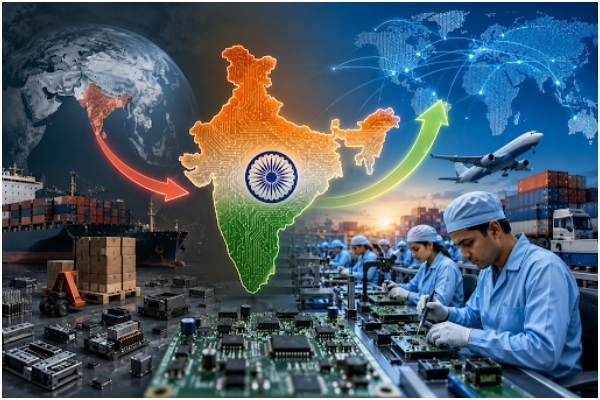
New Delhi, August 18 : India's electronics component industry is undergoing a major transformation, moving beyond import substitution towards becoming an export-oriented manufacturing hub. Domestic manufacturers are now meeting a growing share of demand for key components, while some Indian-made products have begun reaching global markets, including China.
Union minister for railways, electronics and information technology Ashwin Vaishnaw said while reviewing approvals for 31 new electronics component manufacturing projects under the Modified Electronics Components and Semiconductors (ECMS) scheme. The shift reflects the growing strength of India's domestic electronics ecosystem and its move towards greater self-reliance.
Domestic production rises
India has significantly increased its ability to manufacture critical electronics components within the country. Domestic production currently meets 60% of lithium-ion cell demand, 80% of laminate demand and 75% of connector demand. The country also meets 55% of transducer demand, 40% of permanent magnet demand and 20% of capacitor demand.
ALSO READ: Domestic manufacturers, China, ECMS, India, Chinese market, self-reliance,
Vaishnaw said India has achieved complete self-reliance in enclosures, anode materials, optical transceivers and relays. The development marks a shift from a system heavily dependent on imported components to one where Indian manufacturers are increasingly supplying the domestic market themselves.
From replacing imports to making exports
The biggest change is India's growing export capability. anode materials and optical transceivers are already being exported, while some Indian electronics products have also started entering the Chinese market.
This marks an important change in the sector. Earlier, India's focus was largely on reducing imports by producing components domestically. Now, manufacturers are increasingly producing beyond domestic requirements and looking towards international markets.
The entry of Indian products into China is particularly significant, given China's position as one of the world’s largest electronics manufacturing centres.
🚨 BIG: 🇮🇳 India’s electronics manufacturing push is moving from import substitution to exports.
— Beats in Brief 🗞️ (@beatsinbrief) August 18, 2026
India is now fully self-reliant in several key components and has started exporting PCBs to 🇨🇳 China, says Electronics Minister Ashwini Vaishnaw.
India’s Electronics Self-Reliance:… pic.twitter.com/R6lbU9qRJJ
₹69,000 crore investment boost
The number of approved companies has also risen to 106, compared with the initial target of around 60. The latest approvals include projects involving companies such as tata electronics, dixon technologies, motherson, kaynes circuits and wipro global engineering.
Vaishnaw stressed that approvals must translate into actual factories and production. So far, 38 projects have started manufacturing, while another 16 are under construction or installing machinery.
Focus shifts to the next layer
The approved projects are expected to generate 74,628 direct jobs, with the total employment impact potentially reaching around 2.5 lakh opportunities.
The next challenge is to build domestic capabilities for electronics materials and manufacturing machinery. The government is also pushing companies to strengthen design capabilities, build a swadeshi supply chain, improve quality and develop skilled talent.