‘Come to Bastar and see’: Bastar Maoist victims hit out at Chidambaram over ‘proud to be dimaagi Naxal’ remark.
Victims and families of people killed or injured in Maoist violence in Chhattisgarh’s Bastar region on August 18, travelled to New Delhi to protest Congress leader and former Union Home Minister P Chidambaram’s remark, “I am proud to be a dimaagi Naxal.” They said such statements ignore the suffering of victims and could undermine the fragile peace and development achieved in Bastar after decades of violence.
Total Views |


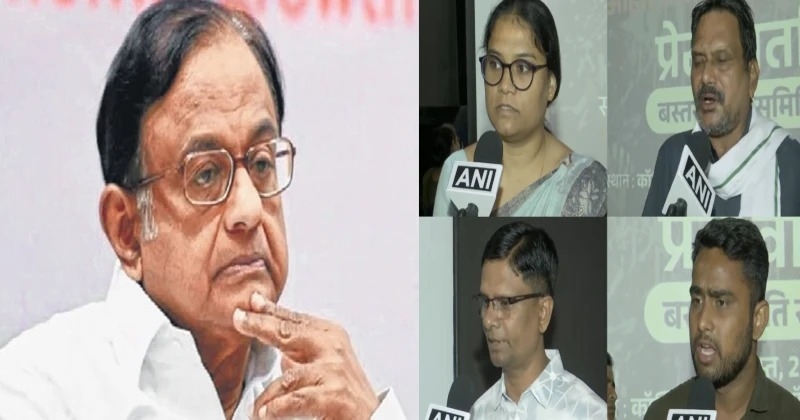
Victims and families affected by decades of Maoist violence in Chhattisgarh’s Bastar region on August 18, criticised senior Congress leader and former Union Home Minister P Chidambaram over his remark that he was “proud to be a dimaagi Naxal”, saying statements made from Delhi should not disregard the experiences of people who have lost their lives, limbs and loved ones in Maoist attacks.
Members of the Bastar Shanti Samiti, comprising people from Maoist-affected areas, held a press conference at the Constitution Club of India in New Delhi and narrated their experiences of losing family members and suffering life-changing injuries in ambushes and improvised explosive device (IED) blasts.
The victims said Chidambaram’s remark was particularly painful because he had served as Union Home Minister and, in their view, should understand the consequences of Maoist violence on civilians and security personnel.
Kameshwar Kumar Sinha, a resident of Kanker in Chhattisgarh, whose father was killed in an IED blast triggered by Maoists, said he was deeply hurt by Chidambaram’s post and travelled to Delhi to question the Congress leader over his statement.
“A statement had come from the X account of former Union Home Minister P Chidambaram that he stands with ‘Dimagi Naxals’ and that he is proud of them. I was really hurt,” Sinha said.
He said people in Bastar were living with the consequences of violence and that the situation on the ground was very different from political debates in the national capital.
“Go and see Bastar. Nobody is making statements there; instead, they are standing there with the victims as well as the jawans. Such statements coming from the national capital hurt me a lot. So, I thought I should come to Delhi and tell him how he can say this,” he said.
Chattisgarh: The Bastar Peace Committee has said that the treatment of Dimagi Naxalites like Chidambaram and Kejriwal is necessary. pic.twitter.com/cI6OIt1B8m
— Megh Updates 🚨™ (@MeghUpdates) August 18, 2026
Aarti, a woman from Kanker whose husband was a security personnel, also opposed Chidambaram’s remarks. She said her husband, an STF jawan, was killed by Maoists in an ambush in Sukma.
“My husband was in the security forces; he was an STF jawan. He was killed by Naxals in an ambush in Sukma,” she said, adding that several women in Bastar had lost their husbands in Maoist violence.
Aarti said she was particularly concerned about the possibility of the region returning to the conditions that prevailed during the peak of the insurgency.
“Now, Bastar is Naxal-free. But there are politicians in Delhi who are sitting here and saying things like this. So, we have come here. I don’t want a repeat of what happened earlier,” she said.
Tarun Kumar from Kanker, who lost both his legs and suffered a spinal cord injury in a Maoist attack, said statements such as Chidambaram’s could have consequences beyond political rhetoric.
He said Bastar had endured violence for about four decades, during which thousands of people lost their lives, and that the region was now moving towards peace and development.
“We held a press conference here because Bastar had been burning in Naxal violence for 40 years and thousands of people sacrificed their lives for establishing peace here. Today, when Bastar is moving ahead on the path to progress, do you want to push it back to hell where it was for 40 years?” Kumar said.
He warned that the mindset reflected in such statements could push Bastar backwards and result in renewed violence, firing and deaths of security personnel.
Kumar also recalled the attack in which he was injured on October 9, 2022.
“I suffered an incident on 9th October 2022 and it is going to be almost four years. Several people in the region suffered. Now, Bastar is becoming peaceful and Naxal-free, but after hearing such statements ... we are pained because he should have stood with us but he is speaking in their support and raking up ‘Dimagi Naxals’,” he said.
Another victim, Siyaram from Bastar, said the group had travelled to Delhi because it could not ignore the remark.
“We do not like this. Such statements should not be made. So, all of us decided to come here and say that such statements should not be made,” he said.
Siyaram said the people of Bastar wanted peace and development and did not want to return to the period when Maoist violence dominated life in the region.
“Bastar wants development. Everyone should support it,” he said.
Rudresh Singh, a Central Reserve Police Force (CRPF) jawan who was injured in a Maoist attack in Chhattisgarh’s Bijapur district, also criticised Chidambaram.
Singh was injured in an IED blast and firing by Maoists during an anti-Naxalite operation. His injuries ultimately resulted in the amputation of one of his legs below the knee.
“Hundreds of people have lost their lives in Naxal violence over the years. A large number of people, who have lost their body parts in various incidents of Naxal violence, are somehow living their life. This is not a joke,” Singh said.
He questioned the appropriateness of making such remarks from Delhi.
“Sitting in an air-conditioned room in Delhi and saying ‘I am proud to be a dimaagi Naxal’ is completely worthless talk. Such remarks should not be made just to increase followers or push some kind of an agenda,” he said.
Several other victims who attended the press conference also expressed their opposition to Chidambaram’s statement and said they were “deeply hurt” by it.
Chidambaram’s remark came after Prime Minister Narendra Modi referred to “dimaagi Naxals” in his Independence Day address from the Red Fort.
Speaking on August 15, Modi said India had succeeded in eliminating armed Naxalism from the forests but warned that ideological supporters of Naxalism were still present in different parts of the country. He called for such elements to be “identified and isolated”.
The Prime Minister’s reference to “dimaagi Naxals” drew criticism from several opposition leaders. Chidambaram subsequently took to X and wrote, “I am proud to be a dimaagi Naxal.”
I am proud to be a dimagi naxal !
— P. Chidambaram (@PChidambaram_IN) August 16, 2026
I am proud to be a dimagi naxal !
— P. Chidambaram (@PChidambaram_IN) August 16, 2026
I am proud to be a dimagi naxal !
— P. Chidambaram (@PChidambaram_IN) August 16, 2026
Congress and Chidambaram have criticised the term “dimaagi Naxals”, arguing that it is a political label used by the BJP against its opponents. The term has also been compared by opposition leaders with labels such as “urban Naxals”, “Andolanjeevi” and “tukde tukde gang”.
The controversy has since moved beyond the political exchange in Delhi, with victims from Bastar directly challenging the use of the term and highlighting the human cost of Maoist violence.
The victims and their families said political arguments over the phrase should not obscure the reality faced by communities in Maoist-affected areas, where civilians, security personnel and their families have lived through years of attacks, killings, IED blasts and ambushes.
Union Parliamentary Affairs Minister Kiren Rijiju also weighed in on the controversy on Tuesday, accusing the Congress of increasingly aligning itself with Maoist ideology.
Speaking to ANI, Rijiju said Modi’s reference to “dimaagi Naxals” was not directed at any particular opposition party but alleged that Congress leaders interpreted it as being aimed at them.
Rijiju further alleged that the National Advisory Council under former Congress president Sonia Gandhi had been “dominated by individuals holding such ideologies” and claimed that the Congress now appeared to be “turning into a Maoist party”.
He also linked what he described as “ideological Naxalism” with separatist tendencies and positions such as demands for restoration of Article 370 or attempts to create divisions between the Northeast and the rest of the country.
The statements have intensified the political dispute over the phrase “dimaagi Naxal”, but for the victims who travelled from Bastar to Delhi, the issue is more personal. They said they have lived through the consequences of Maoist violence and want the region to continue on the path of peace, security and development rather than return to decades of bloodshed.