A sick old man in cell & Pak chooses to play politics? Here's why jailed Imran Khan faces 'harassment' and is now being hospitalized
Old Khan faces worsening health, isolation, and denied medical care amid Pakistan"s deepening political crisis.
Total Views |


Imran Khan is 73 years old. He is the most popular politician in his country. And right now, the state that jails him would apparently rather indulge in political machinations than let a doctor properly examine him.
Imran Khan was ousted from power in 2022 after he fell out with the army establishment, the real force that controls the Islamic Republic of Pakistan. The military establishment and the government they propped up incarcerated him in 2023 on allegedly bogus charges. The former cricketer has been behind bars, many times in isolation, since then.
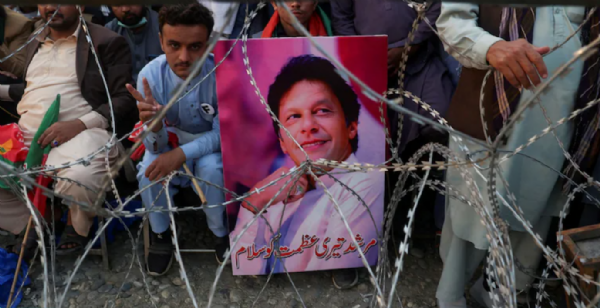
Picture: Imran Khan
Image Courtesy: Money Control
Image Courtesy: Money Control
Consider what happened this week. Pakistan's own Supreme Court, hardly a friend of the opposition, looked at the situation and ordered that Khan be moved from Rawalpindi's Adiala Jail to a private hospital in Islamabad within two days. The court did not stop there. It ordered a five-member medical board, allowed his personal physician and his sister to take part in his care, and directed that he finally be given weekly family meetings and twice-weekly phone calls with his sons in London. In other words, the country's highest court agreed that a sick old man was being denied both proper treatment and basic human contact.
You might expect a government that cared about the man's life to simply comply. Instead, the very next day, it ran back to the same court asking it to reverse the order. The official argument was almost insulting in its coldness: that treating Khan at a hospital of his choice would be "discriminatory" toward other prisoners and might set a precedent. Legal experts pointed out the obvious: a review petition does not suspend the court's order, meaning Khan should have been moved regardless. Yet the government's instinct, faced with a ruling to save a prisoner's health, was to find a way around it.
Think about what this reveals. A political conspiracy was treated as more urgent than a human being's wellbeing. The machinery of the state, which had months to quietly provide decent care, instead mobilised its lawyers to apply all kinds of tricks to keep an ailing 73-year-old exactly where it wanted him.
Cruelty as policy
None of this is new. It is a pattern.
For much of the past two years, Khan's own family has had to beg, protest and file court petitions simply to see him. Late last year, his relatives said they were blocked from visiting for weeks at a stretch, in defiance of an earlier court order that granted them regular meetings. Rumours spread so widely that people openly wondered whether he was still alive. When one of his sisters was finally let in, she said he was being kept in near-total isolation and described his solitary confinement as a form of mental torture, which is worse than physical abuse. His party has said he suffers from an eye condition serious enough to threaten his vision, the very reason his lawyers spent months pleading for a specialist.
This is not the treatment of a dangerous criminal. It is the slow, deliberate grinding-down of a political opponent. Deny him his family. Deny him his doctors. Deny him information. Deny him a swift and fair path through the courts. Keep him weak, isolated and out of sight and hope the public forgets.
The men who really decide
To understand why the elected government behaves this way, you have to look past it, to the institution that has always held the real power in Pakistan: the Army.
Its current chief, Asim Munir, has gathered more authority than perhaps any officer in the country's history. Also it is a well known fact that Asim Munir has had a personal axe to grind with Imran Khan and his treatment of the former cricketer is nothing but personal vendetta.
In May 2025 Munir self-promoted himself to a Field Marshal, a rank only one other man has ever held there. Unusually, he kept his job as serving army chief at the same time. Then, in November 2025, a constitutional amendment created a brand-new post placing all three armed forces under his command for a five-year term. No single person in uniform has ever concentrated so much power. Munir knows very well that once Imran is freed, the former’s dictatorial control over the Islamic Republic would be under threat.
This is the backdrop to Khan's imprisonment. It is also worth remembering that no elected prime minister in Pakistan's entire history has ever completed a full term, a fact that tells you exactly who has been pulling the strings all along. Khan himself was removed in 2022 and he has always argued it happened the moment he lost the establishment's favour. He remains, even from a cell, the single most popular political force in the country. That is precisely why he is so dangerous to them, to the Field Marshal personally and precisely why a fair trial, fair healthcare and a fair political chance are the three things he is least likely to receive.
And the world looks away
Here is the part that should trouble anyone who claims to care about human rights.
Imagine this were happening to a popular former leader almost anywhere else, an ailing 73-year-old kept in isolation, denied his doctors, his family shut out, his government scrambling to overturn a court ruling meant to protect his health. There would be outrage. Statements. Pressure.
Instead, in Pakistan, there is a convenient quiet. And it is not hard to see why. The Pakistani military has made itself useful again on the world stage, valuable to powerful capitals watching the turmoil across the Middle East and needing pliable generals in a strategic corner of the map. When an army becomes geopolitically useful, its abuses at home tend to be politely ignored. The uncomfortable truth is that an old man's health, his rights and his dignity are being quietly traded away for the sake of a military establishment the world finds too convenient to criticise.
A democracy is not only measured by whether it holds elections. It is measured by whether power actually answers to the people and by how it treats the weakest person in its custody. On both counts, an ailing man in an Adiala cell is the living proof of Pakistan's failure. The generals may yet get their way. But history has a long memory and cruelty toward a sick old man is not the kind of thing it forgives.