Kashmir: When Washington’s words trouble Islamabad
NewsBharati 20-Aug-2026 13:01:14 PM
Total Views |


For decades, Pakistan has worked relentlessly to internationalise the Kashmir issue. Islamabad has attempted to portray Jammu and Kashmir as an unresolved international dispute and to persuade major powers that the region requires external intervention. Every diplomatic statement, every international forum and every opportunity for propaganda has been used to keep this narrative alive.
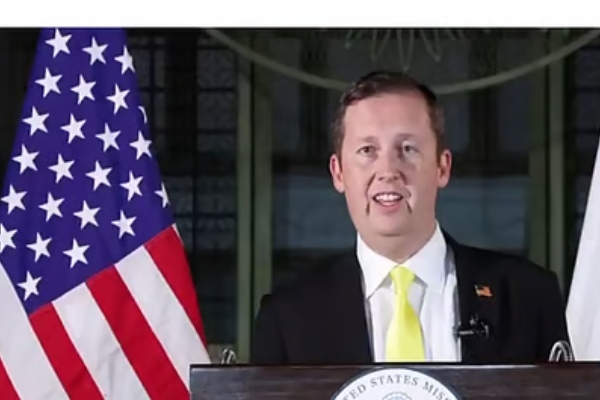 Pakistan reacted swiftly. Islamabad summoned a senior US diplomat and lodged what it called a “strong demarche”, insisting that Jammu and Kashmir remains an internationally recognised disputed territory whose final disposition must be determined in accordance with UN resolutions and what Pakistan describes as the aspirations of the Kashmiri people. The intensity of the Pakistani reaction is revealing. If Gor's statement were merely an inconsequential diplomatic remark, Islamabad would hardly have felt compelled to react so strongly. Pakistan understands that language matters in international diplomacy. The more the international community begins to describe Jammu and Kashmir as part of India rather than simply as a disputed territory between India and Pakistan, the more difficult it becomes for Islamabad to sustain its traditional narrative.
India's position, meanwhile, has never been ambiguous. New Delhi maintains that Jammu and Kashmir is an integral part of India. It has consistently rejected Pakistan's attempts to internationalise the issue and has maintained that Pakistan must vacate the territory under its illegal occupation. India's position also rests on the bilateral framework created by the Simla Agreement, under which India and Pakistan committed themselves to resolving their differences through peaceful means and bilateral negotiations.
There is another development that makes his remarks particularly relevant: the situation in Pakistan-occupied Kashmir itself.
This creates an uncomfortable contradiction for Islamabad. Pakistan wants the world to believe that the central problem in Kashmir is Indian control of Jammu and Kashmir. But developments in PoK are increasingly forcing attention towards another question: how is Pakistan treating the people living in the territory it controls?
The contrast is becoming difficult to ignore. On one side of the Line of Control is Jammu and Kashmir, where an elected government functions within India's constitutional framework and where Washington's representative is sufficiently confident to visit Srinagar and speak about improving security. On the other side is PoK, where protests have exposed deep dissatisfaction with governance and where Pakistan has faced criticism for its response to public unrest. India's External Affairs Ministry has accused Pakistan of answering public discontent in PoK with bullets and blackouts. That contrast weakens Pakistan's moral and diplomatic argument.
Even more significant is the fact that the recent turmoil is not simply an India-Pakistan confrontation. It is a political and governance crisis within PoK. The elections themselves have been affected by protests and security concerns, further exposing the fragility of Islamabad's claim that it represents the democratic aspirations of the people of Kashmir. Pakistan therefore faces a difficult situation. It cannot easily object when India speaks about PoK without simultaneously inviting questions about what is happening inside the territory it controls. Nor can it comfortably welcome international scrutiny of Kashmir when such scrutiny may increasingly encompass PoK as well.
The irony is that Pakistan's own actions in PoK may now be helping India make that argument.
Sergio Gor has not rewritten American policy. But his words have opened a diplomatic window. Pakistan's angry reaction has shown how sensitive that window is. And the growing unrest in PoK has supplied an uncomfortable backdrop. For Islamabad, the Kashmir narrative is no longer as secure as it once appeared. The question is gradually shifting from who speaks for Kashmir to what Pakistan can justify about the territory it occupies.
That is why US Ambassador to India Sergio Gor’s recent description of Jammu and Kashmir as “an important part of India” has caused such discomfort in Islamabad. During his first visit to Srinagar, Gor met Chief Minister Omar Abdullah and spoke positively about the security situation in the Union Territory. He also indicated that Washington would reconsider its travel advisory for Jammu and Kashmir.
But it would be premature to declare that Washington has formally changed its Kashmir policy. One ambassador's statement does not automatically constitute a new US policy doctrine. The significance lies elsewhere. In the possibility that Washington's understanding of the ground reality is evolving.
The important change in recent years has been India's willingness to deal with Kashmir increasingly as a matter of its own sovereignty, security and development rather than as an issue requiring international mediation. The abrogation of Article 370, the subsequent political and administrative integration of Jammu and Kashmir, improvements in security and the expansion of tourism and economic activity have reinforced that approach. Gor's visit therefore acquires significance beyond the words he used.
While Pakistan continues to speak of Kashmir as a cause requiring international attention, people in the territory under its control have been protesting against their own administration. Protests in PoK have involved demands relating to political representation, governance and economic grievances. The unrest has at times turned violent, while authorities have resorted to restrictions and crackdowns.
Even more significant is the fact that the recent turmoil is not simply an India-Pakistan confrontation. It is a political and governance crisis within PoK. The elections themselves have been affected by protests and security concerns, further exposing the fragility of Islamabad's claim that it represents the democratic aspirations of the people of Kashmir. Pakistan therefore faces a difficult situation. It cannot easily object when India speaks about PoK without simultaneously inviting questions about what is happening inside the territory it controls. Nor can it comfortably welcome international scrutiny of Kashmir when such scrutiny may increasingly encompass PoK as well.
This is where Sergio Gor's remark becomes politically important. It may not yet represent a formal change in American policy. But it signals that the old vocabulary surrounding Kashmir cannot be taken for granted indefinitely. The ground reality is changing, the security situation in J&K is changing, and the narrative emerging from PoK is also changing. Pakistan's traditional strategy depended heavily on keeping Kashmir frozen in the international imagination as an unresolved dispute between two equal claimants. India increasingly wants the world to see a different reality - Jammu and Kashmir as an integral part of India, while Pakistan remains in illegal occupation of a part of the territory.
Sergio Gor has not rewritten American policy. But his words have opened a diplomatic window. Pakistan's angry reaction has shown how sensitive that window is. And the growing unrest in PoK has supplied an uncomfortable backdrop. For Islamabad, the Kashmir narrative is no longer as secure as it once appeared. The question is gradually shifting from who speaks for Kashmir to what Pakistan can justify about the territory it occupies.

Editor's Desk
Editor's Desk