Amnesty echoes Congress' language, accuses Police of "deadly attack" on CJP; stays silent on attacks against Police
Amnesty International and its Indian chapter reportedly have a history of activities perceived as anti-Hindu and anti-India. The organisation has repeatedly interfered in India"s internal affairs, consistently attempting to portray the country as a human rights violator and as an "oppressor" of its Muslim population.
Total Views |


On Monday, August 24, a month after the CJP 'students' protest that ended with the resignation of Education Minister Dharmendra Pradhan, Amnesty International, who have a history of anti-Hindu and anti-India activities, began speaking the Indian National Congress' language. It said that the Indian police deployed unlawful and deadly force against 'peaceful' protesters during the 'Chalo Sansad' march in New Delhi. It also added that weapons were used, including pellet-firing shotguns, tear gas launchers, grenades, batons and electric shock devices against protesters between 20 July and 24 July in Delhi and also in Siwan town in Bihar state.
_202608241646413799_H@@IGHT_400_W@@IDTH_700.jpg "Amnesty International") Its Indian chief, Aakar Patel, who has in the past supported anti-CAA riots, accused Umar Khalid, blamed the Modi government for mismanagement of the protest and called it state-sanctioned violence masked as crowd control.
Its Indian chief, Aakar Patel, who has in the past supported anti-CAA riots, accused Umar Khalid, blamed the Modi government for mismanagement of the protest and called it state-sanctioned violence masked as crowd control.
"Instead of facilitating the right to protest, Indian authorities suppressed it first with a communication blackout, barricades and transport disruption. They then attempted to crush it with unnecessary or excessive use of force against peaceful protesters, including children. This heavy-handed response was state-sanctioned violence masked as crowd control. The continued impunity after a month is a testament to that,” Patel said.

It called on Indian authorities to order a prompt, impartial and effective investigation into the alleged use of firearms, birdshot ammunition, tear gas, lathis and electric shock weapons against protesters in Delhi and Siwan, and to publish its findings. “The deployment and use of birdshot ammunition and direct contact electric shock devices must also end immediately," Aakar Patel said.
Congress alleges use of guns, demands FIR against alleged use of guns
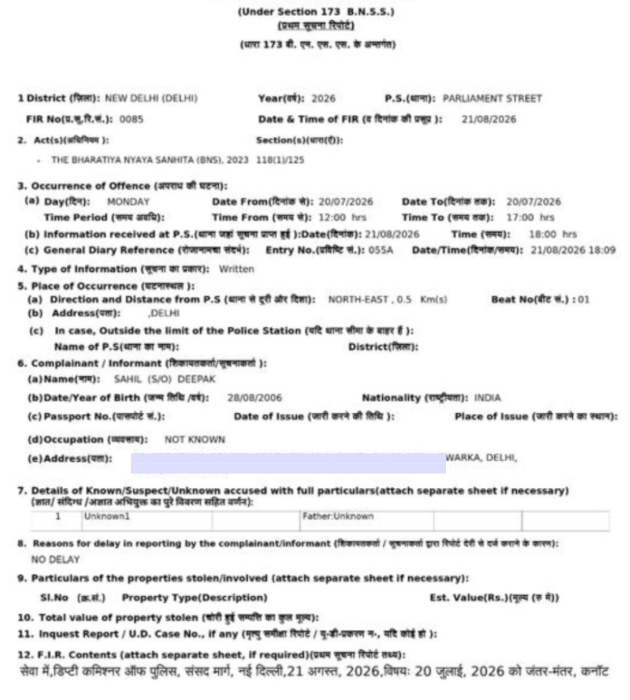
It seems that Amnesty International and its Indian unit are speaking the language of the Indian National Congress and its 'youth' leader Rahul Gandhi. Gandhi had earlier in the day visited Delhi's Parliament Street police station and staged a sit-in, demanding that an FIR be registered in the matter. This is after one of the 'students', Sahil Lochav, who claims he was allegedly injured in the pellet firing, filed a police complaint against the police.
"We are demanding that an FIR be registered. They told us that they have received an order from the top and they cannot file an FIR. We won't budge from here until an FIR is registered. All we demand is justice for this family. In this country, Amit Shah's Home Ministry and Delhi Police personnel won't let justice happen," he added.
Notably, the sit-in protest ended after the Delhi Police on Friday, August 24, registered a First Information Report (FIR) over a complaint alleging the use of pellet guns during Cockroach Janta Party (CJP) protests.
SC constitutes high-powered committee to probe police action against Jantar Mantar protesters
It is important to note that the SC has constituted a High-Powered Committee (‘HPC’) headed by former Supreme Court judge R. Subhash Reddy to inquire into the allegations of use of alleged excessive force and violence by Delhi Police against the protesting students at Jantar Mantar last month.
A Bench headed by the Chief Justice of India (‘CJI’) and comprising Justices Joymalya Bagchi and V. Mohana outlined the mandate of the HPC to inquire into:

2. The question of ensuring a proportionate and measured police response during protests, public gatherings, and peaceful assemblies, so as to strike an appropriate balance between the maintenance of public order and the constitutional right to peaceful dissent;
4. The necessity of ensuring that police and security personnel wear proper uniforms and visible nameplates at the time of effecting arrests or using force during crowd-control operations, so as to secure accountability and enable the identification of individual officers;
5. An inquiry into the allegations about the monitoring and surveillance of protesters by police personnel, and the extent to which such measures, if undertaken, were consistent with the protesters’ constitutional rights to privacy and free assembly;

7. The provision of medical and other requisite support, including award of compensation, to victims of alleged police abuse, including the manner and adequacy of such support extended thus far;
8. Regulation of the issuance of blanket prohibitory orders under Section 163 of the Bharatiya Nagarik Suraksha Sanhita, 2023, so as to prevent their use as a routine or pre-emptive measure that forecloses the exercise of the right to peaceful assembly rather than as a genuine, proportionate response to a real and imminent threat to public order; and
9. The establishment of strict constitutional thresholds and safeguards to prevent Section 152 of the Bharatiya Nyaya Sanhita, 2023, from being invoked as an instrument to stifle political dissent and peaceful protest, thereby ensuring that the provision remains confined to its intended purpose and is not permitted to operate as a chilling restraint upon constitutionally protected speech and assembly.
When the country's top court is already looking into the matter, what exactly do Amnesty International and Rahul Gandhi hope to achieve by releasing unwanted investigation documents and sitting outside a police station in front of the cameras, respectively? This purely shows that the Leader of the Opposition and Amnesty don't trust the country's judiciary.

As covered earlier, family members of injured officers later held press conferences in New Delhi to express trauma and stated that the narrative surrounding the police response was one-sided. Over 100 to 240 Delhi Police personnel, including senior officers like ACPs and inspectors, sustained injuries during violent clashes at the July 20, 2026 "Sansad Chalo" protest march organized by the Cockroach Janta Party (CJP) in New Delhi.
Delhi Police on July 21 further stated that more than 118 police personnel, including some senior officers, sustained injuries as protesters attacked them with “stones and other objects” and “resorted to large-scale violence”.
“The protesters displayed unruly, aggressive and violent behaviour. Despite repeated warnings and lawful directions issued by the police, they refused to disperse and deliberately violated the prohibitory orders in force. The protesters attacked police personnel with stones and other objects, attempted to breach police barricades, vandalised police and other government vehicles, damaged public property, and resorted to large-scale violence, posing a serious threat to public order, the security arrangements in place, and the safety of police personnel performing their lawful duties,” it said.
As reported earlier, the Delhi Police were forced to resort to a lathi charge on July 20, as thousands of CJP 'student' protesters illegally gathered at the Jantar Mantar in New Delhi. The police facilitated the action as they had already issued warnings against large gatherings at the site. This is because the police on July 19 had denied them permission and banned large gatherings. They also warned that any person violating the prohibitory orders could face action. 
Amnesty, in its report, talked about lathi charges, alleged attacks on 'peaceful protesters', but failed to talk about illegal gatherings, stone-pelting, and vandalism at the hands of protesters.
Amnesty International and its anti-Hindu, Anti-India activities
Amnesty International and its Indian chapter reportedly have a history of activities perceived as anti-Hindu and anti-India. The organisation has repeatedly interfered in India's internal affairs, consistently attempting to portray the country as a human rights violator and as an "oppressor" of its Muslim population.

Notably, not only India, but Russia has also been a critic of Amnesty International. In 2025, it banned Amnesty International as an “undesirable organization”, citing concerns that the human rights group’s activities allegedly undermine national security. In a statement, Russia’s prosecutor general alleged that Amnesty’s London office was a “centre for the preparation of global Russophobic projects” and accused it of advocating on behalf of Ukraine.
It also alleged the rights group is “doing everything possible to intensify the military confrontation in the region. They justify the crimes of Ukrainian neo-Nazis, call for an increase in their funding, and insist on the political and economic isolation of our country.”
Amnesty International claims to be an international non-governmental organization focused on human rights, with its headquarters in the United Kingdom.
"The weapons were deployed in a manner that breached international law and standards and domestic policing guidelines. We also verified two instances of a police officer unlawfully using lethal force against a crowd. On X, the Delhi Police publicly denied any disproportionate use of force, repeating it before India’s Supreme Court, describing its handling of the protest as “professional”. Evidence gathered by Amnesty International directly contradicts this account," it said.
Amnesty International show an RAF officer firing a shotgun (L); delhi Police personnel injued at the hands of 'peaceful CJP protesters' (R)
"Instead of facilitating the right to protest, Indian authorities suppressed it first with a communication blackout, barricades and transport disruption. They then attempted to crush it with unnecessary or excessive use of force against peaceful protesters, including children. This heavy-handed response was state-sanctioned violence masked as crowd control. The continued impunity after a month is a testament to that,” Patel said.
As per the Amnesty International group, which has been banned by Russia citing national security concerns, it verified 17 videos filmed on 20 July in central Delhi across the area spanning Jantar Mantar, Sansad Marg and Connaught Place and two videos filmed in Siwan town of Bihar state on 24 July. "In videos filmed in Delhi, personnel from Delhi Police, the Rapid Action Force (RAF), and the Central Reserve Police Force (CRPF) were identified. Amnesty International also verified one video of an RAF officer using an electric shock baton on a peaceful protester," it said.
It stated that the state police deliberately used lathis and also caught an RAF officer using an electric shock baton against the 'peaceful protesters'. In many instances, they hit people indiscriminately on all parts of the body. In one video, a man knocked to the ground is struck repeatedly while unable to move or pose any threat, it said.
It called on Indian authorities to order a prompt, impartial and effective investigation into the alleged use of firearms, birdshot ammunition, tear gas, lathis and electric shock weapons against protesters in Delhi and Siwan, and to publish its findings. “The deployment and use of birdshot ammunition and direct contact electric shock devices must also end immediately," Aakar Patel said.
Congress alleges use of guns, demands FIR against alleged use of guns
It seems that Amnesty International and its Indian unit are speaking the language of the Indian National Congress and its 'youth' leader Rahul Gandhi. Gandhi had earlier in the day visited Delhi's Parliament Street police station and staged a sit-in, demanding that an FIR be registered in the matter. This is after one of the 'students', Sahil Lochav, who claims he was allegedly injured in the pellet firing, filed a police complaint against the police.
"A pellet gun was used at Connaught Place on 20 July. The AIIMS report clearly says that there are more than 200 shells inside his body and 3 in his eye. He has lost vision in that eye. There are shells near his heart that cannot be touched. Delhi Police say they did not fire pellet guns. So, there is just one question: someone must have done it...A crime has indeed happened," Gandhi said.
VIDEO | Delhi: Sahil Lochav, the youth who allegedly suffered pellet injuries during the July 20 protest at Jantar Mantar, thanked Congress leader and Lok Sabha LoP Rahul Gandhi after the Delhi Police registered an FIR.
— Press Trust of India (@PTI_News) August 21, 2026
The development came after Rahul Gandhi staged a sit-in… pic.twitter.com/SOgcMqH39q
"We are demanding that an FIR be registered. They told us that they have received an order from the top and they cannot file an FIR. We won't budge from here until an FIR is registered. All we demand is justice for this family. In this country, Amit Shah's Home Ministry and Delhi Police personnel won't let justice happen," he added.
Notably, the sit-in protest ended after the Delhi Police on Friday, August 24, registered a First Information Report (FIR) over a complaint alleging the use of pellet guns during Cockroach Janta Party (CJP) protests.
Following this, Union Minister JP Nadda criticised Gandhi for staging the protest outside the Parliament Street Police Station, saying the Supreme Court had already taken cognisance of the 20 July incident and set up a five-member high-powered committee headed by a former judge.
"The entire nation is once again witnessing the kind of cheap, attention-seeking politics that Rahul Gandhi displayed today outside the Sansad Marg police station. Rahul Gandhi's sit-in protest today is neither for the students nor for the sake of justice; it is a symbol of the Congress party's political desperation and Rahul Gandhi's hunger for media attention," he said.
FIR filed by Delhi Police in the case
SC constitutes high-powered committee to probe police action against Jantar Mantar protesters
It is important to note that the SC has constituted a High-Powered Committee (‘HPC’) headed by former Supreme Court judge R. Subhash Reddy to inquire into the allegations of use of alleged excessive force and violence by Delhi Police against the protesting students at Jantar Mantar last month.
The HPC will also comprise former Chief Justice of the Punjab and Haryana High Court Justice Ravi Shankar Jha; former judge of the Delhi High Court Justice Shalinder Kaur; former Director of the Central Bureau of Investigation (‘CBI’) Rishi Kumar Shukla; and former Director General of Police, Meghalaya, Dr. L.R. Bishnoi as members.
A Bench headed by the Chief Justice of India (‘CJI’) and comprising Justices Joymalya Bagchi and V. Mohana outlined the mandate of the HPC to inquire into:
1. The use of excessive force and violence against protesters by police authorities and other agencies, including the deployment of pellet guns, electric batons, lathi charges, and tear gas without adequate warning or proportionality, resulting in severe bodily harm and injuries, some of which are alleged to be of a grievous and lasting nature;
Order exclusively obtained by Newsbharati
2. The question of ensuring a proportionate and measured police response during protests, public gatherings, and peaceful assemblies, so as to strike an appropriate balance between the maintenance of public order and the constitutional right to peaceful dissent;
3. The desirability of banning the use of metallic kinetic projectiles or pellets fired from pump-action rifles or projectile-action guns, having regard to the grave and, at times, irreversible bodily harm occasioned by their deployment against protesters;
4. The necessity of ensuring that police and security personnel wear proper uniforms and visible nameplates at the time of effecting arrests or using force during crowd-control operations, so as to secure accountability and enable the identification of individual officers;
5. An inquiry into the allegations about the monitoring and surveillance of protesters by police personnel, and the extent to which such measures, if undertaken, were consistent with the protesters’ constitutional rights to privacy and free assembly;
6. The alleged incidents of targeted violence, harassment, molestation and/or any secondary victimisation directed against female protesters, which, given the gravity and sensitivity of the allegations, warrant a focused and expeditious inquiry;
Order exclusively obtained by Newsbharati
7. The provision of medical and other requisite support, including award of compensation, to victims of alleged police abuse, including the manner and adequacy of such support extended thus far;
8. Regulation of the issuance of blanket prohibitory orders under Section 163 of the Bharatiya Nagarik Suraksha Sanhita, 2023, so as to prevent their use as a routine or pre-emptive measure that forecloses the exercise of the right to peaceful assembly rather than as a genuine, proportionate response to a real and imminent threat to public order; and
9. The establishment of strict constitutional thresholds and safeguards to prevent Section 152 of the Bharatiya Nyaya Sanhita, 2023, from being invoked as an instrument to stifle political dissent and peaceful protest, thereby ensuring that the provision remains confined to its intended purpose and is not permitted to operate as a chilling restraint upon constitutionally protected speech and assembly.
When the country's top court is already looking into the matter, what exactly do Amnesty International and Rahul Gandhi hope to achieve by releasing unwanted investigation documents and sitting outside a police station in front of the cameras, respectively? This purely shows that the Leader of the Opposition and Amnesty don't trust the country's judiciary.
Notably, the Delhi Police on Friday registered a First Information Report (FIR) over a complaint alleging the use of pellet guns during Cockroach Janta Party (CJP) protests in Delhi on 20 July. A probe is underway.
How Amnesty failed to highlight deadly attacks on Delhi Police
Notably, on July 20, amid the Chalo Sansad Protest, the 'peaceful student CJP protesters' began pelting stones at the Delhi Police personnel at Feroz Shah Road in New Delhi, the video of which made rounds on social media. In the video, a large crowd of 'protesters' could be seen standing in front of the Delhi Police and armed forces, and later pelting stones at them.
ALSO READ: Around 100 CJP 'peaceful' protesters gherao RAF officer, assault him brutally; FIR filed
This was hours after CJP protest leader and party founder Abhijeet Dipke blatantly accused the Delhi Police of planning to orchestrate alleged stone-pelting at Jantar Mantar, Delhi, and blame it on the 'peaceful' CJP protesters. He shared two videos of trucks filled with stones and claimed that the police were trying to trap the CJP protesters by orchestrating stone-pelting on the peaceful CJP protesters.
Following this, on July 21, the Delhi Police registered an FIR against unidentified persons in connection with the violence, stone-pelting and vandalism of government vehicles reported during the "Sansad Chalo" protest near Regal Cinema in Connaught Place.
This was hours after CJP protest leader and party founder Abhijeet Dipke blatantly accused the Delhi Police of planning to orchestrate alleged stone-pelting at Jantar Mantar, Delhi, and blame it on the 'peaceful' CJP protesters. He shared two videos of trucks filled with stones and claimed that the police were trying to trap the CJP protesters by orchestrating stone-pelting on the peaceful CJP protesters.
#WATCH | Delhi: Protesters pelt stones at Delhi Police personnel at Feroz Shah Road.#CJPProtest pic.twitter.com/CSCibKGpfT
— ANI (@ANI) July 20, 2026
Following this, on July 21, the Delhi Police registered an FIR against unidentified persons in connection with the violence, stone-pelting and vandalism of government vehicles reported during the "Sansad Chalo" protest near Regal Cinema in Connaught Place.
Govt vehicles vandalized by CJP (Image from the NB Bank)
As covered earlier, family members of injured officers later held press conferences in New Delhi to express trauma and stated that the narrative surrounding the police response was one-sided. Over 100 to 240 Delhi Police personnel, including senior officers like ACPs and inspectors, sustained injuries during violent clashes at the July 20, 2026 "Sansad Chalo" protest march organized by the Cockroach Janta Party (CJP) in New Delhi.
Delhi Police on July 21 further stated that more than 118 police personnel, including some senior officers, sustained injuries as protesters attacked them with “stones and other objects” and “resorted to large-scale violence”.
‘Students’ peacefully toppling a police van and throwing stones and bricks.
— Abhijit Majumder (@abhijitmajumder) July 21, 2026
All for the cause of education. #CJPProtest pic.twitter.com/rowOy8xI6M
“The protesters displayed unruly, aggressive and violent behaviour. Despite repeated warnings and lawful directions issued by the police, they refused to disperse and deliberately violated the prohibitory orders in force. The protesters attacked police personnel with stones and other objects, attempted to breach police barricades, vandalised police and other government vehicles, damaged public property, and resorted to large-scale violence, posing a serious threat to public order, the security arrangements in place, and the safety of police personnel performing their lawful duties,” it said.
As reported earlier, the Delhi Police were forced to resort to a lathi charge on July 20, as thousands of CJP 'student' protesters illegally gathered at the Jantar Mantar in New Delhi. The police facilitated the action as they had already issued warnings against large gatherings at the site. This is because the police on July 19 had denied them permission and banned large gatherings. They also warned that any person violating the prohibitory orders could face action.
On July 21, a mob of around 100 CJP 'student' protesters also launched a brutal attack on Rapid Action Force (RAF) personnel amid the 'peaceful' protest in New Delhi. The video of the same made rounds on social media, in which hundreds of people posing as 'student' protesters could be seen gheraoing the RAF personnel and assaulting them. In another video, the 'peaceful' protesters could be seen yelling that 'bhaga diya, bhaga diya' (we made him run away), directing it to the Delhi Police officer.
Amnesty, in its report, talked about lathi charges, alleged attacks on 'peaceful protesters', but failed to talk about illegal gatherings, stone-pelting, and vandalism at the hands of protesters.
Amnesty International and its Indian chapter reportedly have a history of activities perceived as anti-Hindu and anti-India. The organisation has repeatedly interfered in India's internal affairs, consistently attempting to portray the country as a human rights violator and as an "oppressor" of its Muslim population.
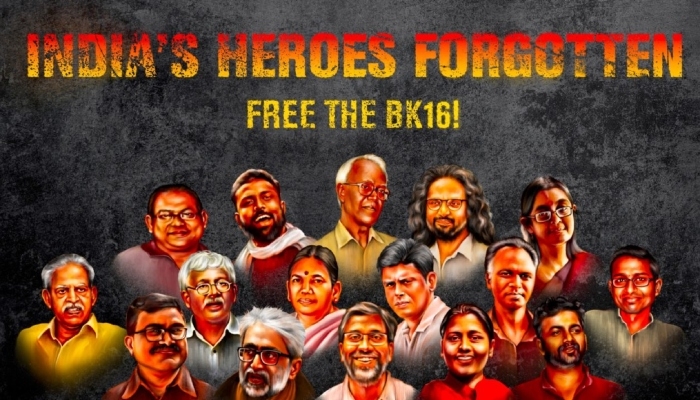
Amnesty India and its head, Aakar Patel, have also been accused of spreading misleading narratives and fake news to cast India in a negative light. The organisation also reportedly campaigned in support of the arrested "Urban Naxals" in the Bhima Koregaon violence case. Given this, its conduct amounts to foreign interference in India's internal matters, and strict action against it would be justified.
Bhima Koregaon 16 campaign image by Amnesty International
Amnesty India was also accused of money laundering and violating the Foreign Contribution Regulation Act. In October 2022, the Enforcement Directorate (ED) attached assets worth Rs 1.54 crore of Amnesty International India under the anti-money laundering law for alleged violation of the Foreign Contribution Regulation Act, making the total attached assets worth over 21 crore. “A provisional order for attachment has been issued under the Prevention of Money Laundering Act (PMLA). With this attachment, the total attachment now stands at Rs 21.08 crores”, the ED said.
Aakar Patel in 2023 also extended support to anti-Hindu, anti-CAA riots accused Umar Khalid. "Locking up a man indefinitely without conviction is not democracy; it’s tyranny," he said in a tweet in 2023.
Notably, not only India, but Russia has also been a critic of Amnesty International. In 2025, it banned Amnesty International as an “undesirable organization”, citing concerns that the human rights group’s activities allegedly undermine national security. In a statement, Russia’s prosecutor general alleged that Amnesty’s London office was a “centre for the preparation of global Russophobic projects” and accused it of advocating on behalf of Ukraine.
It also alleged the rights group is “doing everything possible to intensify the military confrontation in the region. They justify the crimes of Ukrainian neo-Nazis, call for an increase in their funding, and insist on the political and economic isolation of our country.”
Amnesty International claims to be an international non-governmental organization focused on human rights, with its headquarters in the United Kingdom.