Churches seek prayer consent forms from worshippers ahead of Maharashtra's anti-conversion law, details
Total Views |


With Maharashtra's anti-conversion law, which tightens restrictions on forced religious conversions, due to take effect on August 28, Christian prayer groups and churches across the Mumbai Metropolitan Region (MMR), including Vasai, Virar, Mira-Bhayandar, Palghar, and Thane, have begun adopting a new measure, requiring attendees to complete self-declaration forms.
At prayer halls in Vasai, Virar, Mira-Bhayandar, Palghar, and Thane, worshippers are now being asked to sign statements affirming that they are attending prayer meetings entirely by choice, free from any "pressure, inducement, temptation, lure or threat," according to the report.
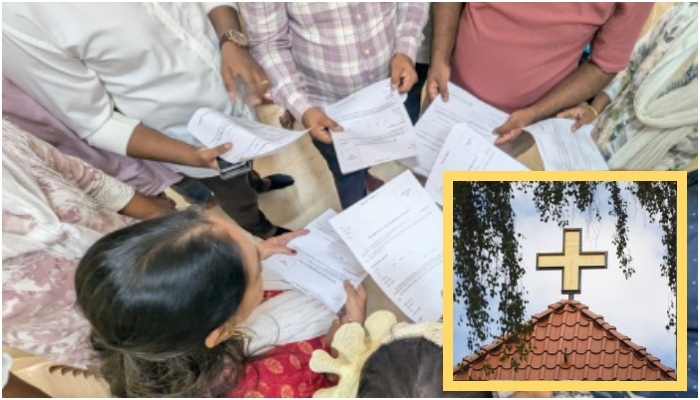
Maharashtra churches seek prayer consent forms from worshippers (Image: Indian Express)
The declaration further states that attending church is a matter of "completely personal, voluntary and independent" choice. As part of the process, attendees are required to provide a passport-size photograph along with proof of identity, such as Aadhaar or PAN details.
Maharashtra Anti-Conversion Law impact: Mumbai pastors ask worshippers to sign declaration form | Watch full report
— Republic (@republic) August 25, 2026
Tune in - https://t.co/Q9vInZ7tCK #Mumbai #Maharashtra #MumbaiNews #RepublicWorld pic.twitter.com/t2ubMmlLc1
Why sudden prayer consent from worshippers?
Previously, most prayer meetings did not require any form of documentation for attendance. Organisers, however, claim the introduction of these forms is a precautionary step taken in light of rising tensions surrounding religious gatherings.
A wave of alleged disruptions and FIRs, between April and July 2026; nine FIRs were registered in connection with five incidents at prayer meetings in the MMR region. Seven of these FIRs were filed against organisers and worshippers, while two involved individuals accused of allegedly disrupting the meetings. One widely reported incident occurred on April 12 in Vasai East, where a prayer meeting of 100–150 people was disrupted by a group that included Bajrang Dal members, leading to five FIRs at Achole police station.
The Bajrang Dal members in Mumbai have been opposing and raising their voices against several meetings organized by the evangelical organizations in the name of 'healing prayer' meetings. Such events have been foiled by the Hindu organization in Vasai, Virar, Mira-Bhayander, Ghatkopar and several other parts of Mumbai.
ALSO READ: Looking for love, listing 'God-fearing': How matrimony sites for Sikkim's Christian Converts turn faith into a selling point
Reports mention that the Missionaries organize congregation events in the name of 'healing' prayer meetings leading to potential religious conversion events. The Bajrang Dal has defended entering prayer spaces, saying it acts on information from social media and targets what it considers cases of conversion by inducement, though it acknowledges some of its members have had FIRs filed against them.
Police officials say they've received complaints from both sides but haven't classified the disruptions as a clear "trend." Mira-Bhayandar Vasai-Virar Police Commissioner Niket Kaushik noted only one local incident in recent months, with action taken, but no pattern of repeated incidents.
New anti-conversion law cautions churches and missionaries
The new law's strict provisions, the Maharashtra Freedom of Religion Act, criminalize conversions carried out through coercion, fraud, inducement, misrepresentation, or undue influence, with penalties of up to seven years' imprisonment (10 years for repeat offenders). It also requires anyone intending to convert to notify the district magistrate at least 60 days in advance. Because the definitions of terms like 'inducement' and 'undue influence' are broad, churches worry that ordinary religious activity, worship, counselling, or charitable work could be misconstrued as attempted conversion.
Protecting against alleged false accusations, Church leaders say the forms exist primarily to create a documented record showing that attendance is voluntary, which can be shown to police if a meeting is disrupted or if false accusations of forced conversion arise.
Reports mention that the Missionaries organize congregation events in the name of 'healing' prayer meetings leading to potential religious conversion events. The Bajrang Dal has defended entering prayer spaces, saying it acts on information from social media and targets what it considers cases of conversion by inducement, though it acknowledges some of its members have had FIRs filed against them.
Police officials say they've received complaints from both sides but haven't classified the disruptions as a clear "trend." Mira-Bhayandar Vasai-Virar Police Commissioner Niket Kaushik noted only one local incident in recent months, with action taken, but no pattern of repeated incidents.
New anti-conversion law cautions churches and missionaries
The new law's strict provisions, the Maharashtra Freedom of Religion Act, criminalize conversions carried out through coercion, fraud, inducement, misrepresentation, or undue influence, with penalties of up to seven years' imprisonment (10 years for repeat offenders). It also requires anyone intending to convert to notify the district magistrate at least 60 days in advance. Because the definitions of terms like 'inducement' and 'undue influence' are broad, churches worry that ordinary religious activity, worship, counselling, or charitable work could be misconstrued as attempted conversion.
Protecting against alleged false accusations, Church leaders say the forms exist primarily to create a documented record showing that attendance is voluntary, which can be shown to police if a meeting is disrupted or if false accusations of forced conversion arise.
Christian groups say the forms are not meant to restrict participation but to protect congregations from allegations of forced conversion. Devdan Tribhuvan, state president of the Maharashtra Christian Development Association, was quoted by The Indian Express as saying the forms were introduced after worshippers were questioned, threatened and prayer meetings were disrupted.
The Maharashtra Freedom of Religion Act, 2026 took effect after receiving presidential assent and being formally notified on July 30. The legislation targets forceful religious conversions carried out through coercion, deception, enticement, or marriage. It mandates that anyone planning to convert to another religion must notify the district magistrate at least 60 days beforehand, with violations of this procedure carrying a penalty of up to seven years' imprisonment.