Nepal’s deluge: When nature meets human arrogance
NewsBharati 27-Aug-2026 12:33:41 PM
Total Views |


Nepal’s latest deluge is a reminder of a truth that modern civilisation repeatedly forgets that nature can be studied, monitored and predicted, but it cannot be commanded. When the Himalayas unleash water with overwhelming force, human confidence in technology suddenly looks fragile. But a natural disaster is not always purely natural. The intensity of rainfall may be beyond human control. The scale of destruction often is not.
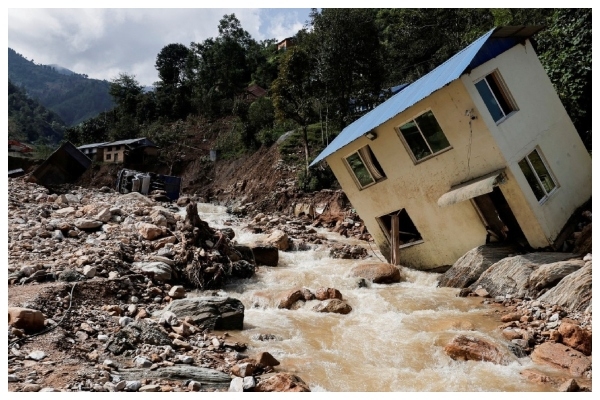 Road construction on unstable slopes, deforestation, quarrying, unplanned settlements along riverbanks and floodplains, and poorly designed infrastructure can turn an extreme weather event into a catastrophe. The river does not need to become more destructive if humans have systematically removed the natural buffers that once absorbed its force. This is where technology becomes crucial.
Modern disaster management does not depend merely on predicting rainfall. It depends on an entire chain - satellite observation, weather radar, rainfall gauges, river-level sensors, hydrological modelling, upstream data, communications networks and, finally, rapid evacuation. A warning that reaches a government office but does not reach a village before the river rises is not an effective warning.
This brings China and the Tibetan plateau into the conversation not as an accusation, but as a matter of geography and hydrological reality. Many major Himalayan rivers originate on or around the Tibetan plateau before flowing into downstream countries. China therefore possesses access to upstream information that can have enormous value for countries downstream. Rainfall, river discharge, reservoir levels and sudden changes in water flow are not merely technical statistics when millions of people live downstream.
The critical question is therefore simple - what information was available upstream, when was it available, and when was it communicated downstream? That question becomes particularly important during extreme events. And here comes the Chinese role? Question is being raised what was the information available with China and was it given timely. The timing of warnings deserves particular scrutiny. Was the event itself too sudden for meaningful prediction? Were upstream measurements available? Were they transmitted in real time? Were there communication delays? Did Nepal possess sufficient sensors and forecasting capacity of its own? Did warnings reach vulnerable communities quickly enough to permit evacuation?
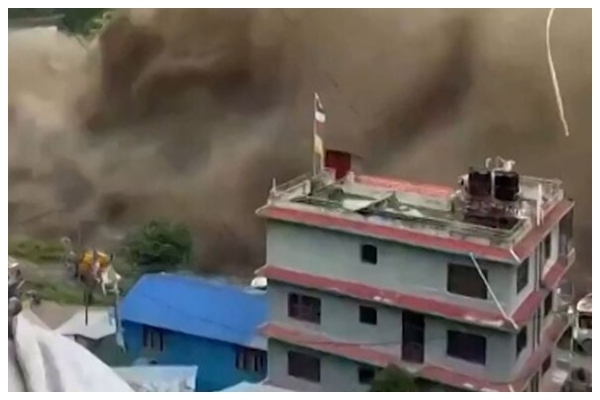
Nepal needs dense networks of automated weather stations, river gauges and seismic and landslide monitoring systems. It needs real-time hydrological modelling, high-resolution satellite surveillance and reliable communication networks extending into remote communities. Most importantly, warnings must become local and actionable: people must know not merely that heavy rain is coming, but which river will rise, when it is likely to rise and where they should go.
Cross-border cooperation is equally important. India, Nepal, China and other Himalayan countries need stronger mechanisms for sharing meteorological and hydrological information during extreme events. Data cannot remain trapped behind bureaucratic procedures when minutes and hours can determine whether people live or die. And this is where the Nepal deluge becomes a warning for the entire Himalayan neighbourhood. Nature is sending increasingly difficult questions. Humanity must stop answering them with arrogance. The real lesson of a flood is not that nature has defeated technology. It is that technology without humility can become dangerous. A road built without geological wisdom, a settlement built in a floodplain, a river altered without understanding its ecology, or a warning delayed when lives depend upon it can all transform a natural hazard into a human catastrophe.
Nepal’s waters will eventually recede. The questions they have raised should not. Who knew? When did they know? What was shared? What was ignored? And why were people still vulnerable? Those questions deserve answers based on data, not speculation. The Himalayas belong to nature. Humans merely inhabit them. The sooner we remember that distinction, the fewer lives we will have to mourn when the mountains and rivers remind us again.
Nepal sits in one of the most geologically and hydrologically sensitive regions on earth. Its rivers descend rapidly from the Himalayas through narrow valleys and steep terrain. Extreme rainfall can trigger flash floods, landslides and debris flows within hours. Climate change is also altering rainfall patterns, glacier dynamics and the frequency or intensity of extreme weather events. But another question deserves serious examination -how much are human interventions increasing the vulnerability of Himalayan communities?
ALSO READ: From Kerala to Keralam officially
This brings China and the Tibetan plateau into the conversation not as an accusation, but as a matter of geography and hydrological reality. Many major Himalayan rivers originate on or around the Tibetan plateau before flowing into downstream countries. China therefore possesses access to upstream information that can have enormous value for countries downstream. Rainfall, river discharge, reservoir levels and sudden changes in water flow are not merely technical statistics when millions of people live downstream.
The critical question is therefore simple - what information was available upstream, when was it available, and when was it communicated downstream? That question becomes particularly important during extreme events. And here comes the Chinese role? Question is being raised what was the information available with China and was it given timely. The timing of warnings deserves particular scrutiny. Was the event itself too sudden for meaningful prediction? Were upstream measurements available? Were they transmitted in real time? Were there communication delays? Did Nepal possess sufficient sensors and forecasting capacity of its own? Did warnings reach vulnerable communities quickly enough to permit evacuation?
These are technical questions, but they are ultimately questions about human lives. The Himalayas do not recognise national boundaries. Water does not wait for diplomatic procedures. A river originating in one country can become a deadly force in another within hours. In such circumstances, hydrological data should be treated as an instrument of humanitarian cooperation. There is another uncomfortable dimension. Humanity increasingly behaves as though every river can be engineered, every mountain can be cut open and every natural system can be redesigned. The Himalayan region is now witnessing roads, tunnels, hydropower projects, dams, transmission infrastructure, settlements and other forms of development on an unprecedented scale.
Development is necessary. But the Himalayas are not ordinary terrain. They are young, geologically active mountains. Their slopes are inherently unstable. Their river systems are dynamic. Glaciers are changing. Extreme precipitation can rapidly overwhelm infrastructure. Engineering designed without adequate understanding of cumulative environmental impacts can create vulnerabilities that become visible only during a disaster. This is the great paradox of modern development - the same technology that allows humans to conquer difficult terrain can sometimes make the consequences of nature more severe when that technology is poorly planned. The answer cannot be to stop all development. Nor can every Himalayan disaster be blamed on climate change, dams, roads or deforestation. Such simplistic explanations are scientifically inadequate. The answer is better science.
ALSO READ: MPSC cancels drug inspector recruitment after question paper leak allegations
Cross-border cooperation is equally important. India, Nepal, China and other Himalayan countries need stronger mechanisms for sharing meteorological and hydrological information during extreme events. Data cannot remain trapped behind bureaucratic procedures when minutes and hours can determine whether people live or die. And this is where the Nepal deluge becomes a warning for the entire Himalayan neighbourhood. Nature is sending increasingly difficult questions. Humanity must stop answering them with arrogance. The real lesson of a flood is not that nature has defeated technology. It is that technology without humility can become dangerous. A road built without geological wisdom, a settlement built in a floodplain, a river altered without understanding its ecology, or a warning delayed when lives depend upon it can all transform a natural hazard into a human catastrophe.
Nepal’s waters will eventually recede. The questions they have raised should not. Who knew? When did they know? What was shared? What was ignored? And why were people still vulnerable? Those questions deserve answers based on data, not speculation. The Himalayas belong to nature. Humans merely inhabit them. The sooner we remember that distinction, the fewer lives we will have to mourn when the mountains and rivers remind us again.

Editor's Desk
Editor's Desk