Rahul’s Date With Rakhi
Total Views |


There are moments in politics when a photograph says more than a thousand speeches. This Raksha Bandhan, Rahul Gandhi may have produced one of those moments.
There he was, celebrating Raksha Bandhan with Priyanka Gandhi Vadra.
Or, at least, celebrating it in the way a modern political communication team might prefer it to be seen.
Because the first mystery is not the rakhi.
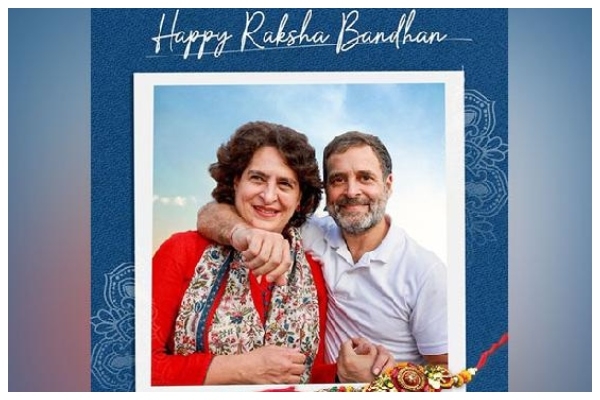 Why does Rahul's Raksha Bandhan post look so much like a greeting card and so little like an ordinary family photograph? Where is the natural, spontaneous brother-sister picture? Where is the photograph that simply says: “Priyanka tied a rakhi; Rahul smiled; family celebrated”?
Instead, we get something that looks carefully composed, almost as if Raksha Bandhan passed through the Congress media department before reaching the public.
One is tempted to ask: Was this a family moment or a communication strategy?
And then comes the second mystery.
What exactly was Priyanka wearing?
Sari? Punjabi attire? Something with a tribal touch? The Gandhi family has apparently decided that even Priyanka's attire should retain an element of suspense.
Yesterday, we could at least imagine Priyanka looking every bit the traditional Indian sister in a sari. Today, the picture is less certain. And perhaps that uncertainty itself is amusing.
One can almost hear a Congress communications meeting:
“Should we show the sari?”
“Will it look too traditional?”
“What about the new ecosystem?”
“Which ecosystem?”
“You know… the Left.”
“Ah.”
“Will they object?”
“Don't know.”
“Then make it look like a greeting card.”
And thus, perhaps, was born the most politically cautious Rakhi photograph in recent memory.
But satire does not require a conspiracy.
It only requires an interesting contradiction.
And Rahul Gandhi has supplied one.
Because here is a politician whose relationship with Hindu traditions has fascinated Indian politics for years. Rahul has visited temples, spoken about Hinduism and publicly discussed his Hindu identity. The Congress, meanwhile, has spent decades negotiating the complicated territory between secularism, minority politics and India's overwhelmingly Hindu cultural landscape.
Now Raksha Bandhan arrives.
A sister.
A brother.
A rakhi.
A Hindu festival.
And suddenly Rahul Gandhi looks perfectly comfortable with a tradition that has survived considerably longer than most political ideologies.
One cannot help wondering:
What happened?
Has Rahul finally discovered the Indian family?
Has the Congress research department discovered Raksha Bandhan?
Or has somebody quietly informed him that not every Hindu tradition needs to be examined through the lens of patriarchy?
 It is Raksha Bandhan.
A brother and sister celebrating a festival is hardly a constitutional crisis.
But politics has a strange way of turning ordinary family moments into ideological events.
Which brings us to the question nobody is asking loudly enough:
Is Rahul Gandhi worried about what his new-found ecosystem will say?
After years of moving closer to a political ecosystem in which the Left and its intellectual vocabulary occupy considerable space, Rahul now finds himself celebrating a very old Indian family tradition. Will the ecosystem applaud?
Will it analyse?
Will somebody produce a paper on the patriarchal implications of the rakhi?
Will another discover that the brother's promise of protection requires a gender audit?
Or will everyone simply decide that this is one festival where ideology can take a holiday?
That would be a refreshing development.
Because Raksha Bandhan is wonderfully inconvenient for ideological over-analysis.
A sister ties a rakhi.
A brother accepts it.
There are sweets.
There are memories.
There is affection.
Nobody needs a seminar.
Nobody needs a manifesto.
Nobody needs a resolution of the Congress Working Committee.
And certainly nobody needs Rahul Gandhi to explain the sociology of the thread.
Yet here we are.
Then there is the old question:
What religion is this Rahul Gandhi?
It has been hanging around Indian politics for years.
When Rahul visits a temple, the question is whether it is faith or optics. When he does not, another question appears. When he speaks about Hinduism, political commentators begin measuring its electoral value. Now that he celebrates Raksha Bandhan, we are once again tempted to look for a political calculation hidden underneath the rakhi.
At this rate, the Congress may soon need a new organisational department:
And Then Comes the Patriarchy Police
There is, however, one particularly awkward question for Rahul's new political neighbourhood: patriarchy.
Raksha Bandhan is almost tailor-made for an ideological interrogation. A sister ties a thread around her brother's wrist. The brother promises to protect her. There is affection, certainly but there is also a traditional gendered symbolism that could make a modern ideological theorist reach for a microphone.
One can almost hear the question:
“Why does the brother protect the sister? Why not the other way around?”
Excellent question.
Perhaps next year Rahul and Priyanka could negotiate a mutual protection treaty.
Priyanka protects Rahul from political mistakes.
Rahul protects Priyanka from… well, perhaps from having to explain Rahul's political mistakes.
Problem solved.
But what about the rakhi itself?
Is it patriarchal?
Is the brother's promise of protection an assertion of male authority?
Does accepting the rakhi reinforce traditional gender roles?
Should Rahul have consulted his ideological ecosystem before extending his wrist?
And most importantly, would the same people who have spent years warning India about patriarchy now object if Rahul celebrated one of India's oldest brother-sister traditions?
That would be quite a spectacle.
Imagine a seminar titled:
“Raksha Bandhan: Patriarchy, Protection and the Politics of the Wrist.”
Three professors.
Four papers.
Five interpretations.
And Rahul Gandhi sitting in the front row wondering why he cannot simply eat a ladoo.
The beauty of Raksha Bandhan is that ordinary Indians do not treat it this way.
The sister does not tie the rakhi because she has accepted a constitutional theory of male protection. The brother does not extend his wrist because he has been elected head of the household. The ritual survives because it expresses affection, responsibility and a family bond.
And there is nothing stopping a sister from protecting her brother either.
Indeed, in most Indian families, she probably does—emotionally, financially, practically and occasionally by reminding him of things he would rather forget.
So perhaps the patriarchy debate can take the day off.
But Rahul's new ecosystem may not be granted the same privilege.
Because if Hindu traditions are acceptable when celebrated privately by a Gandhi, perhaps the question is not whether Raksha Bandhan is patriarchal.
Perhaps the more uncomfortable question is:
Why does a perfectly ordinary Indian family tradition become “patriarchy” only when someone decides to interpret it politically?
Rahul need not answer.
Priyanka has already tied the rakhi.
The rest of us can enjoy the comedy.
 Agenda item one: Why did Rahul accept the rakhi?
Agenda item two: What exactly was Priyanka wearing?
Agenda item three: Why does the photograph look like a greeting card?
Agenda item four: Was the photograph approved by the ideological ecosystem?
Agenda item five: Most importantly — did Rahul Gandhi celebrate Raksha Bandhan as a brother, as a Hindu, or as a politician?
There is, fortunately, a simpler possibility.
Maybe he celebrated it because Priyanka is his sister.
That possibility is so uncomplicated that Indian politics may find it difficult to process.
And then comes the patriarchy question.
Raksha Bandhan traditionally involves a sister tying a rakhi to her brother, with the brother promising protection. In today's politically correct universe, somebody could presumably ask whether the entire arrangement requires a gender audit.
Is the brother's promise to protect his sister patriarchal?
Should the rakhi come with an equality clause?
Should Rahul first obtain Priyanka's written consent before accepting the thread?
Should Priyanka promise to protect Rahul too?
Actually, that last one might be useful.
Given Rahul's political career, perhaps the family should consider it.
Thankfully, Indian families have not yet reached that stage of civilization.
For ordinary Indians, Raksha Bandhan is not a gender-theory conference. It is a sister remembering her brother, a brother remembering his sister, sweets being exchanged and families getting together.
Which brings us back to Priyanka.
Her attire should ordinarily be nobody's concern. Sari, Punjabi dress, tribal-inspired clothing or anything else she chooses fine.
But when a Gandhi family photograph arrives wrapped in political mystery, even the dress becomes part of the comedy.
And the more mysterious it becomes, the more entertaining the question:
Why hide the ordinary?
If the Gandhi family is celebrating an Indian tradition, why not simply show it?
Why the greeting-card treatment?
Why not a natural photograph?
Why not allow Rahul and Priyanka to look like what they actually are a brother and sister celebrating Raksha Bandhan?
Could it be political caution?
Could it be optics?
Could it be an attempt to embrace the cultural sentiment while ensuring that nobody in the new ideological neighbourhood becomes uncomfortable?
Again, we do not know.
And that is precisely why it is funny.
Imagine Rahul's political ecosystem receiving the photograph.
One section says: “Wonderful. Family values.”
Another whispers: “But Hindu?”
A third asks: “Is this soft Hindutva?”
A fourth says: “No, no. It is merely cultural.”
A fifth starts a panel discussion.
And Rahul?
He is probably wondering why accepting a rakhi has become a national debate.
This is the peculiar curse of political visibility.
Celebrate: political.
Don't celebrate: anti-Hindu.
Wear traditional clothes: symbolism.
Don't wear them: disconnect.
Post a natural photograph: political messaging.
Post a greeting card: political messaging.
Smile: photo opportunity.
Don't smile: aloof.
At some point, the politician must simply give up.
Perhaps Rahul Gandhi has discovered that the safest way to celebrate Raksha Bandhan is to let the greeting card do the talking.
But there is another, more serious joke hidden inside all this.
Indian traditions are remarkably difficult to defeat.
They have survived empires, governments, ideological movements, economic revolutions and political parties. They do not need a manifesto. They do not require a press conference. They do not need a communication strategy.
They simply turn up every year.
Raksha Bandhan arrives.
Sisters tie rakhis.
Brothers accept them.
Families celebrate.
And political theories are left trying to explain the phenomenon.
Perhaps that is the real comedy.
The people who spend years trying to explain India to Indians occasionally discover that India has already explained itself.
So, Rahul, congratulations.
Not because one rakhi proves a political conversion.
Not because one photograph can reveal anybody's private beliefs.
Not because Priyanka's mysterious attire settles the great ideological debate.
Simply because a brother celebrated with his sister.
But we reserve the right to ask one last question:
Rahul, was this Rakhi tied by Priyanka—or by the political calendar?
And why did the photograph look like a greeting card?
Maybe there is nothing behind it.
Maybe there is everything behind it.
Either way, Raksha Bandhan has produced an unexpected achievement.
For one day, Rahul Gandhi, Hindu tradition, family values, political optics and the nervous Left ecosystem have all found themselves in the same frame.
Well almost the same frame.
The greeting-card frame.
There he was, celebrating Raksha Bandhan with Priyanka Gandhi Vadra.
Or, at least, celebrating it in the way a modern political communication team might prefer it to be seen.
Because the first mystery is not the rakhi.
This is the photograph.
Instead, we get something that looks carefully composed, almost as if Raksha Bandhan passed through the Congress media department before reaching the public.
One is tempted to ask: Was this a family moment or a communication strategy?
And then comes the second mystery.
What exactly was Priyanka wearing?
Sari? Punjabi attire? Something with a tribal touch? The Gandhi family has apparently decided that even Priyanka's attire should retain an element of suspense.
Yesterday, we could at least imagine Priyanka looking every bit the traditional Indian sister in a sari. Today, the picture is less certain. And perhaps that uncertainty itself is amusing.
One can almost hear a Congress communications meeting:
“Should we show the sari?”
“Will it look too traditional?”
“What about the new ecosystem?”
“Which ecosystem?”
“You know… the Left.”
“Ah.”
“Will they object?”
“Don't know.”
“Then make it look like a greeting card.”
And thus, perhaps, was born the most politically cautious Rakhi photograph in recent memory.
Of course, this may all be completely innocent. Perhaps Rahul simply liked the picture. Perhaps the Gandhi family has its own reasons for choosing it. Perhaps there is another photograph sitting happily in somebody's phone.
ALSO READ: UPI@10: India’s digital leap
It only requires an interesting contradiction.
And Rahul Gandhi has supplied one.
Because here is a politician whose relationship with Hindu traditions has fascinated Indian politics for years. Rahul has visited temples, spoken about Hinduism and publicly discussed his Hindu identity. The Congress, meanwhile, has spent decades negotiating the complicated territory between secularism, minority politics and India's overwhelmingly Hindu cultural landscape.
Now Raksha Bandhan arrives.
A sister.
A brother.
A rakhi.
A Hindu festival.
And suddenly Rahul Gandhi looks perfectly comfortable with a tradition that has survived considerably longer than most political ideologies.
One cannot help wondering:
What happened?
Has Rahul finally discovered the Indian family?
Has the Congress research department discovered Raksha Bandhan?
Or has somebody quietly informed him that not every Hindu tradition needs to be examined through the lens of patriarchy?
Relax.
A brother and sister celebrating a festival is hardly a constitutional crisis.
But politics has a strange way of turning ordinary family moments into ideological events.
Which brings us to the question nobody is asking loudly enough:
Is Rahul Gandhi worried about what his new-found ecosystem will say?
After years of moving closer to a political ecosystem in which the Left and its intellectual vocabulary occupy considerable space, Rahul now finds himself celebrating a very old Indian family tradition.
Will it analyse?
Will somebody produce a paper on the patriarchal implications of the rakhi?
Will another discover that the brother's promise of protection requires a gender audit?
Or will everyone simply decide that this is one festival where ideology can take a holiday?
That would be a refreshing development.
A sister ties a rakhi.
A brother accepts it.
There are sweets.
There are memories.
There is affection.
Nobody needs a seminar.
Nobody needs a manifesto.
Nobody needs a resolution of the Congress Working Committee.
And certainly nobody needs Rahul Gandhi to explain the sociology of the thread.
Yet here we are.
Then there is the old question:
What religion is this Rahul Gandhi?
It has been hanging around Indian politics for years.
When Rahul visits a temple, the question is whether it is faith or optics. When he does not, another question appears. When he speaks about Hinduism, political commentators begin measuring its electoral value. Now that he celebrates Raksha Bandhan, we are once again tempted to look for a political calculation hidden underneath the rakhi.
ALSO READ: ISRO set to return to launch pad with strategic Earth observation satellite GISAT-1A
And Then Comes the Patriarchy Police
There is, however, one particularly awkward question for Rahul's new political neighbourhood: patriarchy.
Raksha Bandhan is almost tailor-made for an ideological interrogation. A sister ties a thread around her brother's wrist. The brother promises to protect her. There is affection, certainly but there is also a traditional gendered symbolism that could make a modern ideological theorist reach for a microphone.
One can almost hear the question:
“Why does the brother protect the sister? Why not the other way around?”
Excellent question.
Perhaps next year Rahul and Priyanka could negotiate a mutual protection treaty.
Priyanka protects Rahul from political mistakes.
Rahul protects Priyanka from… well, perhaps from having to explain Rahul's political mistakes.
Problem solved.
But what about the rakhi itself?
Is it patriarchal?
Is the brother's promise of protection an assertion of male authority?
Does accepting the rakhi reinforce traditional gender roles?
Should Rahul have consulted his ideological ecosystem before extending his wrist?
And most importantly, would the same people who have spent years warning India about patriarchy now object if Rahul celebrated one of India's oldest brother-sister traditions?
That would be quite a spectacle.
Imagine a seminar titled:
“Raksha Bandhan: Patriarchy, Protection and the Politics of the Wrist.”
Three professors.
Four papers.
Five interpretations.
And Rahul Gandhi sitting in the front row wondering why he cannot simply eat a ladoo.
The beauty of Raksha Bandhan is that ordinary Indians do not treat it this way.
The sister does not tie the rakhi because she has accepted a constitutional theory of male protection. The brother does not extend his wrist because he has been elected head of the household. The ritual survives because it expresses affection, responsibility and a family bond.
And there is nothing stopping a sister from protecting her brother either.
Indeed, in most Indian families, she probably does—emotionally, financially, practically and occasionally by reminding him of things he would rather forget.
ALSO READ: Drone Activity Detected Along LoC in Rajouri, Security Forces on High Alert
But Rahul's new ecosystem may not be granted the same privilege.
Because if Hindu traditions are acceptable when celebrated privately by a Gandhi, perhaps the question is not whether Raksha Bandhan is patriarchal.
Perhaps the more uncomfortable question is:
Why does a perfectly ordinary Indian family tradition become “patriarchy” only when someone decides to interpret it politically?
Rahul need not answer.
Priyanka has already tied the rakhi.
The rest of us can enjoy the comedy.
Department of Hindu Intentions.
Agenda item two: What exactly was Priyanka wearing?
Agenda item three: Why does the photograph look like a greeting card?
Agenda item four: Was the photograph approved by the ideological ecosystem?
Agenda item five: Most importantly — did Rahul Gandhi celebrate Raksha Bandhan as a brother, as a Hindu, or as a politician?
There is, fortunately, a simpler possibility.
Maybe he celebrated it because Priyanka is his sister.
That possibility is so uncomplicated that Indian politics may find it difficult to process.
And then comes the patriarchy question.
Raksha Bandhan traditionally involves a sister tying a rakhi to her brother, with the brother promising protection. In today's politically correct universe, somebody could presumably ask whether the entire arrangement requires a gender audit.
Is the brother's promise to protect his sister patriarchal?
Should the rakhi come with an equality clause?
Should Rahul first obtain Priyanka's written consent before accepting the thread?
Should Priyanka promise to protect Rahul too?
Actually, that last one might be useful.
Given Rahul's political career, perhaps the family should consider it.
Thankfully, Indian families have not yet reached that stage of civilization.
ALSO READ: UPI@10: India’s digital leap
Which brings us back to Priyanka.
Her attire should ordinarily be nobody's concern. Sari, Punjabi dress, tribal-inspired clothing or anything else she chooses fine.
But when a Gandhi family photograph arrives wrapped in political mystery, even the dress becomes part of the comedy.
And the more mysterious it becomes, the more entertaining the question:
Why hide the ordinary?
If the Gandhi family is celebrating an Indian tradition, why not simply show it?
Why the greeting-card treatment?
Why not a natural photograph?
Why not allow Rahul and Priyanka to look like what they actually are a brother and sister celebrating Raksha Bandhan?
Could it be political caution?
Could it be optics?
Could it be an attempt to embrace the cultural sentiment while ensuring that nobody in the new ideological neighbourhood becomes uncomfortable?
Again, we do not know.
And that is precisely why it is funny.
Imagine Rahul's political ecosystem receiving the photograph.
One section says: “Wonderful. Family values.”
Another whispers: “But Hindu?”
A third asks: “Is this soft Hindutva?”
A fourth says: “No, no. It is merely cultural.”
A fifth starts a panel discussion.
And Rahul?
He is probably wondering why accepting a rakhi has become a national debate.
This is the peculiar curse of political visibility.
Celebrate: political.
Don't celebrate: anti-Hindu.
Wear traditional clothes: symbolism.
Don't wear them: disconnect.
Post a natural photograph: political messaging.
Post a greeting card: political messaging.
Smile: photo opportunity.
Don't smile: aloof.
At some point, the politician must simply give up.
Perhaps Rahul Gandhi has discovered that the safest way to celebrate Raksha Bandhan is to let the greeting card do the talking.
But there is another, more serious joke hidden inside all this.
Indian traditions are remarkably difficult to defeat.
They have survived empires, governments, ideological movements, economic revolutions and political parties. They do not need a manifesto. They do not require a press conference. They do not need a communication strategy.
They simply turn up every year.
Raksha Bandhan arrives.
Sisters tie rakhis.
Brothers accept them.
Families celebrate.
And political theories are left trying to explain the phenomenon.
Perhaps that is the real comedy.
The people who spend years trying to explain India to Indians occasionally discover that India has already explained itself.
So, Rahul, congratulations.
Not because one rakhi proves a political conversion.
Not because one photograph can reveal anybody's private beliefs.
Not because Priyanka's mysterious attire settles the great ideological debate.
Simply because a brother celebrated with his sister.
But we reserve the right to ask one last question:
Rahul, was this Rakhi tied by Priyanka—or by the political calendar?
And why did the photograph look like a greeting card?
Maybe there is nothing behind it.
Maybe there is everything behind it.
Either way, Raksha Bandhan has produced an unexpected achievement.
For one day, Rahul Gandhi, Hindu tradition, family values, political optics and the nervous Left ecosystem have all found themselves in the same frame.
Well almost the same frame.
The greeting-card frame.