The Affordability Gap the establishment left wide open and Islamists using it as a Trojan Horse
Establishment parties ignored cost of living and now face insurgent Islamist challenge in cities.
Total Views |


Something is shifting in the United States of America's big cities and both major establishment parties, the Democrats and Republicans would be wise to understand it before it hardens into a permanent realignment. A new generation of Islamists pretending to be left-wing or democratic socialists are winning by talking about one thing relentlessly: the cost of living. The establishment democrats and republicans left that ground unguarded and now they are paying for it.
Look at the numbers and the opening is obvious. American income inequality has widened for four straight decades; the Congressional Budget Office finds the Gini coefficient for household income rose steadily between 1979 and 2021, even after taxes and transfers.
The Gini coefficient is a statistical measure used to calculate income or wealth inequality within a nation or social group.
The racial dimension is starker still. As of late 2023, white households held roughly 84 percent of all U.S. wealth while making up about 66 percent of households, Black families were 11.4 percent of households but owned 3.4 percent of wealth and Hispanic families 9.6 percent of households but 2.3 percent of wealth. Poverty tells the same story: in 2023, about 20.8 percent of Black Americans, 16.6 percent of Hispanics and 20.9 percent of American Indian and Alaska Native households lived at or below the poverty line, roughly double the white and Asian rates.
Now add the cities, where the squeeze is sharpest. When New Yorkers voted in 2025, the housing vacancy rate sat at just 1.4 percent, its lowest since 1968. Into that pressure walked Zohran Mamdani, a 34-year-old democratic socialist and allegedly a person with Islamist sympathies who made "freeze the rent" the drumbeat of his campaign and won decisively, carrying renter-majority districts and surging turnout among them. Whatever one thinks of a rent freeze as policy and many economists warn it discourages investment and worsens supply over time, the political lesson is unmistakable. He named the pain people feel and promised to act on it. It's a different matter that after coming to office, he regularly focuses his attention ranting his opinions on Israel, Netanyahu or Hindutva or Islamophobia, issues which have nothing to do with New York City.
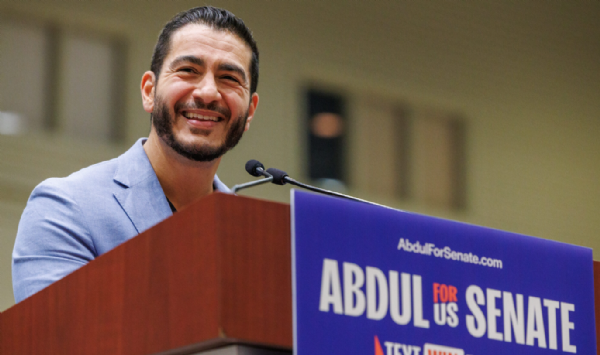
Image: Abdul el-Sayed
Image Credit: Michigan Advance
Mamdani is not alone. Ilhan Omar in Minnesota, Rashida Tlaib in Michigan, and now Abdul El-Sayed, the former Detroit health director who built his profile on Medicare-for-all style economics, all belong to the same insurgent wing. They may differ on plenty, but they share a formula: go straight at wages, rent, healthcare, and childcare and go there louder than anyone else in the room. That formula works because the pain is real and, for too long, unanswered. Abdul El-Sayed’s sister was allegedly celebrating October 7 Hamas terrorist attacks on Israel and he himself has very colorful opinions on the same.
Here is the uncomfortable part for the establishment. This lane was open because mainstream lawmakers of both parties, including the many Christian and Jewish legislators who dominate Congress and city halls largely stopped competing for it. They spoke about growth in the abstract while a bus driver in Queens or a nurse in Detroit watched half a paycheck vanish into rent. When responsible voices go quiet on affordability, the loudest populist voice wins by default. Politics abhors a vacuum. And this time, that vacuum is being filled by alleged democratic Islamists.
Also Read: RSS "exclusionary"? Mamdani's own records, including sheltering Md Khalil, who supported Hamas, complicate that charge, details
The answer is not only to attack these politicians’ faith or heritage, which only hands them the moral high ground and changes no one's rent. The answer is to out-compete them on substance. That means a serious center and center-right offering on housing supply, on wage growth, on the cost of childcare and care for the elderly, an agenda that speaks to the same marginalized communities the data show are hurting most, but with policies that build rather than freeze.
Marginalized Americans are not a captured constituency for any faction. They are voters looking for whoever will take their economic anxiety seriously. If mainstream lawmakers want them back, the path is not grievance or suspicion. It is showing up, every day, on the one issue the insurgents understood first: the cost of simply getting by.
Now add the cities, where the squeeze is sharpest. When New Yorkers voted in 2025, the housing vacancy rate sat at just 1.4 percent, its lowest since 1968. Into that pressure walked Zohran Mamdani, a 34-year-old democratic socialist and allegedly a person with Islamist sympathies who made "freeze the rent" the drumbeat of his campaign and won decisively, carrying renter-majority districts and surging turnout among them. Whatever one thinks of a rent freeze as policy and many economists warn it discourages investment and worsens supply over time, the political lesson is unmistakable. He named the pain people feel and promised to act on it. It's a different matter that after coming to office, he regularly focuses his attention ranting his opinions on Israel, Netanyahu or Hindutva or Islamophobia, issues which have nothing to do with New York City.
Image: Abdul el-Sayed
Image Credit: Michigan Advance
Mamdani is not alone. Ilhan Omar in Minnesota, Rashida Tlaib in Michigan, and now Abdul El-Sayed, the former Detroit health director who built his profile on Medicare-for-all style economics, all belong to the same insurgent wing. They may differ on plenty, but they share a formula: go straight at wages, rent, healthcare, and childcare and go there louder than anyone else in the room. That formula works because the pain is real and, for too long, unanswered. Abdul El-Sayed’s sister was allegedly celebrating October 7 Hamas terrorist attacks on Israel and he himself has very colorful opinions on the same.
Here is the uncomfortable part for the establishment. This lane was open because mainstream lawmakers of both parties, including the many Christian and Jewish legislators who dominate Congress and city halls largely stopped competing for it. They spoke about growth in the abstract while a bus driver in Queens or a nurse in Detroit watched half a paycheck vanish into rent. When responsible voices go quiet on affordability, the loudest populist voice wins by default. Politics abhors a vacuum. And this time, that vacuum is being filled by alleged democratic Islamists.
Also Read: RSS "exclusionary"? Mamdani's own records, including sheltering Md Khalil, who supported Hamas, complicate that charge, details
The answer is not only to attack these politicians’ faith or heritage, which only hands them the moral high ground and changes no one's rent. The answer is to out-compete them on substance. That means a serious center and center-right offering on housing supply, on wage growth, on the cost of childcare and care for the elderly, an agenda that speaks to the same marginalized communities the data show are hurting most, but with policies that build rather than freeze.
Marginalized Americans are not a captured constituency for any faction. They are voters looking for whoever will take their economic anxiety seriously. If mainstream lawmakers want them back, the path is not grievance or suspicion. It is showing up, every day, on the one issue the insurgents understood first: the cost of simply getting by.