Meet Kusha: India's New Guardian of the Skies
Project Kusha also places India among a small group of technologically advanced nations capable of developing indigenous long-range air defence systems.
Total Views |


Let's begin with a picture. Not of tanks rolling across a border, or infantry storming a hill. That is an old war. The picture that matters today is a screen, glowing in a dark control room, somewhere in India, tracking a swarm of small dots moving low and fast toward our territory. No pilots. No warning sirens on the other side. Just machines, sent to test how well we watch our own sky.
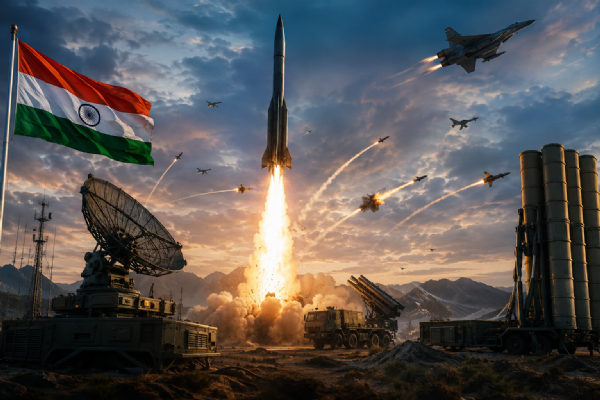
That test came in May 2025, during Operation Sindoor. And India passed it in a way that deserves far more attention than it has received.
- The Night the Sky Held
Pakistan sent close to a thousand drones across the western border over four nights. This was not a probing attack. It was an attempt to overwhelm, to throw enough machines into the sky that something, somewhere, would get through.Nothing did.
Two Indian systems did the heaviest lifting. The S-400, watching the deep sky out to 600 kilometres, caught anything trying to sneak in high and fast. And Akashteer, India's own command network, built at home, did something arguably more impressive. It took data from dozens of radars and missile batteries scattered across the front and stitched it into one live picture. A commander in one sector could see what a radar in another sector was tracking, instantly. No confusion. No overlap. No gaps.
Think of Akashteer as the nervous system of India's air defence. The S-400 and the other missile batteries are the muscle. But muscle without a nervous system just twitches randomly. Akashteer is what lets every twitch become a coordinated, deliberate strike. Every armed drone Pakistan sent was brought down. That is not spin. That is the record.
- A Good General Never Fights the Last War With the Last Weapon
Here is where strategic thinking has to kick in, and this is the part most commentary misses.
Winning decisively is exactly the moment a serious military planner starts asking, what next. Not because anything failed. Because nothing should be left to chance twice
India's air defence architecture that night was layered, but the outermost layer, the one meant to catch the fastest, farthest threats, was carried almost entirely by one system. A brilliant system, built by a trusted partner. But strategic doctrine, going back centuries, has always said the same thing. Depth wins wars. Redundancy wins wars. You do not build your strongest wall out of a single kind of brick, however good that brick is.
This is precisely why Project Kusha exists.
- What Kusha Actually Is
On July 23, 2026, DRDO tested the first missile in the Kusha family, off the Odisha coast. It found its target. It destroyed it. Every part of the system, missile, radar, launcher, and command centre, worked together correctly, on the first real attempt.
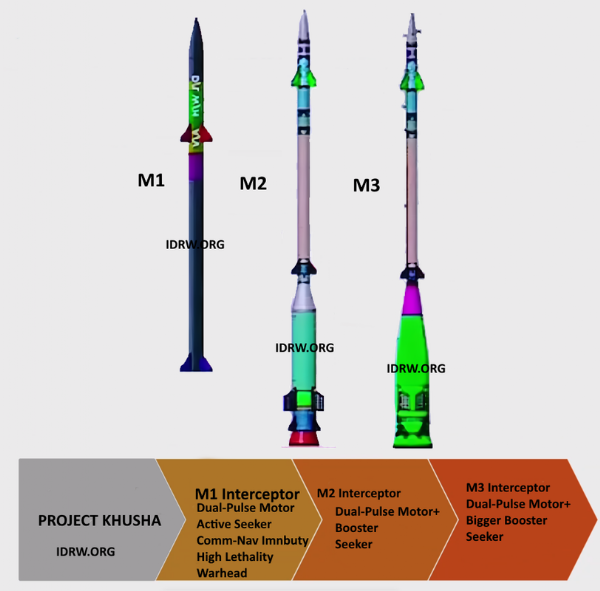
Kusha is not one missile. It is a family of three, all sharing a common design, each one built to fly further than the last.
The M1 covers 150 kilometres.
The M2 covers 250 kilometres.
The M3, still to be tested, is built to reach 350 to 400 kilometres.
Picture three archers standing on the same wall, each one strung for a different distance. That is Kusha. A short-range threat gets met by the archer built for that range. A distant threat gets met by the one built to reach that far. Nothing is wasted. Nothing is overmatched.
- Why This Matters Strategically, Not Just Technically
Here is the honest, positive case for Kusha, without any unnecessary hand-wringing.
India's partnership with Russia has been one of the steadiest relationships in our foreign policy since independence, and there is every reason to expect it will keep deepening in the years ahead. The S-400 has proven its worth. This is not about walking away from that friendship. It is about something every serious power eventually does once it has the means: build the same capability at home, so that strength never has a single point of failure, no matter how strong or friendly that single point is.
That is not caution born of doubt. That is what confidence looks like when a country has grown strong enough to build its own version of the very best.
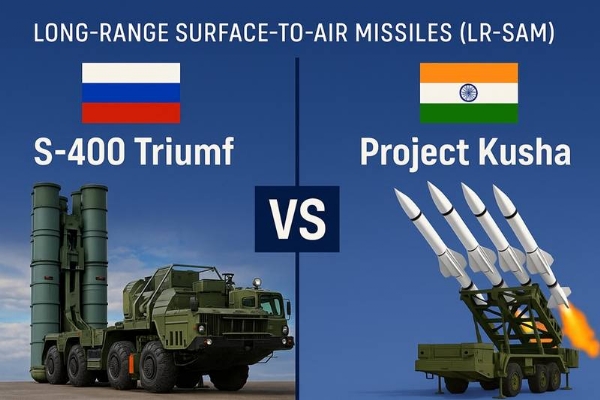
And the numbers back the confidence up. Five squadrons of S-400 cost India close to ₹45,000 crore. Five squadrons of Kusha have been cleared for roughly ₹21,700 crore, and each Kusha missile is expected to cost ₹40 to 50 crore against nearly ₹100 crore for a comparable imported interceptor. That is strength, at less than half the price, with every future upgrade decided in Delhi.
- The Industrial Base Behind Kusha
Project Kusha rests on a coordinated industrial effort. DRDO holds overall design authority. Bharat Dynamics Limited (BDL) is responsible for missile production, while Bharat Electronics Limited (BEL) is developing the associated radar and sensor suite. A widening base of private firms and start-ups is supplying subsystems and components, a structure that reflects the broader shift in India's defence-industrial policy toward public-private integration under the Atmanirbhar Bharat framework.
- Entry Into a Select Strategic Club
Project Kusha also places India among a small group of technologically advanced nations capable of developing indigenous long-range air defence systems. Countries such as the United States, Russia and Israel have invested for decades in layered missile defence architectures. India's entry into this domain reflects the steady growth of its scientific capabilities and the success of sustained investments in defence research and manufacturing. Rather than merely acquiring advanced systems, India is increasingly contributing to the global evolution of defence technology through indigenous innovation.
- How This Protects Us, In Practice
When Kusha is fully deployed alongside Akashteer, here is what changes on the ground.
A drone crossing the border gets picked up the moment it enters range, and the system already knows which interceptor should handle it. A cruise missile flying low, trying to hide from radar, gets tracked continuously across sectors rather than lost at a boundary between commands. A fighter jet approaching from far away gets engaged well before it is close enough to release its weapons.
This is the layered shield doctrine in its most complete form. Short range guns and missiles for the closest threats. Akash and Barak-8 for the middle distance. Kusha's M1, M2, and M3 for everything from 150 to 400 kilometres out. And Akashteer tying every layer into one coordinated response, so that the whole system thinks as one mind rather than reacting as separate units.
- The Larger Picture
Kusha sits inside something even bigger. Mission Sudarshan Chakra, announced by the Prime Minister in his 2025 Independence Day address, aims to knit this entire architecture, radars, missiles, command systems, satellites, into a single unified shield covering all of India by 2035.
It is worth remembering what Operation Sindoor already proved. A determined adversary sent everything it had into our sky, and India's layered defence, anchored by the S-400 and coordinated by Akashteer, held completely. Project Kusha does not exist because that defence was weak. It exists because India has decided that what worked brilliantly with a trusted partner's help should also exist, fully, as our own.
That is not defensiveness. That is what a rising power does. It builds redundancy into its strength, deepens every friendship that helped it get there, and keeps adding new layers of capability that answer to no one but itself.
The sky held once. With Kusha, it holds on India's own terms, for good.