One medal, two messages: How Lovlina Borgohain flagged missing Northeast on inaccurate map of India in Glasgow
Total Views |


For most athletes, the story ends with the medal ceremony. For Lovlina Borgohain, the real story began after she stepped off the podium.
Within 48 hours of winning the Commonwealth Games 2026 silver medal, the Olympic medallist from Assam made headlines twice, first for dedicating her medal to the flood-affected people of her home state, and then for spotting and objecting to an incorrect map of India at a Glasgow restaurant.
As celebrations followed her silver-medal finish, Lovlina's thoughts travelled nearly 8,000 kilometres away—to Assam, where thousands of families were battling one of the worst flood seasons in recent years.
Instead of speaking only about her achievement, she dedicated the medal to those struggling back home.
The dedication transformed a personal sporting success into a message of solidarity. It reminded the country that athletes often remain emotionally rooted in the communities that shaped them.
_202608041209494331_H@@IGHT_458_W@@IDTH_700.jpg "Lovlina")
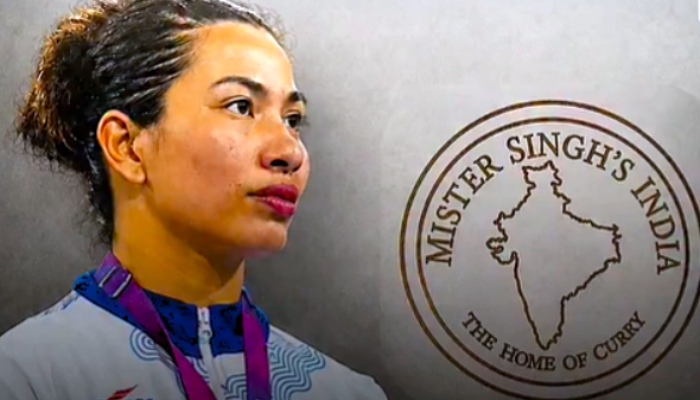
Incomplete map of India on Mister Singh’s napkin
The following day, another incident unfolded at Mister Singh's India, a well-known Indian restaurant in Glasgow where members of the Indian boxing contingent had gathered after the Games.
While celebrating the team's success, Lovlina noticed that the restaurant's logo, printed on its signboard and paper napkins, carried an incorrect map of India. The Northeast was missing altogether, while parts of Jammu & Kashmir were also depicted inaccurately.
Rather than ignoring it, she immediately but politely brought the matter to the attention of the management.
Her words were calm but unmistakably clear. "Please don't take this the wrong way. I felt a little hurt by this. In the map of India, our North East is missing. As someone from the North East, that really hurts us. Please keep this in mind next time. Thank you so much."
The restaurant later issued an apology and agreed to redesign its logo.
Elite boxers are trained to observe the smallest opening in an opponent's defence. Lovlina displayed the same sharp awareness outside the ring.
_202608041211168399_H@@IGHT_458_W@@IDTH_700.jpg "Lovlina") Many customers had probably used those napkins without paying attention. She noticed immediately that the map excluded the very region she comes from.
Many customers had probably used those napkins without paying attention. She noticed immediately that the map excluded the very region she comes from.
Her response was neither angry nor theatrical. She did not create a public confrontation. She simply pointed out the mistake and explained why it mattered. That restraint made her message stronger.
To some, it may appear to be a simple design error. But maps are not merely decorative graphics. They are visual representations of a nation's territorial identity and constitutional boundaries.
There is another reason her intervention resonated. For decades, people from India's Northeast have often spoken about feeling geographically and emotionally distant from the national mainstream. The region contributes soldiers, sportspersons, artists and entrepreneurs, yet many still complain of being misunderstood or overlooked.
When Lovlina said, "As someone from the North East, that really hurts us," she was not speaking only for herself. She was expressing a sentiment familiar to many in the region, that recognition matters, and that every part of India deserves equal visibility and respect.
Ironically, it took a boxer from Assam, not a diplomat or a politician, to remind an overseas establishment that the Northeast is inseparable from India.
Taken individually, dedicating a medal to flood victims and correcting an inaccurate map may appear unrelated.
Within 48 hours of winning the Commonwealth Games 2026 silver medal, the Olympic medallist from Assam made headlines twice, first for dedicating her medal to the flood-affected people of her home state, and then for spotting and objecting to an incorrect map of India at a Glasgow restaurant.
Neither act was scripted. Neither had anything to do with boxing. Yet together they revealed why champions are remembered not only for the medals they win, but also for the values they carry.
A medal for ‘Assam’
Instead of speaking only about her achievement, she dedicated the medal to those struggling back home.
For an athlete standing on an international podium, it was a deeply human gesture. At a time when the spotlight naturally belonged to her, she chose to share it with people who had lost homes, livelihoods and, in many cases, loved ones.
The dedication transformed a personal sporting success into a message of solidarity. It reminded the country that athletes often remain emotionally rooted in the communities that shaped them.
The napkin that caught a champion's eye
Incomplete map of India on Mister Singh’s napkin
The following day, another incident unfolded at Mister Singh's India, a well-known Indian restaurant in Glasgow where members of the Indian boxing contingent had gathered after the Games.
While celebrating the team's success, Lovlina noticed that the restaurant's logo, printed on its signboard and paper napkins, carried an incorrect map of India. The Northeast was missing altogether, while parts of Jammu & Kashmir were also depicted inaccurately.
Rather than ignoring it, she immediately but politely brought the matter to the attention of the management.
Her words were calm but unmistakably clear. "Please don't take this the wrong way. I felt a little hurt by this. In the map of India, our North East is missing. As someone from the North East, that really hurts us. Please keep this in mind next time. Thank you so much."
"INCOMPLETE INDIA MAP"
— Sports Wonderful World (@RathwaKevin) August 2, 2026
Assam's Star Boxer Lovlina Borgohain Flags Missing North East, Kashmir on India Map In Glasgow Restaurant's Napkins.
Jai Hind 🇮🇳🇮🇳🇮🇳🇮🇳🇮🇳
#LovlinaBorgohain #IndianBoxer #glasgow #Northeast #Boxing #CWG2026 pic.twitter.com/UiCJTtTXsn
Later, she explained what had happened. "It was an Indian restaurant where we were having food. I felt really bad about it and raised my voice. They apologised and said they would change the map."
The restaurant later issued an apology and agreed to redesign its logo.
Presence of mind beyond the ring
Glasgow restaurant Mister Singh’s India logo too displays an incomplete map of India
Her response was neither angry nor theatrical. She did not create a public confrontation. She simply pointed out the mistake and explained why it mattered. That restraint made her message stronger.
Why an incorrect map matters
In India's case, depictions involving the Northeast or Jammu & Kashmir carry particular sensitivity because they touch upon issues of sovereignty and national integrity.
Incorrect maps, especially when displayed by businesses claiming to represent India, can unintentionally reinforce misconceptions among international audiences. Lovlina's objection therefore went beyond correcting a logo. It underscored the importance of getting the country's identity right.
Boxing Federation of India (BFI) President Ajay Singh, who was part of the Indian contingent at the dinner, backed Lovlina's objection. He pointed out that the restaurant's logo not only omitted the Northeast but also inaccurately depicted parts of Jammu & Kashmir.
The objection prompted an immediate response from Mister Singh's India. In a formal statement, the restaurant apologised for the oversight, saying there was never any intention to offend anyone. It assured the Indian team that the incorrect design would be withdrawn and replaced with an accurate map of India across all its branding.
The objection prompted an immediate response from Mister Singh's India. In a formal statement, the restaurant apologised for the oversight, saying there was never any intention to offend anyone. It assured the Indian team that the incorrect design would be withdrawn and replaced with an accurate map of India across all its branding.
A voice for the Northeast
When Lovlina said, "As someone from the North East, that really hurts us," she was not speaking only for herself. She was expressing a sentiment familiar to many in the region, that recognition matters, and that every part of India deserves equal visibility and respect.
Ironically, it took a boxer from Assam, not a diplomat or a politician, to remind an overseas establishment that the Northeast is inseparable from India.
Taken individually, dedicating a medal to flood victims and correcting an inaccurate map may appear unrelated.
Viewed together, however, they reveal a consistent character. One act reflected compassion. The other reflected civic awareness and quiet patriotism.