New Delhi Declaration: India rewrites the rules of a ‘multipolar world’
The real story of the New Delhi Declaration is consequently larger than its 140 points. India brought together countries that do not agree on everything and secured agreement on enough.
NewsBharati 13-Sep-2026 04:09:28 AM
Total Views |


The final hours of the 18th BRICS Summit in New Delhi were simply historic moments of excellent diplomacy in global political history. After intense negotiations, the expanded grouping unanimously adopted the 140-point ‘New Delhi Declaration’ on September 12.
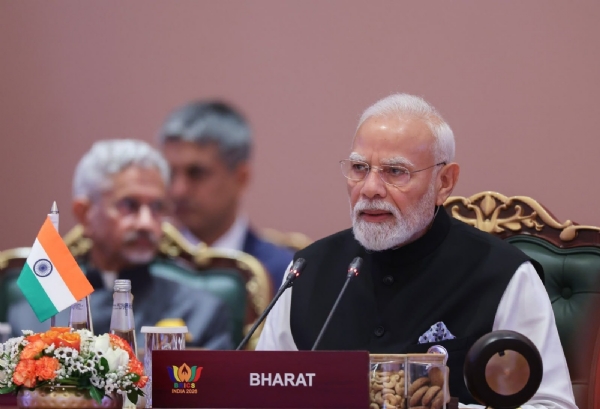
Hosted at Bharat Mandapam under India's chairship, the summit brought together countries with sharply divergent strategic interests, including China, Russia, Iran and the UAE. That the grouping still arrived at a common declaration is extremely significant and symbolic. India's achievement lies in securing consensus in such a miscellaneous group, and even more in using that consensus to advance a larger proposition of global governance, trade and finance to no longer be structured around a single centre of power.
A Declaration against the old order?
The declaration's most consequential message is perhaps its insistence that the institutions governing the international system must reflect contemporary realities. BRICS called for stronger multilateralism and reform of global governance institutions, including greater representation for developing countries. Russia and China have backed a greater role for India and Brazil in the Council, giving New Delhi an important diplomatic opening.
The economic message is equally pointed. The declaration raises concerns over unilateral tariffs, protectionist measures and economic restrictions that it argues undermine the multilateral trading system and disproportionately affect developing economies. In a world where tariffs and sanctions have become instruments of strategic competition, BRICS is asserting that economic sovereignty cannot be separated from political sovereignty.
The New Delhi Declaration extends this thinking to critical minerals, resilient supply chains and development finance. The New Development Bank's role in financing infrastructure and development, including through local currencies, gives the bloc an institutional mechanism through which greater economic autonomy can be pursued.
Besides, its geopolitical language is similarly expansive, that runs through numerous global issues from Gaza and humanitarian assistance to energy security, technology, climate and cultural heritage. The result is a bold statement about who should have a voice in defining the rules of the international system.
India's diplomatic test: China, terrorism and consensus
For India, however, one paragraph carried an unusually heavy strategic weight.
The declaration strongly condemned the April 22, 2025 Pahalgam terrorist attack and reiterated a zero-tolerance approach towards terrorism, including calls for action against terrorist safe havens. The significance lies partly in what was not said. The declaration did not name Pakistan as the perpetrator. Yet securing a collective BRICS condemnation of Pahalgam, including China's participation in the consensus, gave India an important diplomatic outcome.
BRICS contains countries with competing strategic relationships, particularly over West Asia. Iran and the UAE, for instance, sit within the same grouping despite their different strategic alignments, while Russia and China have their own interests in the evolving international order.
India therefore had to perform the more difficult task of bridging differences rather than eliminating them. That is perhaps the clearest measure of New Delhi's diplomatic success, at the moment. It made countries with very different voices agree on a common minimum, which considering the strategic differences, was a very tough task at India’s hand.
Decisive on the “BRICS Currency” debate
Few subjects surrounding BRICS generate as much speculation as de-dollarisation. But the New Delhi Summit demands a distinction between rhetoric and reality.
There is no common BRICS currency. India's External Affairs Ministry made that clear after the summit. What BRICS is actually pursuing is more practical, as expanding trade in national currencies and making cross-border payment systems more interoperable, is on the BRICS agenda.
The declaration calls for practical mechanisms to make cross-border payments faster, cheaper, safer and more accessible, while encouraging greater interoperability between national payment and messaging systems. The BRICS Payment Task Force is expected to continue this work.
This is where India's digital public infrastructure becomes strategically relevant. Linking systems such as UPI with payment networks elsewhere could eventually make bilateral trade less dependent on traditional financial intermediaries and reduce transaction costs.
Although not an overnight assault on the dollar, this is clearly a more gradual way of financial diversification. If energy, commodities, technology and investment can increasingly be settled in national currencies, the demand for dollar-denominated transactions could decline at the margins. Over time, multiple alternative channels could create a parallel layer of financial connectivity.
The New Delhi Declaration is not the birth of a fully integrated alternative world order, that was never on the agenda so far. BRICS members differ enormously in economic structures, currencies, political systems and relationships with the United States and Europe. Even on local-currency settlements, the grouping recognises that there is no single model applicable to every member.
Its strength, therefore, lies in its optionality. BRICS is building the capacity for its members to have more choices—over trade, finance, development and global governance, without necessarily abandoning the existing international system altogether.
The Multipolar Moment
The real story of the New Delhi Declaration is consequently larger than its 140 points. India brought together countries that do not agree on everything and secured agreement on enough. It placed Global South representation, economic autonomy, terrorism and institutional reform within the same diplomatic framework.
It subtly yet boldly marks the acceleration of a world in which the old centre is no longer the only centre. And in that transition, New Delhi has demonstrated that India's greatest diplomatic strength may not be choosing one side of the emerging world, but possessing the credibility to speak across its divides.

Himali Nalawade
Himali Nalawade is associated with News Bharati as an Author since a considerable period. She is mostly linked with researched articles from the areas of Defence, Defence Infrastructure and Culture-Religion. Along with her Masters in Mass Communication and Journalism after her graduation in History, she has also studied Diploma in Underwater Archaeology and Diploma in Indology.