BRICS Success: How India Turned a Divided World into a Consensus Table
NewsBharati 14-Sep-2026 12:58:03 PM
Total Views |


Diplomatic success is not measured merely by the number of foreign leaders who arrive at a summit, the photographs exchanged or the grandeur of the venue. Its real test is whether countries with sharply divergent interests can sit together, negotiate their differences and produce something that they can all accept. Judged by that standard, India’s 2026 BRICS Summit has emerged as a significant diplomatic success. The most important achievement is deceptively simple - consensus.
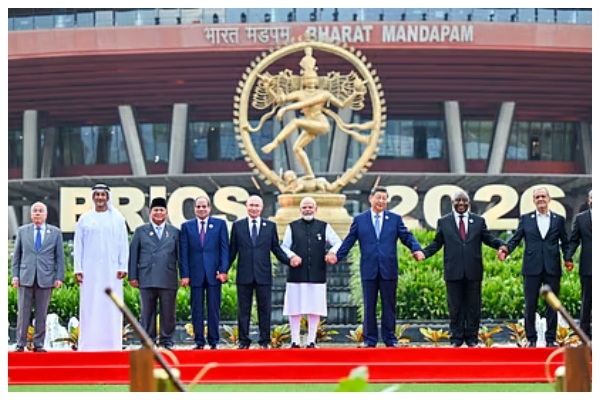
BRICS is no longer the relatively compact grouping of Brazil, Russia, India, China and South Africa with broadly comparable political and economic interests. It has expanded to include Egypt, Ethiopia, Indonesia, Iran and the UAE. It now brings together countries with different political systems, strategic priorities, economic interests and foreign-policy alignments. The larger the grouping becomes, the more difficult consensus becomes. India, therefore, had to do something more sophisticated than simply preside over a meeting. It had to perform the role of a bridge.
This is where New Delhi’s achievement becomes important. India did not attempt to turn BRICS into an ideological or anti-Western alliance. Instead, it pushed the organisation towards practical cooperation and a larger role for the Global South in international decision-making. Prime Minister Narendra Modi argued that the Global South remains at the “front row” of global crises but at the “back row” of decision-making. That formulation captures the larger Indian ambition.
ALSO READ: Muslim Satyashodhak Mandal Exposes Rahul Gandhi
The New Delhi Declaration's emphasis on cooperation, resilience, innovation, sustainability, development and multilateralism reflects this approach. The grouping has also continued discussions on cross-border payments, financial cooperation and reform of international financial institutions. But perhaps the most revealing evidence of India’s diplomatic influence came outside the formal declaration.
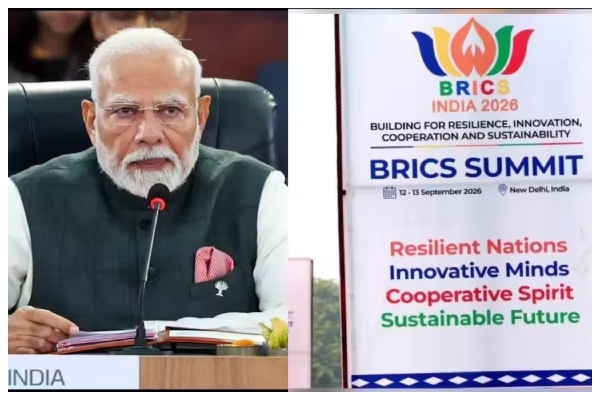
This does not mean that India-China differences have disappeared. They have not. Nor does a summit photograph erase the strategic competition between the two countries. But diplomacy is precisely about maintaining communication despite differences. The same principle applies to India’s engagement with Russia, the UAE, Iran and other BRICS members. This is perhaps the central lesson of the New Delhi summit - a multipolar world cannot function if every disagreement becomes a permanent confrontation. India has demonstrated that there is space between appeasement and confrontation, between alignment and isolation. That space is diplomacy.
ALSO READ: UNSC seats to 'terror crackdown': How India steered the BRICS 'New Delhi Declaration'
The New Delhi summit thus represents something larger than a successful international event. It is an assertion of India’s growing diplomatic weight and of its belief that the Global South need not choose between competing power blocs. It can have its own voice, its own interests and its own diplomatic space.
The world is increasingly fragmented. Wars, trade disputes, sanctions, strategic rivalries and economic uncertainties are pulling countries in different directions. In such an environment, bringing diverse nations to one table and persuading them to leave that table with a common declaration is itself an achievement. India did not merely host BRICS. It showed that, even in a divided world, consensus is still possible.

Editor's Desk
Editor's Desk