Back to Joint Families: Sometimes Looking Back Is Moving Forward!?
This is where the discussion about joint families becomes relevant.
Total Views |


- Remilla Avadhani
Going back is usually considered the opposite of progress. In a rapidly changing society, moving from joint families to nuclear families has been seen as a natural sign of modernization. But, India’s changing social and demographic realities are forcing us to ask a different question: What if some things from the past are worth bringing back?
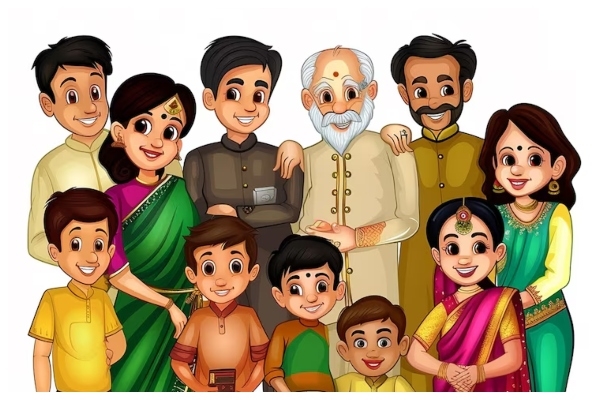
The joint family may not return in the form in which it existed a few decades ago. But, its values togetherness, shared responsibility and intergenerational support could have an important role in addressing some of the problems confronting modern society.
Recently, I listened to Together, a book by Vivek H. Murthy, the 19th Surgeon General of the United States. As the son of Indian immigrants, Murthy writes with an understanding of the importance of family and community. One of the central concerns he discusses is loneliness and the damaging effect of social isolation. His message is particularly relevant to India at a time when families are becoming smaller and increasingly dispersed.
The discussion is not merely academic. It has now entered the policy debate.
Andhra Pradesh Chief Minister N. Chandrababu Naidu recently asked officials not to encourage the fragmentation of families merely for obtaining government welfare benefits. He suggested that the family should remain the basic unit for welfare delivery and that officials should explore ways of providing benefits to eligible members without encouraging families to split into smaller units.
The Chief Minister's observation points to a larger issue. When government benefits become an incentive for families to divide themselves into smaller units, welfare policy can unintentionally influence social structures. The question is whether welfare delivery should strengthen families or encourage their fragmentation.
The strength of togetherness
The traditional joint family had many shortcomings. Privacy was limited, individual choices could be restricted and younger members sometimes had to accept decisions made by elders. The nuclear family emerged partly as a response to these limitations.
But, the joint family also offered something that is becoming increasingly difficult to find today: a built-in support system.
ALSO READ: Tarun Tejpal Surrenders in Goa, Begins 10-Year Jail Term
The presence of grandparents was particularly valuable for children. When parents were busy at work, children could return home to familiar faces. Grandparents could provide companionship, supervision and the wisdom that comes with experience.
The relationship also worked in the opposite direction. Grandchildren gave older people a sense of involvement and purpose.
This intergenerational connection is something modern society is struggling to recreate.
A demographic warning
The debate has become more urgent because India is entering a new demographic phase.
For decades, population policy was focused primarily on controlling population growth. Today, several States are beginning to worry about declining fertility and an ageing population.
Andhra Pradesh is among the States that have started discussing policies to encourage larger families. The State government has spoken about the idea of Pillale Sampada children are wealth. Chief Minister Naidu has also announced incentives for families having a third and fourth child, including ₹30,000 for a third child and ₹40,000 for a fourth child.
The underlying concern is understandable. Andhra Pradesh's total fertility rate has fallen to around 1.5 children per woman, substantially below the replacement level of 2.1.
Tamil Nadu faces an even sharper demographic challenge, with its fertility rate estimated at around 1.3–1.4. A significant and growing share of its population is elderly.
These figures are not merely statistics. They point towards a future in which there could be fewer working-age people supporting a growing elderly population.
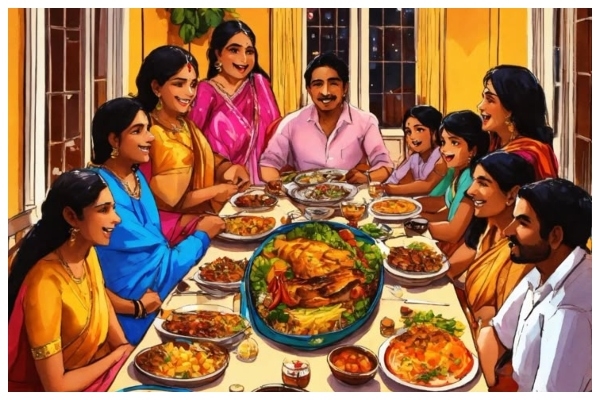
However, encouraging larger families cannot be reduced to financial incentives.
Young couples make decisions about children based on many factors: employment, housing costs, education expenses, childcare, women's careers and economic security. A cash incentive by itself may not change these calculations.
What governments can do is create an environment in which raising children becomes less economically and socially difficult.
This is where the discussion about joint families becomes relevant.
A family that can share childcare, household responsibilities and support for elderly members may be better equipped to manage the pressures of modern life. But that does not mean people should be forced to live under one roof. The joint family of the future may look very different from the traditional one.
Families may live separately but remain closely connected. Parents and children may live in different cities but share responsibilities. Grandparents may spend part of the year with their children and grandchildren. Technology can maintain communication when physical proximity is impossible.
The objective should be togetherness, not compulsion.
ALSO READ: The Empire That Drew the World’s Map, Now Faces Its Own Partition
The real challenge before India is not whether to return to joint families or continue with nuclear families. It is whether we can create a family structure that combines the best features of both.
The nuclear family has given individuals greater independence and privacy. The joint family provided collective strength and emotional security. There is no reason why modern society cannot combine these advantages.
Government policy should therefore recognise the family as more than a unit for distributing welfare benefits. Extended family also an important social institution that provides care, companionship and security.
Loneliness cannot be solved by government schemes alone. Nor can ageing, childcare and emotional support be addressed entirely through institutions.
Sometimes the solution to a new problem lies in an old idea.
India does not have to return to the past. But it can recover the values that worked in the past and adapt them to the present.
Looking back, may not be a step backwards. It could be a step towards a stronger and more connected future.