The Empire That Drew the World’s Map, Now Faces Its Own Partition
NewsBharati 15-Sep-2026 12:58:16 PM
Total Views |


“The sun never sets on the British Empire.” Once, this was the boast of the world's greatest imperial power. Britain ruled territories on which the sun was always shining. It conquered, divided, administered and redrew the political geography of continents. Now look at Britain.
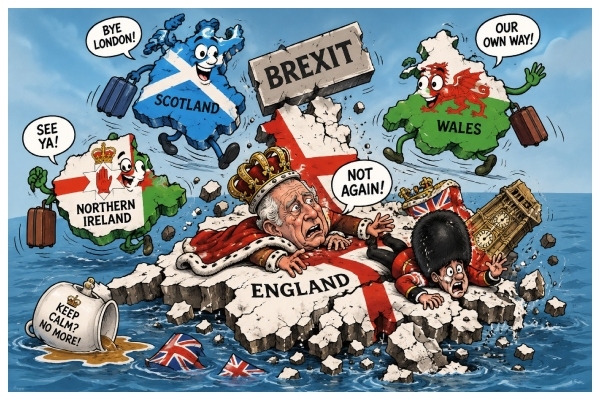
The leaders of Scotland, Wales and Northern Ireland have come together to assert their right to self-determination and demand constitutional change. Scotland wants another independence referendum; Sinn Féin wants a vote on Irish reunification; Wales is demanding a radically different relationship with Westminster. For the first time, nationalist leaders from all three nations are openly coordinating the challenge to the Union.
The vocabulary of the empire has come home: sovereignty, self-determination, identity, consent, independence. This is not merely a Scottish problem. It is a crisis of the Westminster idea itself. Westminster became Britain's greatest political export. Parliamentary sovereignty, cabinet government and majority rule became the institutional grammar of much of the former British world. But Westminster has discovered an uncomfortable truth - A parliamentary majority can rule a state. It cannot manufacture loyalty to that state. That distinction is now haunting Britain.
England may constitute the overwhelming political weight of the United Kingdom, but Scotland is not an English county, Wales is not an English region and Northern Ireland is not simply another administrative unit. They have separate histories, identities and national political aspirations. For years Britain tried to square this circle through devolution. And here lies the delicious constitutional irony.
ALSO READ: India Becomes World’s Fourth-Largest Forex Reserve Holder, Reserves Touch Record $785.7 Billion
Scotland voted to remain in the European Union. Britain voted to leave. Westminster prevailed. For Scottish nationalists, the message was unmistakable: Scottish voters could be taken out of Europe despite voting to remain. The argument for independence acquired a new emotional weapon. What is the meaning of self-government if somebody else can overrule you on the biggest decision of your generation?
Britain once partitioned Ireland. Today Irish reunification is no longer a revolutionary slogan; it is a possibility recognised within the Good Friday constitutional framework. Sinn Féin is openly talking about a border poll. The former imperial power is therefore confronting, inside its own territory, precisely the principle that helped dismantle empires elsewhere - the right of a people to decide where its political future lies. There is a larger identity crisis beneath all this.
The old British identity was extraordinarily powerful because Britain had something bigger than Britain itself - the Empire gave Britain status, purpose and a global role. Empire disappeared. Then Europe became part of Britain's political future. Brexit rejected Europe.
This is where the demographic question. Britain has become more secular, more multicultural and more demographically diverse. That transformation does not explain Scottish or Welsh nationalism, nor can Muslim immigration be blamed for the possible breakup of the Union.
The danger is not diversity. The danger is the disappearance of a sufficiently powerful common identity. That is why Britain's crisis deserves attention in India. India inherited the Westminster system but did not inherit Britain's old imperial conception of political unity. Unity in India is a different kind of virtue, which western schools of thoughts are yet to understand. Despite several attempts, which are still going on, India remains one strong nation largely because of its unique DNA.
ALSO READ: UPI charge that exists only in Congress’s arithmetic
Britain once ruled the world with the confidence that its institutions could hold together an empire spread across continents. Today three of its own constituent nations are telling Westminster that they want the right to decide whether they remain inside the Union. The empire did not collapse because its map suddenly disappeared. It collapsed because the people inside the map stopped accepting the authority behind it.
Britain should understand the warning. The map may still say United Kingdom. The flag may still fly. Westminster may still legislate.
The empire that once believed it had the power to redraw everybody else's map is now discovering that no country, however powerful, possesses a permanent right to draw its own map unchanged. The sun may once have never set on the British Empire. Today, the more immediate question is whether the United Kingdom itself can keep the sun from setting on the Union.

Editor's Desk
Editor's Desk