UPI charge that exists only in Congress’s arithmetic
The real thing being charged here is not 0.5% on UPI payments, but 100% on public belief. And Indians deserve better than political parties trying to make a profit out of a thoughtlessly crafted public confusion.
Total Views |


Apparently, India’s digital payment revolution now requires a political footnote, saying "if you believe Congress, every UPI payment above ₹2,000 is about to become a 0.5% “loot” on ordinary Indians." A ₹5,000 payment allegedly means ₹25 to the government and a ₹10,000 payment, ₹50. There is only one problem with this dramatic arithmetic, that the government has not announced such a consumer charge.
The Finance Ministry’s clarification is not so dramatic. It clearly states that consumers will not be charged for making UPI payments. Person-to-person transactions remain free. The government has said that, if Merchant Discount Rate (MDR) is introduced in future, it would apply only to a limited set of merchant transactions above a threshold, at a nominal rate, while the vast majority of merchant transactions would remain free.
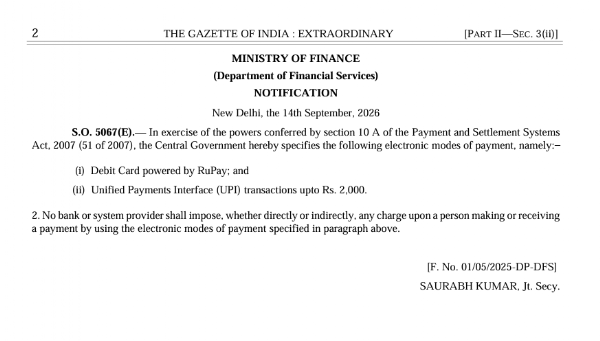
That distinction is the entire story. A merchant-side MDR is not a tax imposed on a citizen for using UPI. It is a payment-network charge between commercial participants such as banks, payment service providers and eligible merchants, intended to help sustain the infrastructure behind an instant, nationwide payment system. The customer does not suddenly receive a “₹25 government bill” because she bought something worth ₹5,000.
झूठ की दुकान Congress is once again spreading FAKE NEWS.
— Pradeep Bhandari(प्रदीप भंडारी)🇮🇳 (@pradip103) September 15, 2026
96% of UPI merchant (P2M) transactions are ₹2,000 or below — and they are 100% CHARGE-FREE.
RuPay debit-card payments remain CHARGE-FREE.
Consumers pay ZERO transaction charge. ZERO.
P2P UPI transactions remain… https://t.co/fZMxIKFYsW pic.twitter.com/HVQcjGKSmZ
In fact, the government has explicitly stated that the proposed legislative framework is an enabling provision aimed at UPI’s long-term sustainability, technological advancement, financial inclusion and resilience. The Ministry has also rejected claims that changes are being made to favour a particular industrial group, calling such reports false and misleading.
So where does the ₹2,000 figure come from? It is being dragged into a completely different argument. Existing government incentive schemes have used ₹2,000 as a threshold for incentivising low-value P2M transactions for small merchants. Under the 2024–25 scheme, transactions up to ₹2,000 for small merchants attracted zero MDR and an incentive, transactions above ₹2,000 also had zero MDR, but no incentive. That is very different from saying that consumers would be charged 0.5% above ₹2,000.
Congress's recent unfounded argument against the UPI-related notification is a classic example of political communication becoming creative writing. Something that frequently happens with Congress's political campaigning.
For a party that claims to defend ordinary citizens, frightening them with an imaginary ₹25 charge on a ₹5,000 payment is an odd way to demonstrate economic literacy. It converts a discussion about payment infrastructure into a fictional taxation story, and then attributes the fiction to the government.
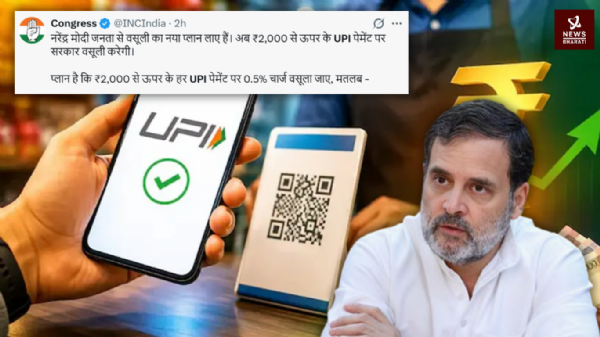
नरेंद्र मोदी जनता से वसूली का नया प्लान लाए हैं। अब ₹2,000 से ऊपर के UPI पेमेंट पर सरकार वसूली करेगी।
— Congress (@INCIndia) September 15, 2026
प्लान है कि ₹2,000 से ऊपर के हर UPI पेमेंट पर 0.5% चार्ज वसूला जाए, मतलब -
• अगर आपने ₹5,000 की खरीदारी की तो ₹25 का चार्ज लगेगा
• अगर ₹10,000 की खरीदारी की तो ₹50…
There is an ideological irony here. UPI is not a private corporate toll road. It is a public digital infrastructure developed by NPCI, an RBI-regulated entity. Its architecture has allowed India to build a payments ecosystem whose scale is extraordinary. NPCI recorded more than 24.5 billion UPI transactions in August 2026 alone. It is an achievement that millions can move money instantly, cheaply and interoperably, all owing to Indian innovation.
The public deserves facts before fury, especially when the subject is infrastructure that affects every household, shopkeeper, worker, student and entrepreneur across the country every single day. But expecting credibility from Congress, is a hopeless act. Criticism of government policy is indispensable to democracy. But criticism built on invented percentages and imaginary bills is not scrutiny. It is fear-mongering. Perhaps, that's all that the opposition has been doing since more than a decade.
The opposition may contest the policy, question future MDR structures or demand safeguards for small merchants. Those are legitimate arguments. But claiming that Narendra Modi has launched a 0.5% “recovery” from citizens when the government explicitly says consumers will pay no UPI transaction charge is not an argument. It is absolute misinformation.
The real thing being charged here is not 0.5% on UPI payments, but 100% on public belief. And Indians deserve better than political parties trying to make a profit out of a thoughtlessly crafted public confusion.
--