Nashik Kumbh 2027: Why the Bhagawad Gita remains a pilgrimage best-seller
Unlike a decorative souvenir, a copy of the Gita gives the pilgrim something to do after returning home.
Total Views |


At a pilgrimage centre, souvenirs are not always small, decorative objects or cheap pieces of jewelry that usually hold little financial value. For millions of devotees, the most meaningful object to carry home may be a book. (Bhagawad Gita)
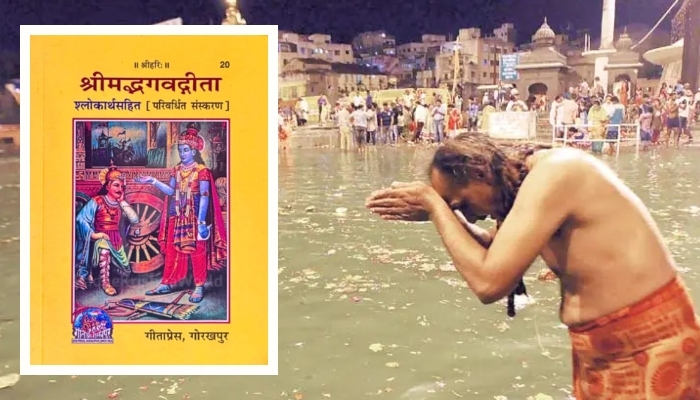
The scale of the market can be understood through the experience of Gita Press, Gorakhpur, one of India's largest publishers of Hindu religious literature. According to Gita Press, more than 16 crore copies of the Shrimad Bhagawad Gita have been published since its establishment in 1923. The organisation says it has published more than 41 crore books overall across 14 languages. That makes the Gita more than a religious classic. It is also one of India's most widely circulated religious books.
A pilgrimage souvenir with a purpose
Unlike a decorative souvenir, a copy of the Gita gives the pilgrim something to do after returning home. A Rudraksha mala may be worn. A framed image may be displayed. But a Gita can be read, studied, gifted, or used for daily recitation. That makes it particularly suited to pilgrimage retail.
There is also a powerful cultural practice behind the purchase. Taking a religious text home can be seen as extending the spiritual experience of the pilgrimage beyond the temple or bathing ghat. For a visitor to Nashik, buying a Gita after visiting the sacred sites of the city and Trimbakeshwar can therefore become part of the pilgrimage itself.
Affordable enough to reach the masses
Price is another reason for the Gita's extraordinary reach. Gita Press built much of its publishing model around producing religious literature at affordable prices. Its publications range from inexpensive small booklets to larger, more elaborate editions. The press has also published the Gita in multiple Indian languages, making it accessible to readers across linguistic communities.
There is another reason religious books perform differently from ordinary books: they can be purchased as gifts. A pilgrim may buy several copies, not just one. One could go to a parent, another to a child, another to a relative or friend. Some devotees may purchase copies as prasad after visiting a sacred place.
The Indian Express reported that increased pilgrim footfall at religious destinations such as Kashi Vishwanath and Ujjain had contributed to increased sales of Gita Press books, with pilgrims buying them from these locations as prasad. That gives the Gita a distribution network extending well beyond conventional bookstores.
A book that travels across generations
The Gita also benefits from something that most commercial products cannot easily replicate: intergenerational relevance. A pilgrim may purchase the same text that their parents or grandparents kept at home. It can become part of a family prayer room, be read during festivals, or be passed from one generation to another.
Its continued popularity therefore does not depend entirely on a new reader discovering it for the first time. Existing readers also become buyers, gifting copies to younger members of the family. This creates a remarkably durable cycle of demand.
Digital age, but physical book survives
Perhaps the most interesting part of the Gita's success is that it has persisted despite the rise of smartphones, e-books and online religious content. Gita Press's own figures show the continuing scale of physical publishing. The press says it has published over 16 crore copies of the Gita, while its overall catalogue spans thousands of religious publications.
_202609171654161697_H@@IGHT_400_W@@IDTH_700.jpg "bhagwad Gita")
Why Nashik could be significant
The scale of the forthcoming Nashik Simhastha makes the opportunity particularly large. Authorities are preparing for a projected 12 crore-plus visitors, compared with around 2.5 crore visitors during the 2015 Nashik Kumbh. The Maharashtra government has also approved a Rs 22,425.39 crore development plan for the Nashik-Trimbakeshwar Simhastha Kumbh.
More than a bestseller
The Bhagawad Gita's success at pilgrimage centres ultimately comes down to its ability to occupy several roles at once. It is scripture for the believer. It is a guide for the seeker. It is a gift for a family member. And at a pilgrimage, it becomes a tangible memory of the journey.
That combination helps explain why, despite changing technology and consumer habits, the Gita continues to move from pilgrimage stalls into Indian homes. When millions of devotees arrive in Nashik for Simhastha 2027, many will return with photographs, sacred objects and memories of the Godavari. And for a significant number, they may also carry home a small book containing a conversation that has travelled across centuries. The pilgrimage may end at the ghat. For the Gita, the journey often begins when the pilgrim takes it home.
Among these, few have the staying power of the Bhagawad Gita. As Nashik prepares for the 2027 Simhastha Kumbh, the ancient Hindu scripture is likely to occupy a familiar place at bookstalls, temple shops and temporary pilgrimage markets. Its appeal lies in an unusual combination: it is simultaneously a scripture, a spiritual guide, a gift and a relatively affordable reminder of a religious journey.
Image- Gita Press, Aaj Tak
The scale of the market can be understood through the experience of Gita Press, Gorakhpur, one of India's largest publishers of Hindu religious literature. According to Gita Press, more than 16 crore copies of the Shrimad Bhagawad Gita have been published since its establishment in 1923. The organisation says it has published more than 41 crore books overall across 14 languages. That makes the Gita more than a religious classic. It is also one of India's most widely circulated religious books.
A pilgrimage souvenir with a purpose
Unlike a decorative souvenir, a copy of the Gita gives the pilgrim something to do after returning home. A Rudraksha mala may be worn. A framed image may be displayed. But a Gita can be read, studied, gifted, or used for daily recitation. That makes it particularly suited to pilgrimage retail.
There is also a powerful cultural practice behind the purchase. Taking a religious text home can be seen as extending the spiritual experience of the pilgrimage beyond the temple or bathing ghat. For a visitor to Nashik, buying a Gita after visiting the sacred sites of the city and Trimbakeshwar can therefore become part of the pilgrimage itself.
Affordable enough to reach the masses
Price is another reason for the Gita's extraordinary reach. Gita Press built much of its publishing model around producing religious literature at affordable prices. Its publications range from inexpensive small booklets to larger, more elaborate editions. The press has also published the Gita in multiple Indian languages, making it accessible to readers across linguistic communities.
This matters enormously at a mass gathering such as Kumbh. A pilgrim does not need to spend thousands of rupees to take home a religious text. A relatively modest purchase can become a meaningful souvenir. And when millions of people pass through a pilgrimage economy, even low-value purchases can create a substantial market.
There is another reason religious books perform differently from ordinary books: they can be purchased as gifts. A pilgrim may buy several copies, not just one. One could go to a parent, another to a child, another to a relative or friend. Some devotees may purchase copies as prasad after visiting a sacred place.
The Indian Express reported that increased pilgrim footfall at religious destinations such as Kashi Vishwanath and Ujjain had contributed to increased sales of Gita Press books, with pilgrims buying them from these locations as prasad. That gives the Gita a distribution network extending well beyond conventional bookstores.
A book that travels across generations
The Gita also benefits from something that most commercial products cannot easily replicate: intergenerational relevance. A pilgrim may purchase the same text that their parents or grandparents kept at home. It can become part of a family prayer room, be read during festivals, or be passed from one generation to another.
Its continued popularity therefore does not depend entirely on a new reader discovering it for the first time. Existing readers also become buyers, gifting copies to younger members of the family. This creates a remarkably durable cycle of demand.
Digital age, but physical book survives
Perhaps the most interesting part of the Gita's success is that it has persisted despite the rise of smartphones, e-books and online religious content. Gita Press's own figures show the continuing scale of physical publishing. The press says it has published over 16 crore copies of the Gita, while its overall catalogue spans thousands of religious publications.
The reason may be partly emotional. A digital copy can provide access to the text. A physical Gita can become a keepsake. It can sit on a shelf, accompany a daily prayer, be carried during a journey or be handed to someone as a gift. In the context of pilgrimage, that physicality matters.
Image soure: Dainik Jagran
Why Nashik could be significant
The scale of the forthcoming Nashik Simhastha makes the opportunity particularly large. Authorities are preparing for a projected 12 crore-plus visitors, compared with around 2.5 crore visitors during the 2015 Nashik Kumbh. The Maharashtra government has also approved a Rs 22,425.39 crore development plan for the Nashik-Trimbakeshwar Simhastha Kumbh.
Such numbers underline the scale of the temporary pilgrimage economy that will emerge around the event, from accommodation and transport to food, religious articles and books. For religious publishers and booksellers, the Kumbh represents an unusual retail environment: an enormous audience arriving with a specific spiritual purpose and a willingness to take something meaningful home.
More than a bestseller
The Bhagawad Gita's success at pilgrimage centres ultimately comes down to its ability to occupy several roles at once. It is scripture for the believer. It is a guide for the seeker. It is a gift for a family member. And at a pilgrimage, it becomes a tangible memory of the journey.
That combination helps explain why, despite changing technology and consumer habits, the Gita continues to move from pilgrimage stalls into Indian homes. When millions of devotees arrive in Nashik for Simhastha 2027, many will return with photographs, sacred objects and memories of the Godavari. And for a significant number, they may also carry home a small book containing a conversation that has travelled across centuries. The pilgrimage may end at the ghat. For the Gita, the journey often begins when the pilgrim takes it home.