Karnataka: Congress’s Anti-Hindutva Laboratory
Total Views |


Karnataka is beginning to look less like an ordinary arena of political contest and more like a laboratory where the Congress is testing the limits of its particular brand of secular politics. The latest flashpoint is Ganeshotsav.
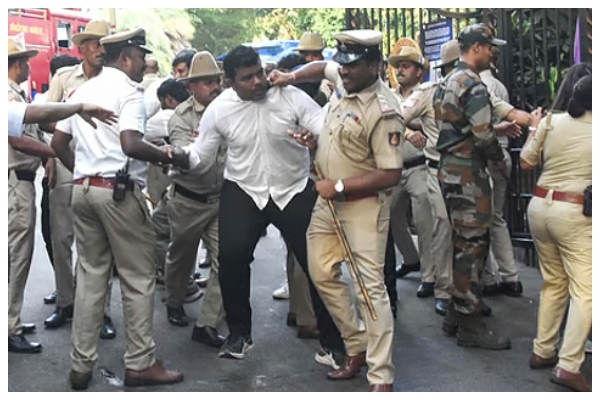 The police have denied imposing any blanket restriction and maintained that traditional routes remain available. That clarification cannot simply be ignored. A government is entitled to regulate religious processions for genuine law-and-order reasons. But the larger question remains - why do Hindu festivals and Hindu public expression so repeatedly become political flashpoints in Karnataka?
Ganeshotsav is not an obscure political invention. It is a deeply rooted public cultural tradition. The state has every right to regulate a procession, but it must demonstrate that the rules are neutral, proportionate and applied without religious discrimination. That question becomes sharper when the Ganeshotsav controversy is placed alongside Karnataka's recent decisions and statements.
Take Vande Mataram. The Karnataka government has directed that only the first two stanzas of Vande Mataram be sung at government functions, except when certain constitutional dignitaries are present. The order has now been challenged before the Karnataka High Court. A government may have administrative reasons for determining the format of a programme. But why should a national song require selective truncation at ordinary government functions? When such a decision comes from a government already involved in controversies over Hindu cultural organisations and festivals, it inevitably invites a political question.
Then comes Priyank Kharge. The Karnataka Home Minister's confrontation with the RSS is not a single stray comment. In 2025, he sought to prohibit RSS activities on government premises, including government and aided educational institutions, public grounds and other government land. In June 2026, the confrontation moved further. Kharge asked the RSS to disclose its legal status, organisational structure, funding, assets and other details, and said the organisation should comply with applicable laws. He also demanded that taxes applicable under law be paid.
In August, he went further, saying that the government was studying the RSS and its history and would act within the legal framework. He said the organisation would be brought within the legal framework.
Then came his striking formulation: “I cannot ban RSS because they don't exist.” His argument was that the RSS is not a registered legal entity. He also said that cases involving individuals associated with the RSS would be registered against those individuals rather than against an organisation without formal legal identity.
There is an important fact here which makes the political controversy even more interesting. Kharge's own statement in the Karnataka Legislative Council, as reported in August, indicated that no cases had been registered against the RSS in Karnataka concerning communal violence or related offences. The BJP has used that fact to challenge the minister's repeated targeting of the organisation.
The issue, therefore, is not whether the RSS should be above the law. No organisation should be. If there are legal violations, the government must act. But a government also needs a demonstrable legal basis before treating a major social organisation as a problem requiring special governmental attention. And this is where the Congress's Karnataka experiment becomes politically significant.
The RSS has been operating for a century. Its shakhas, social organisations and public activities are hardly hidden phenomena. Yet a Congress minister has repeatedly made its legal status, public activities, finances and presence on government premises a political issue.
An organisation associated with the Hindu nationalist tradition is subjected to questions about its existence, registration, finances and activities by a Congress minister. An individual as controversial as Umar Khalid is publicly described as a nationalist by the Karnataka Congress president. One may disagree with either position. But the juxtaposition cannot simply be wished away.
This is why the charge of an “anti-Hindu DNA” in Karnataka Congress politics has acquired political resonance among its critics. The phrase should not be used as a substitute for evidence. Congress leaders can legitimately argue that they are defending constitutional secularism, regulating public order, demanding financial transparency from organisations and protecting freedom of expression. But secularism cannot mean that Hindu public expression is perpetually treated as something requiring suspicion, restriction or administrative management, while political sympathy is extended towards personalities whose nationalism is deeply contested.
The Constitution does not ask the state to become culturally hostile to the majority religion. It asks the state to treat citizens equally. That distinction is fundamental. A Ganesh procession cannot claim exemption from law merely because it is a Hindu procession. But neither can a government impose rules on it that are perceived as religiously selective.
Once politics begins with the assumption that a particular cultural tradition, organisation or ideological family is inherently suspect, every subsequent administrative decision acquires a political colour. Karnataka's Congress government may reject the charge that it is anti-Hindu. It may insist that its actions are driven by constitutionalism, law and order and secular governance. Then it has a simple way to prove it. Apply the same standard to everyone.
Let Ganeshotsav be regulated by law, not by religious identity. Let Vande Mataram be treated with the dignity appropriate to a national song. Let the RSS be subjected to the same legal scrutiny as every other organisation. Let minority organisations face identical standards wherever the law requires it. And let political leaders be judged by one constitutional yardstick rather than by the identity of the people they defend or oppose. Because secularism that becomes selective is not secularism at all.
And if Karnataka continues to produce controversies in which Ganeshotsav, Vande Mataram and the RSS occupy the side of suspicion while Umar Khalid is described as a nationalist, the Congress cannot indefinitely dismiss the emerging pattern as propaganda by its opponents.
The question is no longer merely what Congress says it believes. The question is what kind of state its politics is beginning to produce. Karnataka may indeed become a laboratory. But the experiment cannot be allowed to test whether secularism can survive by making Hindu identity increasingly apologetic in its own civilisational home.
In T. Narasipura in Mysuru district, a controversy erupted over alleged police restrictions on the Ganesh procession. BJP leaders accused the administration of imposing conditions relating to the procession route, slogans and firecrackers, particularly in areas near a mosque. Leader of Opposition R. Ashoka and other BJP leaders protested and were detained. Chief Minister D.K. Shivakumar subsequently directed the police to remain alert amid the escalating dispute.
Ganeshotsav is not an obscure political invention. It is a deeply rooted public cultural tradition. The state has every right to regulate a procession, but it must demonstrate that the rules are neutral, proportionate and applied without religious discrimination. That question becomes sharper when the Ganeshotsav controversy is placed alongside Karnataka's recent decisions and statements.
Take Vande Mataram. The Karnataka government has directed that only the first two stanzas of Vande Mataram be sung at government functions, except when certain constitutional dignitaries are present. The order has now been challenged before the Karnataka High Court. A government may have administrative reasons for determining the format of a programme. But why should a national song require selective truncation at ordinary government functions? When such a decision comes from a government already involved in controversies over Hindu cultural organisations and festivals, it inevitably invites a political question.
ALSO READ: Disha Salian Case: Father Serves Rs 500 Crore Legal Notice On Aaditya Thackeray, Anil Deshmukh
In August, he went further, saying that the government was studying the RSS and its history and would act within the legal framework. He said the organisation would be brought within the legal framework.
Then came his striking formulation: “I cannot ban RSS because they don't exist.” His argument was that the RSS is not a registered legal entity. He also said that cases involving individuals associated with the RSS would be registered against those individuals rather than against an organisation without formal legal identity.
There is an important fact here which makes the political controversy even more interesting. Kharge's own statement in the Karnataka Legislative Council, as reported in August, indicated that no cases had been registered against the RSS in Karnataka concerning communal violence or related offences. The BJP has used that fact to challenge the minister's repeated targeting of the organisation.
The issue, therefore, is not whether the RSS should be above the law. No organisation should be. If there are legal violations, the government must act. But a government also needs a demonstrable legal basis before treating a major social organisation as a problem requiring special governmental attention. And this is where the Congress's Karnataka experiment becomes politically significant.
The RSS has been operating for a century. Its shakhas, social organisations and public activities are hardly hidden phenomena. Yet a Congress minister has repeatedly made its legal status, public activities, finances and presence on government premises a political issue.
At the same time, Karnataka Congress president B.K. Hariprasad has now described jailed activist Umar Khalid as a “nationalist” while attacking the ABVP over a proposed documentary screening at the National Law School of India University. The documentary screening was subsequently postponed. Hariprasad's statement is his political position; it does not establish Khalid's legal guilt or innocence. But politically, the contrast is striking.
An organisation associated with the Hindu nationalist tradition is subjected to questions about its existence, registration, finances and activities by a Congress minister. An individual as controversial as Umar Khalid is publicly described as a nationalist by the Karnataka Congress president. One may disagree with either position. But the juxtaposition cannot simply be wished away.
This is why the charge of an “anti-Hindu DNA” in Karnataka Congress politics has acquired political resonance among its critics. The phrase should not be used as a substitute for evidence. Congress leaders can legitimately argue that they are defending constitutional secularism, regulating public order, demanding financial transparency from organisations and protecting freedom of expression. But secularism cannot mean that Hindu public expression is perpetually treated as something requiring suspicion, restriction or administrative management, while political sympathy is extended towards personalities whose nationalism is deeply contested.
The Constitution does not ask the state to become culturally hostile to the majority religion. It asks the state to treat citizens equally. That distinction is fundamental. A Ganesh procession cannot claim exemption from law merely because it is a Hindu procession. But neither can a government impose rules on it that are perceived as religiously selective.
ALSO READ: Cong again suffers from Vote-Bank Politics! Karnataka falls into an energy crisis
The same principle applies to the RSS. If there are legal violations, prosecute them. If public premises are being misused, regulate their use. If finances violate the law, investigate them. But the state should not turn ideological hostility into an administrative principle. That is the danger of the laboratory model.
Let Ganeshotsav be regulated by law, not by religious identity. Let Vande Mataram be treated with the dignity appropriate to a national song. Let the RSS be subjected to the same legal scrutiny as every other organisation. Let minority organisations face identical standards wherever the law requires it. And let political leaders be judged by one constitutional yardstick rather than by the identity of the people they defend or oppose. Because secularism that becomes selective is not secularism at all.
And if Karnataka continues to produce controversies in which Ganeshotsav, Vande Mataram and the RSS occupy the side of suspicion while Umar Khalid is described as a nationalist, the Congress cannot indefinitely dismiss the emerging pattern as propaganda by its opponents.
The question is no longer merely what Congress says it believes. The question is what kind of state its politics is beginning to produce. Karnataka may indeed become a laboratory. But the experiment cannot be allowed to test whether secularism can survive by making Hindu identity increasingly apologetic in its own civilisational home.