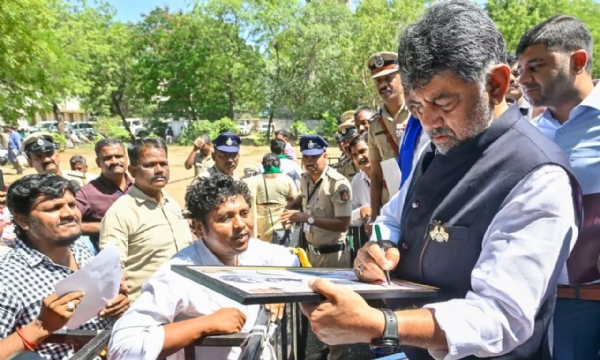
On Sep 18, 2026, the historic coastal city of Mangaluru bore witness to an emotional and administrative homecoming. In a landmark decision that bridges political governance with the deepest chords of cultural identity, the Karnataka Cabinet formally recognized 'Tulu' as the state’s second additional official language. The announcement, delivered by Chief Minister D K Shivakumar following a Cabinet session at the Praja Soudha, marks the culmination of a relentless, generations-long struggle by the Tulu-speaking community. For nearly one crore Tuluvas globally, the resolution transitions their beloved 'Appe Bashe' (mother tongue) from an oral treasure to a recognized pillar of the state's diverse self-identity.
Blueprint of the Decision:
The Cabinet's resolution provides the language with statutory validation for administrative purposes. Shared via an official communique from the Chief Minister’s Office (CMO), 'Tulu' will function as the "second additional administrative language" across its primary strongholds of Dakshina Kannada and Udupi districts, as well as parts of neighboring Chikkamagaluru and Shivamogga.
To catalyze this administrative integration, the state government approved an initial recurring allocation of ₹82 lakh annually. This fund is explicitly earmarked for translation services, government employee training, and public structural updates overseen by the respective district administrations. The decision coincided with a broader package including a separate tourism policy for coastal and Malnad districts and a historic draft notification inviting public suggestions to rename Dakshina Kannada district to Mangaluru district, further anchoring the region’s distinct historical geography.
Legacy of over two millennia
Unlike how it was established over the years, 'Tulu' is not a mere regional dialect. It is recognized by linguists as the fifth major Dravidian language, possessing a classical heritage stretching back over 2,000 years. Complete with its own ancient script, 'Tulu' possesses a sophisticated literary tradition, ranging from historical epics to an incredibly rich wealth of oral folk literature known as 'Paddanas'.
Its preservation has long held international academic interest, finding its way into research modules at premier European institutions in Germany and France. Furthermore, its modernization has evolved digitally, achieving integration into
global utilities like Google Translate, quite recently. Yet, despite this formidable global footprint, the language lacked domestic statutory validation within its own birthplace, a missing link in the state's approach that has finally been mended.
History of a relentless struggle
The road to official recognition has been paved with unwavering persistence. For decades, local socio-cultural organizations, literary scholars, and coastal representatives pushed for structural intervention. The movement saw intermittent political promises, as early as 2008, former Chief Minister B S Yediyurappa had expressed intent to accord it official status.
The structural foundation for the current cabinet decision was laid by an expert panel established under the leadership of renowned educationist
Dr M. Mohan Alva. The Alva Committee performed an extensive audit of the language’s history, inscriptions, and cultural mechanics, presenting a definitive report to the state government.
The cause saw a modern, digital resurgence through youth-led advocacy groups like '
Jai Tulunad'. Merely days before the final cabinet assembly, a massive online movement trended extensively on social media platform X under the campaign
#TuluOfficialinKA_KL, demanding that the state cross the final administrative finish line.
Reaffirming the Soul of Karnataka
Throughout this long journey, the core essence of the movement remained deeply rooted in a pride that complements, rather than competes with, the broader state identity. Activists successfully bridged any perceived divide with the harmonizing slogan, “Kannada ulisi, Tulu belesi” (Preserve Kannada, grow Tulu). Proponents consistently reiterated that the move does not challenge the sovereignty of Kannada as the state's primary language. Instead, this additional status serves to honor the multifaceted roots that make Karnataka whole. It acknowledges that the identity of the state thrives when its individual cultural tributaries are allowed to flow with dignity.
Empowering the future
For the Tuluva community, this milestone alters the socio-educational circumstances in the state, for the coming generations. The official designation opens up avenues for structured educational integration, moving Tulu beyond just a voluntary tertiary script into a well-funded academic option. It guarantees that administrative applications, land records, local government notices, and civic services in the coastal region will eventually be accessible in the native language of the soil, which is extremely important.
Ultimately, this executive order provides a platform of dignity, ensuring that the ancient language of 'Tulunadu' will not only survive in historical texts but continue to actively thrive within the machinery of modern governance.