Bhagwat’s Message to Gen Z: Dharma Is About How You Live
Total Views |


Mohan Bhagwat’s message to Gen Z in Ujjain can be reduced to a simple proposition: dharma is not something to inherit, perform and eventually retire into. It is something to live.
Young Indians today have greater individual choice than previous generations. They are connected to the world through technology, exposed to competing ideas and increasingly accustomed to defining themselves on their own terms. Bhagwat’s question is essentially: What guides those choices?
His answer is dharma.
A person's putra dharma, raj dharma or manav dharma is not primarily about what that person professes to believe. It is about what that person owes to others and how that responsibility is discharged.
That makes dharma less a matter of identity and more a matter of accountability.
Bhagwat also challenged the idea that India's civilisational texts are subjects to be discovered only in later life. The Gita and the Ramayana, in his formulation, are not retirement reading. Their questions about duty, desire, conflict, responsibility and self-control belong to the period when young people are making consequential choices.
There is another dimension to his message. Bhagwat spoke of respecting different forms of worship while remaining rooted in one's own. His emphasis was therefore on coexistence without requiring the abandonment of one's own tradition.
He also warned against the egoistic belief that human beings can control everything. In an age of artificial intelligence, instant communication and extraordinary technological power, that warning acquires a contemporary meaning - capability does not automatically produce wisdom.
The environmental dimension follows naturally. If dharma means responsible conduct, then treating nature merely as an unlimited resource becomes a moral question, not just an ecological one.
This is ultimately what makes Bhagwat's appeal to Gen Z different from a conventional call to religiosity. He is asking a younger generation to think about duty before entitlement, responsibility alongside freedom, and restraint alongside power. Whether Gen Z accepts that framework is another matter. But the proposition is clear: Dharma is not about what you call yourself. It is about how you conduct yourself. And that is a conversation that belongs to the young as much as to anyone else.
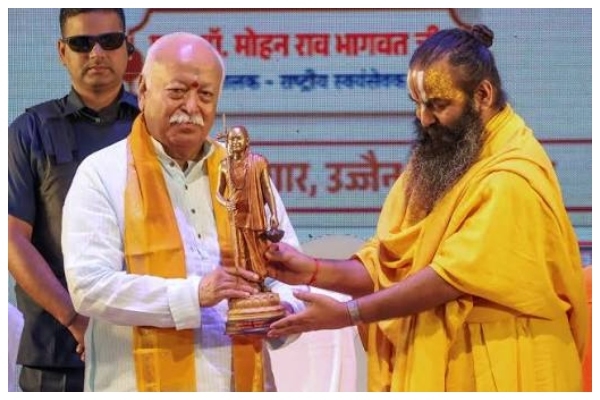
Addressing young participants at the Yuva Dharma Sansad, the RSS chief placed dharma in a much wider frame than religion. Religion can concern faith, worship and ritual. Dharma, in the Indic conception he invoked, concerns conduct, responsibility and the duties that accompany one’s place in family, society and the world.
That distinction is particularly relevant to Gen Z.Young Indians today have greater individual choice than previous generations. They are connected to the world through technology, exposed to competing ideas and increasingly accustomed to defining themselves on their own terms. Bhagwat’s question is essentially: What guides those choices?
His answer is dharma.
ALSO READ: The Umar Khalid Syndrome
That makes dharma less a matter of identity and more a matter of accountability.
Bhagwat also challenged the idea that India's civilisational texts are subjects to be discovered only in later life. The Gita and the Ramayana, in his formulation, are not retirement reading. Their questions about duty, desire, conflict, responsibility and self-control belong to the period when young people are making consequential choices.
There is another dimension to his message. Bhagwat spoke of respecting different forms of worship while remaining rooted in one's own. His emphasis was therefore on coexistence without requiring the abandonment of one's own tradition.
ALSO READ: Kohat Mosque Blast in Pak Kills 21, More Than 80 Injured
The environmental dimension follows naturally. If dharma means responsible conduct, then treating nature merely as an unlimited resource becomes a moral question, not just an ecological one.
This is ultimately what makes Bhagwat's appeal to Gen Z different from a conventional call to religiosity. He is asking a younger generation to think about duty before entitlement, responsibility alongside freedom, and restraint alongside power. Whether Gen Z accepts that framework is another matter. But the proposition is clear: Dharma is not about what you call yourself. It is about how you conduct yourself. And that is a conversation that belongs to the young as much as to anyone else.