Greenland and the New Face of Imperialism
Total Views |


Greenland has suddenly become much more than a frozen Arctic territory. It has become a test of how power will be exercised in the 21st century. The emerging agreement between the United States, Denmark and Greenland may leave Greenland formally under Danish sovereignty, but it raises a much larger question - can a powerful country exercise strategic control over another territory without formally acquiring it?
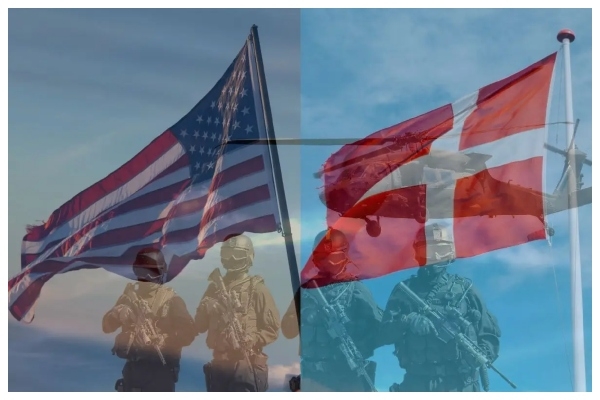 This distinction between sovereignty and control is at the heart of the Greenland story. The old imperialism was straightforward. A powerful country conquered territory, planted its flag and ruled the people. The new form can be much more sophisticated. It can leave the flag where it is while securing military access, strategic infrastructure, control over security arrangements and the ability to prevent rival powers from entering. In other words, influence without formal ownership.
If the reported arrangement gives Washington permanent security control while simultaneously preventing its adversaries from establishing bases or making sensitive investments, the United States would acquire an extraordinary strategic position without formally acquiring Greenland. That is not classical colonialism. But neither is it merely an ordinary defence arrangement. It raises the possibility of what may be called imperialism without annexation.
It also explains why the comparison with Russia's conduct in Eastern Europe inevitably arises. The two situations are obviously not identical. Russia's actions in Ukraine involved military force and territorial conquest; Greenland's present arrangement is being negotiated between governments and is being presented as a security agreement. But there is a common strategic question - how far can a major power go in asserting that its own security interests justify exceptional influence over strategically important territory?
The logic is familiar: a great power wants to ensure that a strategically critical territory cannot be used by its rivals. But there is a deeper danger here.
If every major power begins defining strategically important territories according to its own security requirements, the principle of sovereign equality becomes increasingly conditional. America wants Greenland secure from its adversaries. Russia has long argued that its security interests require a particular strategic environment in Eastern Europe. China increasingly speaks of its core interests and strategic space in its own neighbourhood.
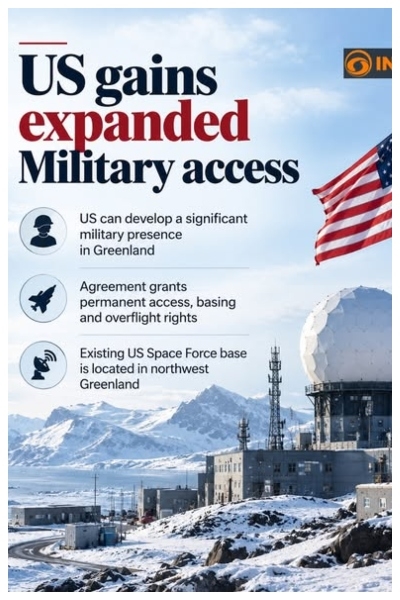
The vocabulary differs. The underlying reality is the return of great-power geopolitics. And the Arctic is rapidly becoming one of its most important arenas. Climate change, emerging shipping routes, minerals, energy resources and military geography are increasing the strategic importance of the region. Greenland's location between North America and Europe gives it extraordinary significance. The United States already operates the Pituffik Space Base there. The new agreement would potentially deepen America's military footprint while restricting the strategic presence of competitors.
 India may not be an Arctic territorial power, but it has scientific, economic, environmental and strategic interests in the region. More importantly, India has a direct interest in the evolution of the international rules governing great-power behaviour.
India's foreign policy has consistently emphasised strategic autonomy. That principle becomes increasingly important in a world where power is no longer exercised only through formal alliances or territorial acquisition. It can be exercised through bases, ports, infrastructure, technology, supply chains, resources and security arrangements. The Greenland episode offers India an important lesson - strategic dependence can become almost as consequential as formal loss of sovereignty.
India therefore need not look at Greenland through a simplistic pro-American or anti-American lens. Nor should it equate the United States' Greenland arrangement with Russia's actions in Ukraine. The more useful question is whether the international community is entering an era in which powerful states increasingly seek strategic dominance over territories without necessarily seeking formal ownership.That would represent a profound change in the grammar of international politics.
The 19th century was the age of territorial empires. The 20th century saw ideological blocs, military alliances and spheres of influence. The 21st century may produce something different: strategic empires without formal empires. A country need not own the territory if it can determine who may establish a military presence there, what strategic investments may enter it and how its security environment is shaped.
That is the real significance of Greenland.
The question is no longer simply “Who owns Greenland?” The more consequential question is - “Who has the power to decide what happens there?” If the answer increasingly becomes the stronger power rather than the formally sovereign authority, the world will have to confront a new form of imperialism—one in which the map does not change, but power over the map does. This is much closer to the original 900-word argument you were referring to, rather than the substitute version I gave you earlier.
That question is more important than the immediate diplomatic settlement. US President Donald Trump has described the agreement as giving America “permanent control” over Greenland’s security and said Washington would develop a larger military presence there. Denmark and Greenland, however, insist that their sovereignty remains intact. The precise text of the agreement has not yet been made public, and it is expected to be formally signed and subjected to the necessary parliamentary processes.
If the reported arrangement gives Washington permanent security control while simultaneously preventing its adversaries from establishing bases or making sensitive investments, the United States would acquire an extraordinary strategic position without formally acquiring Greenland. That is not classical colonialism. But neither is it merely an ordinary defence arrangement. It raises the possibility of what may be called imperialism without annexation.
ALSO READ: Rahul Gandhi, Ask Your Mother About Her Voter-List Entry
The distinction matters because the international system has traditionally treated sovereignty as the fundamental principle of relations between states. But sovereignty is meaningful only when the sovereign retains meaningful freedom of action. If a territory remains legally independent or autonomous but another power acquires overwhelming influence over its security and strategic choices, the legal map may remain unchanged while the geopolitical map changes dramatically. That is why Greenland cannot be viewed merely as an American-Danish dispute.
For Russia, the argument has centred on strategic depth and preventing hostile military structures from approaching its borders. For the United States, Greenland is being viewed through the Arctic, North Atlantic, military and geopolitical competition with Russia and China.
If every major power begins defining strategically important territories according to its own security requirements, the principle of sovereign equality becomes increasingly conditional. America wants Greenland secure from its adversaries. Russia has long argued that its security interests require a particular strategic environment in Eastern Europe. China increasingly speaks of its core interests and strategic space in its own neighbourhood.
The vocabulary differs. The underlying reality is the return of great-power geopolitics. And the Arctic is rapidly becoming one of its most important arenas. Climate change, emerging shipping routes, minerals, energy resources and military geography are increasing the strategic importance of the region. Greenland's location between North America and Europe gives it extraordinary significance. The United States already operates the Pituffik Space Base there. The new agreement would potentially deepen America's military footprint while restricting the strategic presence of competitors.
For China and Russia, this is therefore not an insignificant development. For India, it should be watched with equal seriousness.
India's foreign policy has consistently emphasised strategic autonomy. That principle becomes increasingly important in a world where power is no longer exercised only through formal alliances or territorial acquisition. It can be exercised through bases, ports, infrastructure, technology, supply chains, resources and security arrangements. The Greenland episode offers India an important lesson - strategic dependence can become almost as consequential as formal loss of sovereignty.
India therefore need not look at Greenland through a simplistic pro-American or anti-American lens. Nor should it equate the United States' Greenland arrangement with Russia's actions in Ukraine. The more useful question is whether the international community is entering an era in which powerful states increasingly seek strategic dominance over territories without necessarily seeking formal ownership.That would represent a profound change in the grammar of international politics.
ALSO READ: Major boost to domestic gas production! ONGC finds gas near Odisha coast in Mahanadi
That is the real significance of Greenland.
The question is no longer simply “Who owns Greenland?” The more consequential question is - “Who has the power to decide what happens there?” If the answer increasingly becomes the stronger power rather than the formally sovereign authority, the world will have to confront a new form of imperialism—one in which the map does not change, but power over the map does. This is much closer to the original 900-word argument you were referring to, rather than the substitute version I gave you earlier.