India and New Zealand Seal Historic FTA for Massive Growth
Massive Wins for Indian STEM Graduates and Skilled Professionals in New Zealand


New Delhi, Sep 22. In a historic economic move between India and New Zealand, the two countries have officially announced that their landmark Free Trade Agreement (FTA) will enter into force on Oct 20 this year.
The discussion follows a recent meeting between India’s Commerce and Industry Minister, Piyush Goyal, and New Zealand’s Minister for Trade and Investment, Todd McClay, and the passage of the trade legislation by the New Zealand Parliament.
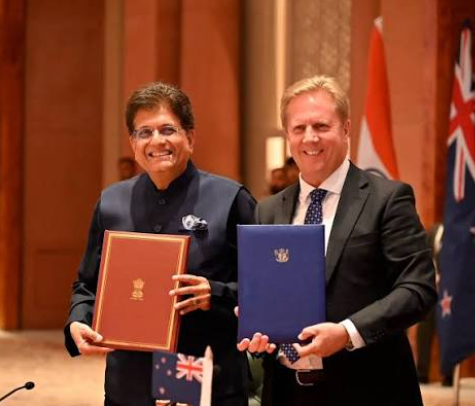
As per the data, the agreement aims to achieve economic growth, operating under a roadmap to double two-way trade in goods and services to NZ$7 billion, almost ₹35,000 crore by 2030. Bilateral merchandise trade stood at approximately USD 1.1 billion in 2025-26. With immediate effect (Oct 20), New Zealand will provide 100% duty-free market access on all tariff lines, removing peak border duties of up to 10% on Indian exports like textiles, apparel, leather, footwear, gems, and engineering goods. Indian factories will also get tariff-free access to raw materials like wooden logs, coking coal, and metal scrap.
Truly delighted to announce, along with my friend Mr. Todd McClay, New Zealand's Minister for Trade & Investment, joining virtually, that the India-New Zealand FTA will enter into force on 20th October 2026, on the occasion of Vijay Dashami.
— Piyush Goyal (@PiyushGoyal) September 21, 2026
Highlighted the joint efforts of both… pic.twitter.com/iTDQ1O43V4
To protect the domestic economy and local livelihoods, India has kept 29.97% of its tariff lines completely excluded from tax cuts. The sensitive products, such as milk products, dairy products, and animal meat excluding sheep, are key agricultural commodities and, along with sugar and edible oils, will receive zero concessions. Only a few tariff lines cover New Zealand apples, kiwifruit, and Mānuka honey; these products will be allowed under strict Tariff Rate Quotas TRQ. These imports will be highly regulated with Minimum Import Prices (MIP) and seasonal import windows to avoid local market disruption.
How are Indians benefiting?
This deal also opens massive pathways for India's services sector, students, and young professionals. New Zealand has formally committed to facilitating USD 20 billion in investment into India to support agriculture, manufacturing, infrastructure, and startups. The deal secures a dedicated quota of 5,000 Temporary Employment Entry visas for skilled Indians at any given time, alongside 1,000 annual Working Holiday visas. Indian students can also benefit from uncapped student mobility with guaranteed post-study work rights of up to three years for Science, Technology, Engineering, and Mathematics graduates and four years for doctoral scholars.