'Heikru Hidongba' connects Manipur to the soul of 'Bharatvarsha'
The resilience of the Meitei cultural spirit, preserved for over a thousand years, is proof that regimes may change and conflicts may test the social fabric, but the civilizational foundations of Manipur remain unshakable.
Total Views |


In Northeast India, particularly Manipur, external pressures and subversive narratives have attempted to fracture cultural integrity. And this has been happening since decades. Yet, the spectacle of a thousand-year-old tradition flourishing openly in Imphal shatters those narratives.
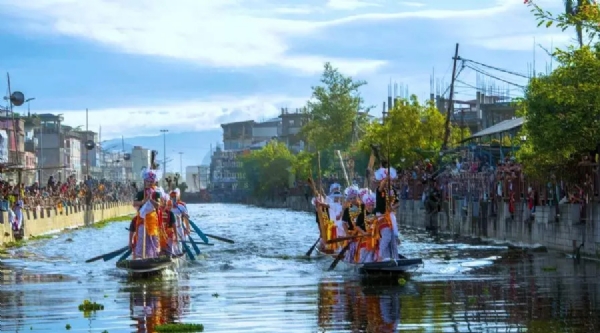
Recently, former Manipur Chief Minister N. Biren Singh took to X (formerly Twitter) to share his reflections on witnessing 'Heikru Hidongba', one of Manipur’s oldest and most sacred traditional boat racing festivals. Celebrated at the historic moat of Bijoy Govinda in Sagolband, the event was held in the presence of Manipur Governor Ajay Kumar Bhalla and local MLA Shri R.K. Imo Singh.
The age-old tradition raising head among the bombardment of the 'conflict' narrative in the northeastern state, is a defiant proclamation that Manipur’s indigenous heritage remains unshakeable, rooted firmly in the grand narrative of 'Bharatvarsha'. Biren Singh’s post thus highlights a profound truth about Manipur’s history, which is deeply intertwined with the broader spiritual landscape of Bharatvarsha, persisting through millennia against structural and historical odds.
Former CM remarks a journey from Maharaja Irengba to Bhagyachandra
As Biren Singh noted, the 'Heikru Hidongba' festival traces its roots back to 984 AD, during the reign of Maharaja Irengba. This places the origin of the festival over a century before even the construction of the Westminster Abbey in London, serving as a stark reminder of the deep, institutionalized governance and cultural sophisticated systems that existed in the Northeast long before Western colonial interventions. Something even most of the Indians miss out on when it comes to the history of Northeastern states.
It is heartening to see Heikru Hidongba, one of Manipur’s most cherished traditions, continue to thrive with the same spirit and reverence even today.
— N. Biren Singh (@NBirenSingh) September 22, 2026
Tracing its roots to the reign of Maharaja Irengba in 984 AD, and later formalised as an annual observance by Maharaja… pic.twitter.com/xdy5NInxBD
The festival was later structured into its modern annual format in 1779 AD by Maharaja Bhagyachandra (Rajarshi Bhagyachandra). Maharaja Bhagyachandra is a monumental figure in India's spiritual history. He was the visionary ruler who consolidated Gaudiya Vaishnavism in the region, composed the sublime Manipuri Raas Leela, and dedicated the state to Govinda (Bhagwan Krishna).
Thus, by formalizing Heikru Hidongba at the Bijoy Govinda moat, Maharaja Bhagyachandra synthesized ancient Meitei water-faring traditions with deep Vaishnava bhakti. The festival that looks like an athletic contest at its surface, is actually a sacred ritual where the twin boats are sanctified, and offerings of 'Heikru' (gooseberry) garlands are made to Bhagwan Krishna before the race begins. It represents the perfect harmony of regional tribal heritage with 'Sanamahi' roots and the pan-Indian 'Sanatana' consciousness.
Sacred Geography of the Northeast
The left-liberal historiography has over all this time attempted to isolate the Northeast from the cultural mainstream of India, treating it as a peripheral zone. However, festivals like 'Heikru Hidongba' prove that Manipur has always been an organic, beating heart of Hindu civilization.
Imphal, Manipur: The 248th Shri Shri Bijoy Govindaji Heikru Hidongba, Manipur’s traditional boat-racing festival, was held at the historic Bijoy Govinda Thangapat in Imphal. Governor Ajay Kumar Bhalla and his wife, along with BJP MLA RK Imo, attended the celebration. Observed on… pic.twitter.com/A973uedlRh
— IANS (@ians_india) September 22, 2026
The moat at Bijoy Govinda is a monument to spiritual resistance and continuity. And the preservation of this sacred geography is vital. In his post, Biren Singh explicitly commended local MLA R.K. Imo Singh for his active role in ensuring that this tradition continues to be celebrated with undiminished zeal.
In an era marked with rapid demographic shifts and external cultural pressures, particularly in the border states, the active participation of state leadership, the constitutional head (the Governor), and local representatives in a civilizational ritual send a powerful message to the world, from Manipur. India's indigenous traditions will no longer be relegated to the margins. They are central to national identity.
Renewal, Peace, and Unity
The timing of this year's 'Heikru Hidongba' carries immense emotional weight for the people of Manipur. Manipur has navigated a painful period of ethnic polarization and unrest. In this context, the festival transcends politics and serves as a cultural anchor.
As the iconic longboats cut through the waters of the Bijoy Govinda moat to the rhythm of traditional chants, it evokes the collective memory of people who have survived foreign invasions, Burmese raids (Chahi Taret Khuntakpa), and colonial partitioning. The festival brings together prayer, community bonding, and competitive spirit, offering a blueprint for societal healing.
Biren Singh’s closing words mirror a sentiment felt by millions of nationalists across the country, where his post reads "May Heikru Hidongba continue to flourish for generations and strengthen the bonds of unity, peace, and harmony in Manipur."
The resilience of the Meitei cultural spirit, preserved for over a thousand years, is proof that regimes may change and conflicts may test the social fabric, but the civilizational foundations of Manipur remain unshakable.
Bharatvarsha's eastern gate stands proud, rooted in its sacred past, looking toward a peaceful and prosperous future.