'Antyodaya' wonders: Vijayawada Family's leap from hardship to financial security
Through the NAMASTE scheme, Vijayawada"s Karnati Srinivasa Rao now earns an extra ₹10,000 each month in addition to his municipal salary, making his total monthly earnings ₹32,500.
Total Views |


New Delhi, Sep 23: Access to affordable credit, capital subsidies, and mechanised equipment is helping local sanitation workers transition toward safer work and stronger financial security. In another story of another sanitation worker of the Vijayawada Municipal Corporation, Karnati Srinivasa Rao, let us try to understand how a thoughtful government scheme, based on the philosophy of ‘Antyodaya’ is bringing transformation in the society.
Vijayawada’s Karnati Srinivasa Rao, 53, has seen a substantial boost in his family's monthly earnings after receiving targeted aid through the Swachhta Udyami Yojana under the NAMASTE Scheme.
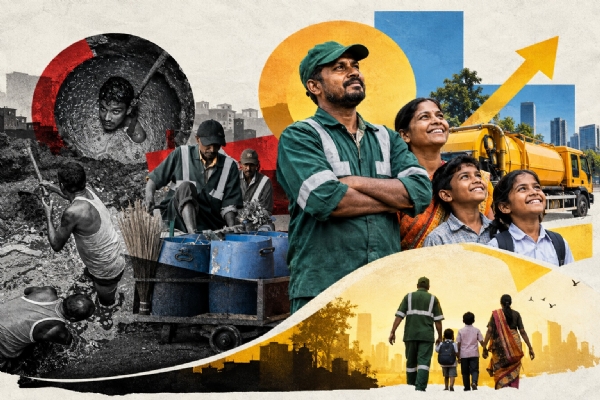
Financial issues during his childhood forced him to leave school after primary school. In 2008, he joined the Vijayawada Municipal Corporation as an outsourced sanitation worker with a starting salary of ₹2,500 per month. Due to a lack of qualifications, he wasn't able to get a high-paying role. However, his earnings rose over time to approximately ₹22,500 per month. On the other hand, rising household costs continued to strain his single-income household.
In August 2025, he and his four group members received support from the government under the Swachhta Udyami Yojana for a heavy-duty, truck-mounted sewer suction and sanitation machine with an 8 Kiloliter tank capacity. The project cost of ₹50 lakh was paid using a loan of ₹31.25 lakh 62.5% and a government subsidy of about ₹18.75 lakh 37.5%. This new machinery helped the group start a modern cleaning business, giving them a reliable way to make extra money.
Under the NAMASTE Scheme, a special-purpose vehicle mounted suction machine has been procured by five sanitation workers of Vijayawada Municipal Corporation (VMC), Andhra Pradesh. Its core function is high-vacuum suction for cleaning and collecting sewage. pic.twitter.com/wQJZOyywFr
— Ministry of Social Justice & Empowerment, GOI (@MSJEGOI) September 9, 2025
Through this initiative, Karnati Srinivasa Rao now earns an extra ₹10,000 each month in addition to his municipal salary, making his total monthly earnings ₹32,500. The additional revenue has removed financial pressure, helped cover household expenses, and enabled his family to build savings for future expenses. The NAMASTE scheme helps many sanitation workers like Karnati Srinivasa Rao build a secure income source. By providing mechanised equipment, affordable loans, and capital subsidies, it replaces unsafe manual cleaning with modern tools. Thousands of workers across India have received financial support to start businesses, earn extra income, and live with dignity.
This transformation embodies the Antyodaya model of governance, which prioritises uplifting the very last person in society. By empowering the most vulnerable sanitation workers with ownership and modern technology, the initiative converts structural marginalisation into economic self-reliance, ensuring that development is not just inclusive, but begins with those who need it most.