'Antyodaya Diwas' demands a civilisational shift in India's development discourse
"Antyodaya Diwas", therefore, must serve as an annual audit of our national conscience. The true measure of our civilisational progress will always be the dignity we accord to the very last man.
NewsBharati 24-Sep-2026 10:36:03 AM
Total Views |


What does development mean when aggregate numbers improve but some citizens remain excluded from opportunity? That question lies at the heart of 'Antyodaya', Pandit Deendayal Upadhyaya's idea of placing the last person at the centre of economic and political thinking. Its intellectual journey intersects, sometimes unexpectedly, with the concerns of Gandhi, Ambedkar, Lohia and Amartya Sen, even as their philosophical premises differ.
Today, 'Antyodaya' also informs the language of welfare, inclusion and last-mile delivery, making its relevance both 'ideological as well as administrative'. September 25 is observed as 'Antyodaya Diwas in memory of Pandit Deendayal Upadhyaya, the ideological inspiration of the Bharatiya Janata Party.
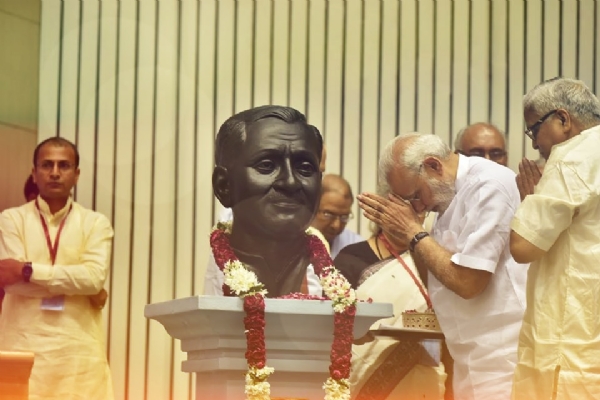
'Antyodaya' poses an uncomfortable question to every government, of what happens to the person whom development statistics leave invisible? Deendayalji's answer to this was precise, suggesting that the last person cannot be an afterthought of governance. He must be the ultimate test of development. Indian politics has produced many slogans for poverty removal, social justice and inclusive development. Few, however, have had the philosophical depth of 'Antyodaya'. It basically refers that a nation's progress must ultimately be measured by what happens to the person at the very end of the social and economic queue.
The concept is closely associated with Deendayal Upadhyaya's philosophy of 'Integral Humanism' (Ekatma Manav Darshan - एकात्म मानव दर्शन). Deendayalji's perspective about development was much different than the ordinary ones, where he linked it not simply with national income, industrial production or state expenditure, but the sole purpose was the integral development of the human being and thus, the welfare of society as a whole.
The official BJP account describes 'Integral Humanism' as an alternative to both capitalism and communism, while government material identifies 'Antyodaya', the uplift of the last person, as central to this holistic vision. Unlike Western materialist ideologies that fragment human existence into competing economic classes or individualistic units, Deendayalji viewed society as an organic whole. In this civilisational framework, the deprivation of the weakest limb weakens the entire national body.
While the Western model of capitalism measures success through Gross Domestic Product (GDP) and the concentration of capital, whereas communism attempts to force equality through state coercion and class conflict. Deendayalji rejected both. He argued that capitalism breeds greed and atomises communities, while communism crushes the individual spirit and destroys cultural continuity. 'Antyodaya' offers a distinctly 'Bharatiya' alternative. It asserts that true prosperity cannot trickle down from the top and it must be built systematically from the ground up. This philosophy bridges ideological divides, finding echoes in various strands of Indian political thought.
Mahatma Gandhi’s concept of 'Sarvodaya' through 'Antyodaya' similarly emphasised the moral imperative of serving the poorest. Dr. B.R. Ambedkar’s relentless pursuit of social democracy and the annihilation of caste barriers aimed to empower those historically pushed to the absolute margins. Ram Manohar Lohia’s socialist crusade sought to dismantle the structural inequalities plaguing rural India. Even the capabilities approach of contemporary economists like Amartya Sen aligns with the core anxiety of 'Antyodaya', that development is meaningless without enhancing the substantive freedom and agency of the individual.
However, where 'Antyodaya' distinguishes itself from secular, materialist theories is its spiritual anchor. It does not treat the marginalized as passive recipients of state charity or as a volatile vote bank to be managed through populist handouts. It recognizes the inherent divine dignity of every human being. Welfare, in the 'Antyodaya' framework, is a sacred duty (Dharma) of the collective, not a political concession.
In the contemporary administrative scenario, this philosophy has undergone a profound transformation from an abstract ideal into a rigorous blueprint for governance. For decades after Independence, Indian welfare policy was trapped in a top-down bureaucratic maze where benefits evaporated long before reaching the grassroots. Today, the principle of 'Sabka Saath, Sabka Vikas, Sabka Vishwas, Sabka Prayas' serves as the modern operationalisation of Upadhyaya’s vision.
Also read: From Deendayal’s Vision to Modi’s Policies: BJP’s Development Model Rooted in Integral Humanism
The transition from policy layout to last-mile delivery represents a paradigm shift. Through the deployment of technology, the creation of robust digital public infrastructure, and the uncompromising pursuit of 'saturation welfare', the state has systematically targeted the systemic leakages that historically disempowered the poor. 'Saturation governance' ensures that welfare schemes do not stop at arbitrary budgetary limits but continue until every eligible citizen at the end of the queue is covered.
When clean cooking fuel, tap water, financial inclusion, and dignified housing reach the remotest hamlets of India, it is truly the realization of 'Antyodaya'. By securing the basic material necessities of the last citizen, governance effectively unlocks their potential to participate in the nation’s growth story.
'Antyodaya Diwas', therefore, must serve as an annual audit of our national conscience. It reminds us that true majoritarian strength does not lie in aggregate economic indices or elite prosperity. It lies in the structural resilience of our most vulnerable communities. As 'Bharat' marches forward on its path to becoming a developed nation, Pandit Deendayal Upadhyaya’s eternal thesis remains our guiding light.
The true measure of our civilisational progress will always be the dignity we accord to the very last man.
Himali Nalawade
Himali Nalawade is associated with News Bharati as an Author since a considerable period. She is mostly linked with researched articles from the areas of Defence, Defence Infrastructure and Culture-Religion. Along with her Masters in Mass Communication and Journalism after her graduation in History, she has also studied Diploma in Underwater Archaeology and Diploma in Indology.