CISF conducts Anti-Hijacking mock drill at Navi Mumbai Airport; Bengal Flags off 226 firefighting vehicles
Total Views |


New Delhi, Sept 24: The Central Industrial Security Force (CISF) conducted its Annual Anti-Hijacking Mock Exercise (AHME) 2026 at the CISF Airport Security Group (ASG) at Navi Mumbai Airport on September 22, as part of the approved contingency plan for aviation security emergencies.
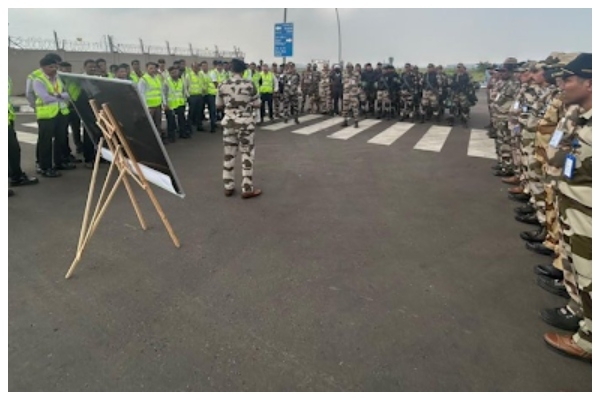
The simulated exercise involved a hijacked aircraft landing at Navi Mumbai Airport. The drill was aimed at assessing the preparedness and coordination of agencies involved in responding to an aviation security contingency.
Personnel from the CISF, Navi Mumbai International Airport Limited (NMIAL), local police, Aircraft Rescue and Fire Fighting (ARFF), Intelligence Bureau (IB), National Security Guard (NSG), airlines, medical services, Air Traffic Control (ATC), Krystal and the Bureau of Immigration (BOI) participated in the exercise.
The Aerodrome Committee was also activated as part of the drill. Navi Mumbai Police Commissioner Milind Bharambe, IPS, and DIG/CASO Sunit Sharma of ASG Navi Mumbai were among those who attended the exercise. All concerned stakeholders assembled at the Airport Crisis Coordination Room (ACCR).
The CISF said the successful exercise demonstrated the coordinated preparedness of various agencies and their ability to respond to aviation security contingencies.
Annual Anti-Hijacking Mock Exercise (AHME)–2026 Conducted at Navi Mumbai Airport
— CISF (@CISFHQrs) September 24, 2026
The Annual Anti-Hijacking Mock Exercise (AHME)–2026 was successfully conducted at CISF ASG Navi Mumbai on 22.09.2026 as per the approved contingency plan.
The simulated scenario involved the… pic.twitter.com/yEFIgBSKkP
Meanwhile, West Bengal on September 23 launched a major expansion of its firefighting and emergency response infrastructure with the ceremonial flagging off of 226 new firefighting vehicles and equipment from Red Road.
The new fleet, launched in the presence of senior officials from the West Bengal Fire & Emergency Services Department, was procured at a cost of Rs 94 crore.
The fleet includes 198 mid-size water tenders with a 2.5-kilolitre capacity, 25 water tenders with a 6-kilolitre capacity and three 36-metre articulating water towers.
The vehicles will be deployed at fire stations, particularly in densely populated areas, markets, industrial zones and other urban and semi-urban locations.
The state is also planning to modernise emergency response through technologies such as firefighting robots, drones, hydraulic platforms and advanced communication systems.
West Bengal is also expanding its fire-service infrastructure. Twenty-three new fire stations are currently under construction, while 10 additional fire-station projects have been announced in the state budget.
ALSO READ: Fear of exodus! Hindu families put up 'house for sale' signs after tribal man's lynching by muslim men
The government has proposed recruitment of 1,400 personnel, including Fire Operators, Fire Engine Operator-cum-Drivers and Sub-Officers. The proposal also includes the creation of 2,500 additional posts.
The state has announced measures for the welfare of fire-service personnel, including an allowance equivalent to 26 days' pay annually for permanent frontline personnel and an additional monthly allowance of Rs 2,000 for contractual Auxiliary Fire Operators.
The broader plan focuses on strengthening fire prevention and safety awareness through regular safety audits, inspections, mock drills and training.