Rahul Gandhi’s Problem Is Not the Vote. It Is the Voter.
Total Views |


Rahul Gandhi's latest assault on the Election Commission is no longer merely an electoral allegation. It is an attempt to construct an entire political theory around his own failure to accept an electoral verdict. On Thursday, Rahul Gandhi escalated his familiar “vote chori” charge into something far bigger: “kanoon chori” and “sanstha chori”. He questioned the legitimacy of laws passed by Parliament if the electoral mandate behind that Parliament was allegedly compromised. He demanded the resignation of Chief Election Commissioner Gyanesh Kumar and declared, with “100 percent certainty”, that elections were rigged. He also directly targeted Prime Minister Narendra Modi and Home Minister Amit Shah.
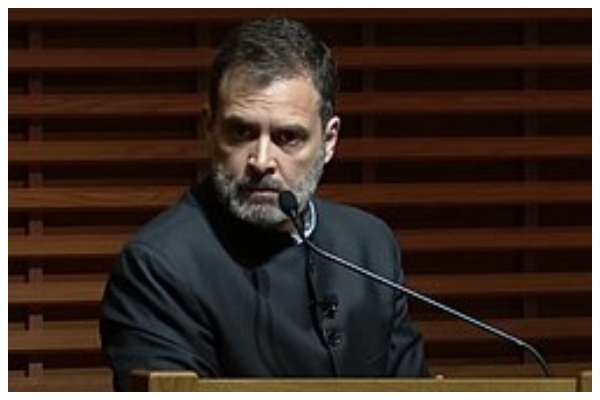
That is not an argument about one constituency, one voter list or one procedural irregularity. It is an argument against the verdict of the voter. And there lies Rahul Gandhi's fundamental political problem.
What if the voter is not being stolen? What if the voter is simply rejecting Congress? Rahul Gandhi wants the country to believe that the BJP's electoral continuity is so unnatural that it requires an institutional conspiracy. But Indian electoral history does not support the idea that anti-incumbency is an automatic law of democracy.
Anti-incumbency is not Article 326 of the Constitution. It is not a constitutional guarantee that every government must be thrown out after five years. Governments are defeated when voters want them defeated. Governments are retained when voters want continuity. Sometimes voters reject the ruling party. Sometimes they reject the opposition even more decisively.
The history of Congress itself destroys the simplistic theory Rahul Gandhi is now presenting. Congress has remained out of power for decades in states including Tamil Nadu, West Bengal, Uttar Pradesh, Bihar and Odisha. BJP national spokesperson Sudhanshu Trivedi made precisely this point in response to Gandhi's argument, citing the long electoral exclusion of Congress from several states. The harsh reality is far simpler: voters in these states did not want Congress in power. They repeatedly rejected the party at the ballot box. Rahul Gandhi cannot blame an electoral method for Congress being uprooted from states where voters themselves chose to remove it from power. The defeat was not engineered by the system; it was delivered by the voter.
ALSO READ: Discredit the ECI, Delegitimize the Verdict
When Congress loses, the discussion turns towards institutions, electoral rolls, the Election Commission, machines, procedures and conspiracies. But where is the equally intense introspection about Congress's own ideological decline, organisational weaknesses, leadership failures and loss of voter confidence?
Why should every defeat be explained through the alleged manipulation of the electoral system? Why is the voter almost never permitted to be wrong from Congress's point of view? Rahul Gandhi’s argument is not merely an insult to voters’ intelligence; it raises a serious question mark over his own commitment to democratic values and electoral verdicts.
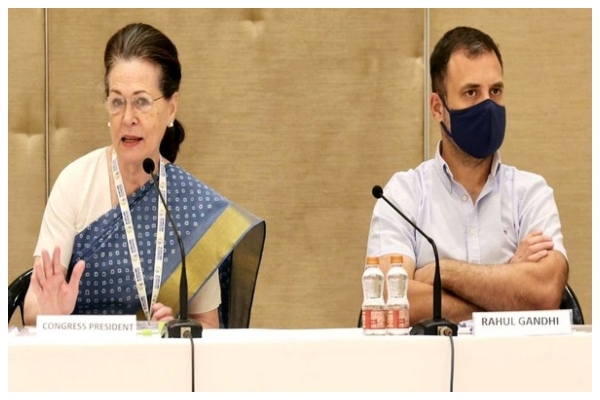
Rahul Gandhi cannot demand that the country treat electoral-roll integrity as a sacred democratic question when he raises it, while expecting questions concerning an electoral-roll entry involving his own mother to be dismissed merely because they are politically inconvenient. If voter lists matter, they matter universally. If electoral transparency matters, it cannot be selectively demanded.
If the Election Commission must answer questions, then questions concerning electoral rolls involving the Gandhi family must also be examined according to law. This is not a question of political revenge. It is a question of consistency.
And an electoral defeat must not automatically become proof that the election was stolen. Rahul Gandhi's formulation of “vote chori–kanoon chori–sanstha chori” takes the argument several steps further. If the votes are allegedly stolen, then Parliament becomes illegitimate. If Parliament becomes illegitimate, its laws become suspect. If its laws become suspect, the entire constitutional structure begins to appear compromised.
This is a remarkably sweeping political proposition. But where does it end? Does every election that Congress loses become illegitimate? Does every mandate that Rahul Gandhi disputes become evidence of institutional capture? And if the answer is yes, what happens to the basic democratic principle that voters can make a choice that an opposition party simply does not like?
A political leader has every right to challenge the Election Commission. He has every right to demand explanations. He has every right to produce evidence of irregularities and seek investigation. But the opposition has no special constitutional right to substitute its preferred electoral outcome for the one produced by voters. That is the line Rahul Gandhi has crossed.
ALSO READ: Vienna’s 42% Question: When Islam Changes a City’s Demography
The voter is sovereign precisely because the voter is unpredictable. The voter can reject a government. The voter can retain it. The voter can abandon a party that once appeared invincible. The voter can refuse to return to a party that once governed for decades. Perhaps this is the political reality Rahul Gandhi finds most difficult to accept.
The Congress of Nehru, Indira Gandhi and Rajiv Gandhi cannot automatically claim the loyalty of today's voter. A younger electorate has different aspirations, different political experiences and a much wider range of political choices. The social and electoral coalitions that once made Congress the natural party of governance have changed dramatically. That transformation cannot be explained away by “vote chori”. It has to be understood. And that requires something more difficult than a press conference - introspection.Rahul Gandhi has chosen to make the Election Commission the accused. He has chosen to make the electoral process the accused. He has chosen to make the BJP's victories the evidence. But perhaps the more important question is one he has avoided - What if the evidence is sitting not inside the ballot box, but inside the changing mind of the voter?
That is the possibility Congress cannot afford to evade. Because if every defeat is theft, every mandate is conspiracy and every victory of the opponent is institutional manipulation, then the opposition is no longer trying to understand democracy. It is trying to explain democracy away. And the most dangerous form of political denial is not refusing to accept defeat. It is refusing to accept that the voter has deliberately chosen someone else.