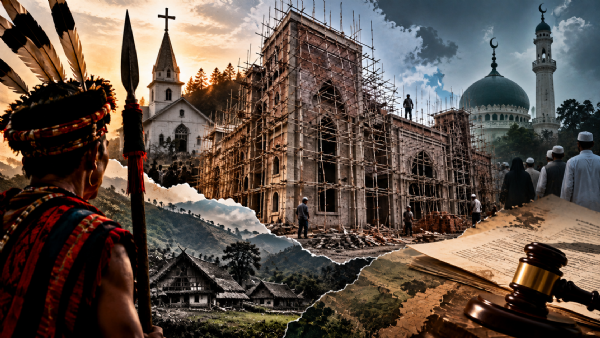
Amid growing concerns over conversion and alleged Muslim encroachment on tribal land across parts of India, a fresh controversy has emerged from Nagaland. As per the reports, a large mosque is being constructed in Nagaland's Dimapur area.
The issue entered the mainstream after the social media account Kreately.in shared a video showing the ongoing construction. The video quickly drew attention online, with claims that the new structure is linked to the Idgah Jame Masjid & Madrassa in Dimapur.
Source link :https://www.facebook.com/homemadedesigns43/posts/new-project-at-its-glorydimapur-idgah-masjidnagaland/886355756840204/
If the Nagaland government is aware of the ongoing construction, another question naturally follows: Who owns the land on which this mosque is being constructed, and under what legal authority was the land acquired, transferred, leased or otherwise made available for the project? Given Nagaland’s special constitutional and land protections, clarity on the ownership and legal status of the land is essential to understanding the controversy.
This comes against an already sensitive backdrop in India’s tribal belt, where debates over religious conversion and alleged “land jihad” have intensified in some regions. States such as Jharkhand and Chhattisgarh have witnessed recurring disputes over tribal land, religious conversion and demographic change. Similar concerns have also been raised in states neighbouring Nagaland. The Dimapur controversy, therefore, has emerged within a wider debate over the protection of tribal land, indigenous identity and customary rights.
Beyond legal and property dimensions, the broader discourse touches upon long-standing transformations in indigenous belief systems. Religious conversion has historically reshaped the social fabric of several tribal regions across India.
Nagaland has already undergone a profound demographic and cultural transformation. The state is home to 17 major tribes, each with its own distinct customs, languages, traditions and social identity.
Religious conversion has been an important part of Nagaland’s modern history, particularly the transition of indigenous communities to Christianity. The scale of that transformation is reflected in the 2011 Census, which recorded Christians as the overwhelming majority of Nagaland’s population. Unfortunately Nagaland is more Baptist than any US state.
The debate over what this transformation has meant for traditional Naga identity has resurfaced through Angh, the 2026 Konyak-language film directed by Theja Rio. Set during the cultural upheaval of the 1960s, the film explores the changes that accompanied the spread of Christianity and their impact on traditional beliefs and community life.
While talking about the Muslim population in Nagaland has been steadily increasing, with estimates suggesting they make up around 5% of the total population, although official census figures report about 2.47%.
Though Outsiders cannot buy land in Nagaland. Article 371A of the Indian Constitution grants Nagaland special provisions to protect its tribal land, customs, and resources, despite that Muslims are becoming a transient community that contributes to the demographic growth, which has become a huge concern for the Nagas.
Way back in 2003, Neiphiu Rio, the Chief Minister of Nagaland, had accused the Government of Assam, led by former Chief Minister Shri. Tarun Gogoi of exporting illegal immigrants into Nagaland, and that Nagaland cannot take any action against them, for they were already in possession of valid identity documents procured fraudulently in Assam. Muslims adopted an ingenious strategy of marrying local Naga girls, with the sole purpose of integrating themselves with the indigenous Naga population and claiming ownership of land, one of the most prestigious assets of the Nagas. Over a period of time, it resulted in the emergence of a hybrid race, often referred to as Nagamia. For instance, if the wife-cum-mother is a Sumi Naga and the husband-cum-father a Muslim, then their offspring are commonly classified as Sumiya or Semiya.
For a state whose identity is deeply rooted in its tribal heritage, the larger question is therefore not simply about religion. It is about whether rapid demographic, religious and cultural changes could gradually weaken the traditions, customary practices and indigenous identity that have defined Nagaland for generations.
For a land shaped by centuries of distinct tribal autonomy, the debate in Nagaland goes far beyond bricks, mortar, or a single construction project. It touches on a profound existential question: Can constitutional shields like Article 371A truly preserve an indigenous heritage when demographic realities, intermarriage trends, and shifting cultural lines are quietly reshaping the ground beneath? As the state walks the tightrope between modern integration and the preservation of its ancestral soul, the unfolding situation in Dimapur serves as a stark reminder that protecting a unique civilization requires more than just laws on paper—it demands unyielding vigilance over the identity of the land itself.
If these changes continue unchecked, could the growing influence of Abrahamic religions eventually erode the customs, traditions and indigenous identity that make Nagaland what it is today? That is the question Nagaland cannot afford to ignore.