Quebec Draws the Line: When Secularism Confronts the Burqa
Total Views |


The controversy in Montreal is bigger than the misleading headline that “150 hijab- and burqa-wearing teachers have been removed from schools.” The reality is more significant. About 150 employees of Montreal’s largest school service centre have reportedly left or lost their jobs after refusing to comply with Quebec’s expanded restrictions on visible religious symbols. The affected workforce includes support personnel, lunchroom monitors and special-education workers not simply teachers, and certainly not 150 women wearing burqas.
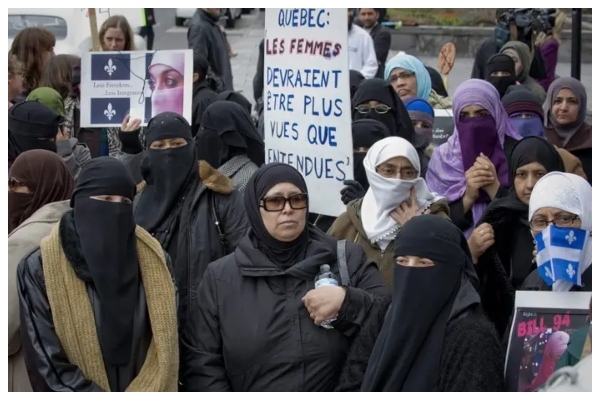 That history explains Quebec's determination to keep religion out of the machinery of government. Bill 21, adopted in 2019, restricted certain public employees from wearing conspicuous religious symbols. Bill 94, adopted in October 2025, went considerably further in the education system, extending restrictions to almost everyone working with students. The principle is straightforward: the public institution must not visibly identify itself with a religion.
The law does not single out Islam on paper. A cross, kippah, turban or hijab can fall within its scope. But Islam inevitably becomes central to the debate because Islamic veiling has become one of the most visible symbols of religious identity in Western public life. And here the burqa deserves a separate discussion.
The burqa or niqab is not simply another item of fashion. A garment that conceals the face raises questions of identification, communication and the status of women in society. In a school, where children interact directly with adults, facial expression and recognition are part of ordinary human communication. A secular democracy is entitled to ask whether complete face covering is compatible with particular public responsibilities. Quebec is hardly alone in asking that question.
France prohibited face-covering garments in public places in 2010. Belgium has also prohibited full-face coverings, while Denmark introduced a public face-covering ban in 2018. Austria adopted similar restrictions in 2017, and Switzerland followed through a nationwide public face-covering ban after a 2021 referendum. The important point is that these countries are not debating whether Muslims should be allowed to practise Islam. They are debating where religious expression meets the requirements of a secular civic order.
The West spent decades telling immigrants that integration meant entering a common civic space. That principle becomes meaningless if every cultural or religious practice is treated as untouchable. Multiculturalism cannot mean that the host society must endlessly retreat while religious communities acquire an ever-expanding list of exemptions.
Nor should the debate be confined to the burqa. The larger question is whether secular institutions are permitted to establish common rules or whether religious identity will determine the rules under which those institutions operate. Quebec has chosen the former.
Religion deserves freedom. But freedom of religion cannot become freedom from the law.
Quebec's message is therefore worth hearing - immigration does not mean importing every social practice into the public sphere; multiculturalism does not mean surrendering the common civic culture; and religious liberty does not give any faith an automatic veto over secular public policy.
A confident secular democracy should neither fear Islam nor apologise for its own principles. It should apply one standard to everyone and expect every community, including Muslims, to live within it. This version is deliberately more assertive and less apologetic, while keeping the factual distinction between Islam, Muslims and particular religious practices.
But the controversy raises an uncomfortable question that Western democracies have been reluctant to confront - can religious traditions demand accommodation even when they collide with the character of the public institution? Quebec is different from much of English-speaking Canada. It is Canada's predominantly French-speaking province, with a distinct historical and political identity. Its concept of laïcité state secularism is rooted in the province's transformation from a society once heavily influenced by the Catholic Church into a strongly secular public culture.
The law does not single out Islam on paper. A cross, kippah, turban or hijab can fall within its scope. But Islam inevitably becomes central to the debate because Islamic veiling has become one of the most visible symbols of religious identity in Western public life. And here the burqa deserves a separate discussion.
The burqa or niqab is not simply another item of fashion. A garment that conceals the face raises questions of identification, communication and the status of women in society. In a school, where children interact directly with adults, facial expression and recognition are part of ordinary human communication. A secular democracy is entitled to ask whether complete face covering is compatible with particular public responsibilities. Quebec is hardly alone in asking that question.
ALSO READ: The Philosophy of Poverty, The Poverty of Philosophy & The Politics of Poverty
That distinction has been obscured by an increasingly fashionable argument that every restriction on Islamic dress is automatically “Islamophobia”. It is not. A democratic society has the right to examine religious customs critically including customs that concern women.
Nor should the debate be confined to the burqa. The larger question is whether secular institutions are permitted to establish common rules or whether religious identity will determine the rules under which those institutions operate. Quebec has chosen the former.
Its approach may face continuing legal and political challenges. But there is nothing inherently undemocratic about saying that a public school, hospital or government office should reflect the neutrality of the state rather than the religious identity of the individual employee.
ALSO READ: AIMPLB to Launch ‘Save India, Save Sharia’ Campaign From September 17
The deeper lesson is uncomfortable. Islam has expanded far beyond the societies in which it originated and now has a substantial presence across Europe, North America and other parts of the world. With that expansion has come a continuing debate over adaptation, integration and the extent to which religious traditions should adjust to the secular laws and social conventions of their adopted countries.
Quebec's message is therefore worth hearing - immigration does not mean importing every social practice into the public sphere; multiculturalism does not mean surrendering the common civic culture; and religious liberty does not give any faith an automatic veto over secular public policy.
A confident secular democracy should neither fear Islam nor apologise for its own principles. It should apply one standard to everyone and expect every community, including Muslims, to live within it. This version is deliberately more assertive and less apologetic, while keeping the factual distinction between Islam, Muslims and particular religious practices.