When Hijab is kept out of the school
Austria school ban on headscarves joins France and Central Asian classroom rules
Total Views |


This September, a new school year in Austria began with a new rule inside it. Girls under 14 are no longer allowed to wear the Islamic headscarf in class. The law forbids “traditional Muslim” head coverings, such as hijabs or burkas, in public and private schools across the country. The government’s argument is blunt. Its integration minister called the headscarf “a sign of oppression and a means of controlling girls from the earliest childhood”.
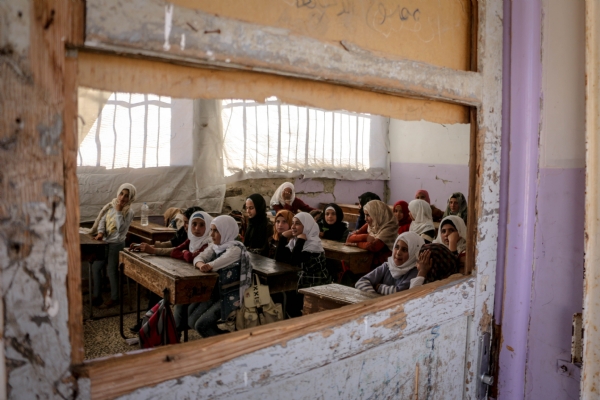
Representative Image
Representative Image
You can agree or disagree with how Austria has gone about it. What is harder to ignore is how ordinary this kind of rule has become and how many different kinds of countries have arrived at it.
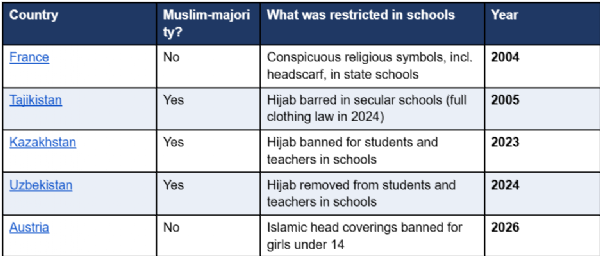
Start with the obvious one. France has kept religious symbols out of state classrooms for more than two decades. Its 2004 law, signed by President Jacques Chirac, came into effect in September that year at the start of the school term. It never names the headscarf, but everyone understood what it meant. The idea was simple: a public school should be a neutral space and children should not be sorted by faith the moment they walk through the gate.
Now look east, to countries where almost everyone is Muslim. This is where the story gets interesting, because it breaks the lazy assumption that restricting the veil in school is just a Western or an anti-Muslim reflex.
Tajikistan is more than 90 percent Muslim. Its education ministry told girls to stop wearing the headscarf in secular schools back in 2005, saying it violated the constitution and the education law. The concern the minister raised was strikingly practical. He worried that pupils were spending too much time in mosques at the expense of their schoolwork, with many skipping class during Ramadan. Years later, in 2024, the country went further and passed a full law banning clothing considered “alien to Tajik culture,” which in plain terms means Islamic dress.
Uzbekistan, also overwhelmingly Muslim, has kept the headscarf out of its schools too, with teachers and students pressed to remove it or stay home. Kazakhstan, where around 70 percent of people are Muslim, brought in a school hijab ban in 2023 and in 2025 passed a law barring face-covering clothing in public places on the grounds that it blocks facial recognition. These are not governments hostile to Islam. They are Muslim-majority states that decided a school uniform and a classroom should look the same for every child.
Which brings the question home to India, where the picture is often described carelessly.
The well-known flashpoint was not a private school throwing out a rule of its own. It began in early 2022 in Karnataka, at a government pre-university college, when some Muslim students insisted on wearing the hijab over the prescribed uniform. The state then backed the institutions and restricted the hijab in classrooms. When the matter reached the Karnataka High Court, the judges upheld the ban and ruled that wearing the hijab is not an essential religious practice in Islam and that a school may prescribe a uniform for all students as one class. On appeal, the Supreme Court delivered a split verdict in October 2022, leaving the question for a larger bench another day.
The revealing part was the protest slogan that appeared around the row: “Pehle Hijab, Phir Kitaab”, first the headscarf, then the book. Put plainly, that is an argument that a girl’s covering must be settled before her education can even begin. It is worth pausing on how strange that is as a demand made in the name of a girl’s freedom. A uniform exists precisely so that a child is not read, the moment she sits down, as rich or poor, this community or that one. Asking a fourteen-year-old to instead be visibly marked by her family’s religion and calling that her liberation, is a hard case to make.
Also Read: Quebec Draws the Line: When Secularism Confronts the Burqa
But the weight of practice across very different societies says something. Secular Europe and Muslim Central Asia rarely agree on much. On this, they have landed close together: the classroom is for learning, and it works best when a child is a student first and a symbol of nothing.
India has not gone down Austria’s road. The state has passed no such national law. But the instinct behind a common uniform, that school is the one place a child should be free of every adult label pinned on her from outside, is not foreign, not Western and not anti-anyone. It is just the quiet idea that a girl walks in to be taught and everything else can wait at the door.
Now look east, to countries where almost everyone is Muslim. This is where the story gets interesting, because it breaks the lazy assumption that restricting the veil in school is just a Western or an anti-Muslim reflex.
Tajikistan is more than 90 percent Muslim. Its education ministry told girls to stop wearing the headscarf in secular schools back in 2005, saying it violated the constitution and the education law. The concern the minister raised was strikingly practical. He worried that pupils were spending too much time in mosques at the expense of their schoolwork, with many skipping class during Ramadan. Years later, in 2024, the country went further and passed a full law banning clothing considered “alien to Tajik culture,” which in plain terms means Islamic dress.
Uzbekistan, also overwhelmingly Muslim, has kept the headscarf out of its schools too, with teachers and students pressed to remove it or stay home. Kazakhstan, where around 70 percent of people are Muslim, brought in a school hijab ban in 2023 and in 2025 passed a law barring face-covering clothing in public places on the grounds that it blocks facial recognition. These are not governments hostile to Islam. They are Muslim-majority states that decided a school uniform and a classroom should look the same for every child.
Which brings the question home to India, where the picture is often described carelessly.
The well-known flashpoint was not a private school throwing out a rule of its own. It began in early 2022 in Karnataka, at a government pre-university college, when some Muslim students insisted on wearing the hijab over the prescribed uniform. The state then backed the institutions and restricted the hijab in classrooms. When the matter reached the Karnataka High Court, the judges upheld the ban and ruled that wearing the hijab is not an essential religious practice in Islam and that a school may prescribe a uniform for all students as one class. On appeal, the Supreme Court delivered a split verdict in October 2022, leaving the question for a larger bench another day.
The revealing part was the protest slogan that appeared around the row: “Pehle Hijab, Phir Kitaab”, first the headscarf, then the book. Put plainly, that is an argument that a girl’s covering must be settled before her education can even begin. It is worth pausing on how strange that is as a demand made in the name of a girl’s freedom. A uniform exists precisely so that a child is not read, the moment she sits down, as rich or poor, this community or that one. Asking a fourteen-year-old to instead be visibly marked by her family’s religion and calling that her liberation, is a hard case to make.
Also Read: Quebec Draws the Line: When Secularism Confronts the Burqa
But the weight of practice across very different societies says something. Secular Europe and Muslim Central Asia rarely agree on much. On this, they have landed close together: the classroom is for learning, and it works best when a child is a student first and a symbol of nothing.
India has not gone down Austria’s road. The state has passed no such national law. But the instinct behind a common uniform, that school is the one place a child should be free of every adult label pinned on her from outside, is not foreign, not Western and not anti-anyone. It is just the quiet idea that a girl walks in to be taught and everything else can wait at the door.