After 20 years, completion of dedicated freight network to transform how India competes with the world
More than 440 freight trains a day are operating across the completed DFC network, while an estimated freight journey that could take a truck around 30 hours can be reduced to roughly 10–12 hours on the corridor.
Total Views |


Indian Railways has functioned with an awkward paradox for decades, since the nation’s busiest passenger routes also carried the freight that kept its economy moving. A slow goods rake could hold up an express, while congested tracks were reflected into longer delivery times and higher logistics costs. Impressively, the India's growth engine is changing the picture now, faster than ever. With Prime Minister Narendra Modi today (Sep 8) dedicating the final sections of the Western Dedicated Freight Corridor in Gujarat, India has completed the 2,843-km Eastern and Western DFC network, a railway backbone set to reshape how India produces, trades and competes.
The Western DFC is engineered for trains up to 100 kmph, higher axle loads and double-stack containers. With this development, India has literally built a dedicated freight highway on rails.
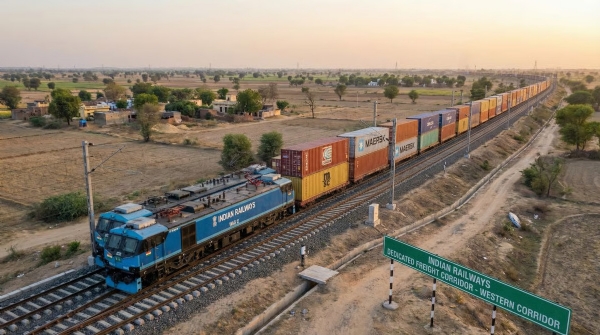
The technological achievement is particularly striking. Conventional overhead electrification is not designed to accommodate two containers stacked vertically. India therefore developed high-rise overhead equipment, with contact-wire heights around 7.5 metres, alongside specially engineered high-reach pantographs.
In 2020, Indian Railways described the first electric double-stack operation under such high-rise OHE as a world first. The breakthrough allowed India to combine electrification with double-stacking at scale, that proved to be an engineering solution tailored to its broad-gauge network rather than borrowing from a standard template.
That matters because freight capacity is ultimately the economic capacity. Separating freight from passenger traffic releases paths on the conventional network, allowing Railways to run more passenger and coaching services while freight gets a dedicated, predictable route. And the result is already visible, as more than 440 freight trains a day are operating across the completed DFC network, while an estimated freight journey that could take a truck around 30 hours can be reduced to roughly 10–12 hours on the corridor.
The Western DFC also creates an industrial spine from Dadri in Uttar Pradesh to Jawaharlal Nehru Port near Mumbai. This connection matters enormously. Factories and agricultural producers in the northern hinterland gain a faster, more reliable route to a major maritime gateway, exporters gain a more dependable supply chain, and ports gain better access to the markets that feed them. For manufacturing, the significance is even larger still, as predictable logistics can influence where factories locate, how inventories are managed and whether Indian products can compete on delivered cost.
Globally, this is India building supply-chain power. Faster rail freight can reduce dependence on long-haul trucking, cut fuel consumption and lower emissions per tonne-kilometre. Electrification also gives India a platform to make freight progressively cleaner as the electricity mix becomes greener. While companies increasingly prefer to scrutinise resilience, delivery times and carbon footprints, a high-capacity rail spine will prove to be the strength of India’s proposition as a manufacturing and export destination.
There is also an important lesson in the corridor’s unusually long gestation. The project was unveiled in 2006, and the original plans envisaged completion within the 11th Five Year Plan. Progress, however, was slow for years amid land acquisition, clearances and execution challenges. By March 2014, official data showed only ₹10,357 crore had been spent and no DFC kilometres commissioned, however, by October 2023, expenditure had crossed ₹1.08 lakh crore and 2,513 km had been commissioned. The contrast speaks less about partisan score-settling than about administrative capacity. Ambitious infrastructure becomes transformative only when funding, land, contracting, monitoring and execution move together.
And this is only the beginning. The government is pursuing further freight corridors, including the East-Coast and East-West spines, while a new Dankuni–Surat corridor has also been announced. The completed Eastern and Western DFCs should therefore be viewed as India’s freight backbone, and as the baseline on which a much larger manufacturing economy can be built.
For a country seeking to become a global production hub, that distinction is decisive. India's infrastructure today has the potential to pull investment towards corridors, ports, cities and industrial clusters built around dependable, efficient movement of goods.
India has ceased to treat logistics as background infrastructure. It is becoming a strategic economic asset. The tracks now being opened for freight are, in effect, the tracks being laid for faster industry, stronger exports and a more competitive India.