Stitching Justice: How the Keralam Church Strangled Its Own Nuns into Economic Survival
Despite serious rape charges, the Catholic Church let Bishop Mulakkal resign quietly, with no canonical punishment. The Church hierarchy chose institutional self-preservation over accountability, letting him keep his title, standing, and privileges — proof the Church protects its own power structure before delivering real justice to survivors.
Total Views |


When power structures feel threatened, they do not merely argue—they starve. The systemic response of organized institutions to internal dissent has historically followed a precise, cold sequence: deny, isolate, and economically incapacitate. The ongoing saga surrounding the Syro-Malabar Catholic hierarchy in Keralam, the Missionaries of Jesus congregation, and the survivor nuns of Kuravilangad convent is no longer just a narrative about alleged high-level clerical overreach. It stands today as a documented case study in structural coercion and the total abandonment of institutional duty.
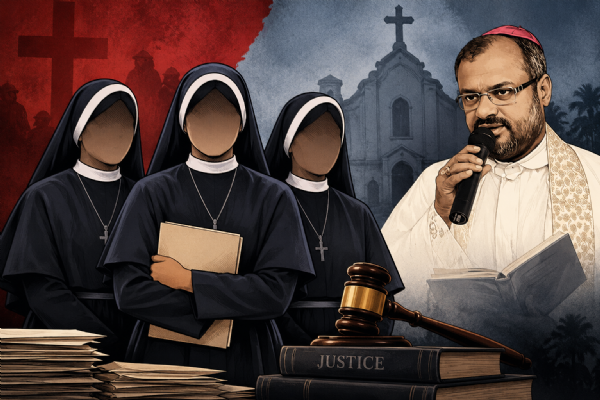
A rape survivor nun, along with the brave sisters who stood by her side, has been forced to launch a clothing brand just to earn a single meal a day and fund her legal battle against former Jalandhar Bishop Franco Mulakkal. Read that again. Consecrated women of God, who dedicated their lives, youth, and labor to the Church, are now stitching clothes on sewing machines because the institutional Church decided to starve them out.
The background of this case is as grim as it is revealing. Between 2014 and 2016, a senior Catholic nun residing in a Kottayam convent was subjected to repeated sexual violence by Franco Mulakkal, the then-Bishop of the Jalandhar diocese. When the survivor finally broke her silence in 2018, the clerical establishment did not rally to support the victim. Instead, it mobilized every institutional leverage at its disposal to defend the powerful prelate. What followed was a protracted legal conflict where the victim and five fellow nuns had to sit on public protests simply to force the local law enforcement apparatus to arrest the accused Bishop. Although a lower trial court acquitted Mulakkal in 2022 under questionable circumstances, the case currently sits before the Kerala High Court, where the survivor continues to challenge the verdict.
Despite the severity of the charges, Mulakkal was never stripped of his title. While he eventually resigned as the Bishop of the Diocese of Jalandhar under intense public pressure and legal scrutiny, the Vatican accepted his resignation without imposing formal canonical penalties. By allowing him to step down quietly while retaining his full status as a Bishop, the Church hierarchy prioritised institutional self-preservation over moral accountability, ensuring he retained his social standing and ecclesiastical privileges.

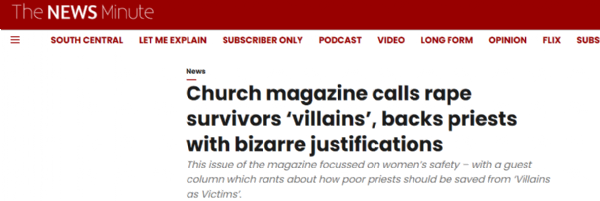
The whitewashing extended beyond internal church proceedings into media platforms controlled by the religious establishment.A prime example was an article published in Indian Currents a weekly publication under the patronage of the Capuchins of the Krist Jyoti Province. Authored by A.J. Philip under the title ‘Villains as Victims’, the piece framed accused clerics, including Mulakkal and priests involved in the Malankara Orthodox Church abuse scandal, in a sympathetic light.
However, the real cruelty unfolded away from the courtrooms.After the survivor nun had the courage to report years of horrific sexual abuse by Bishop Franco Mulakkal, the ecclesiastical machinery tried every trick in the book.
Character assassination, social intimidation, and institutional isolation were deployed immediately. But when those tactics failed to break the resolve of these women, the Church reached for its ultimate weapon: financial starvation.
In 2023, the congregation completely blocked and stopped all financial aid, stipends, and basic allowances meant for the survivor and the supporting nuns.In 2023, Sister and the nuns who stood by her were cut off from financial assistance from the Church. Their names were also removed from the Jalandhar Diocese list after they spoke publicly against Bishop Franco, they said.
The convent, once a place where the nuns lived together, gradually split into two groups: those supporting Sister Ranit and those backing Franco. The latter group, the sisters said, isolated them completely.
They stopped sharing food or money, and even basic interactions ended.
With no financial support, the six nuns tried different ways to survive. They started a hostel for girl students and later a home for senior citizens, but both had to shut down because of a lack of resources. Attempts to grow vegetables and rear ducks and hens on the convent premises also did not last.
Think about the sheer cruelty of this move. These nuns hold Master’s degrees in Social Work, yet the social stigma and direct Church pressure made it impossible for them to secure jobs anywhere else in the state. The message sent by the Church hierarchy was loud, clear.
Faced with systematic economic blockades, the nuns refused to collapse. Instead, operating out of the Kuravilangad convent in Kottayam, they procured basic sewing machines and launched their own independent clothing line, aptly named 'Stand By Me'. Sticking nighties, bags, and traditional attire, these women turned to manual labor to survive. The state government was eventually forced to intervene quietly just to issue them basic ration cards so they wouldn't starve. The launch of 'Stand By Me' is not merely a micro-business story; it is a desperate, firebrand act of resistance against an all-powerful ecclesiastical apparatus that attempted to crush its own daughters.
This episode strips away the grand facade that foreign funded missionary and clerical institutions in India have built for themselves. Their public relations machinery churns out sermons on constitutional values, gender justice and compassion. Their internal reality looks a lot more like dogmatic authoritarianism, where institutional self-preservation comes before basic human dignity every single time it's tested. And the silence from Kerala's secular-liberal ecosystem is its own kind of scandal. The same commentators who lecture the country daily on civil rights have had almost nothing to say about a Church behaving like a state within a state toward its own women. That's not an oversight either. It's a blind spot that only shows up when the institution being scrutinised is a religious one.
An institution that uses its wealth to shield an accused bishop while its own consecrated nuns are stitching clothes just to afford food and a lawyer has forfeited any standing to lecture the rest of Indian society on righteousness. The sanctimony has worn thin. What's left underneath looks less like a moral authority and more like an apparatus built to demand obedience first and deliver justice only when it's convenient.