Int'l Literacy Day: PM Modi shares wisdom of a bee as India's lesson for literacy in changing world
Conventional definitions of literacy focus on the ability to read and write. Indian thought builds that foundation on a bigger concept, that we know as "vidya".
Total Views |


On International Literacy Day, the world is asking a question that goes beyond whether people can read and write: what does it mean to be literate in an age of artificial intelligence, endless information and rapidly changing technology? UNESCO’s 2026 observance, marking the 60th anniversary of the day, comes amid persistent literacy gaps and emerging challenges in digital and media literacy. Against this backdrop, Prime Minister Narendra Modi shared a Sanskrit Subhashit on September 8 that offers an unexpectedly modern answer.
“अणुभ्यश्च महद्भ्यश्च शास्त्रेभ्यः कुशलो नरः।
सर्वतः सारमादद्यात् पुष्पेभ्य इव षट्पदः॥”
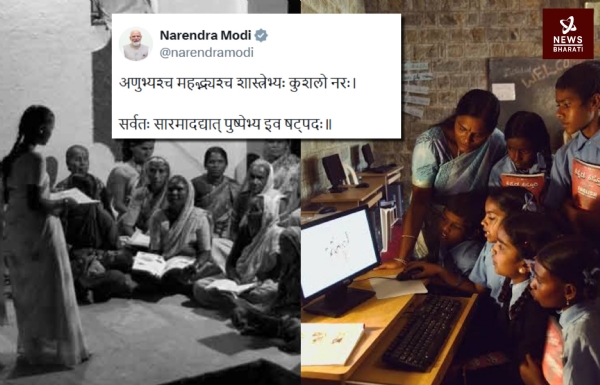
The verse says that a wise and skilled person should draw the essence from every branch of knowledge, whether great or small, just as a six-legged bee gathers nectar from flowers. Its relevance is enormous.
The bee as a model of intelligence
The image of the 'शतपद' or the honeybee, is central in this equation of literacy, wisdom, and modern-day opportunities and challenges. A bee does not demand that every flower be magnificent. It moves from blossom to blossom, gathering what is valuable. It neither consumes everything nor does it reject something just because it is small.
That is precisely the distinction the information age demands. Humanity has moved from information scarcity to information abundance. Search engines, social platforms, smartphones and generative AI can place more information before an individual in minutes than earlier generations could encounter in months. Yet abundance has produced a new problem of knowing what deserves attention.
अणुभ्यश्च महद्भ्यश्च शास्त्रेभ्यः कुशलो नरः।
— Narendra Modi (@narendramodi) September 8, 2026
सर्वतः सारमादद्यात् पुष्पेभ्य इव षट्पदः॥ pic.twitter.com/tRxMbC7War
Literacy, therefore, cannot stop at decoding words. It needs to evolve into insightful literacy, which means the ability to question, compare, contextualise, verify and extract the “सार”, or essence, from what we encounter. UNESCO itself has expanded its understanding of literacy toward media and information literacy, emphasising the ability to critically assess what people read, hear and learn.
The Sanskrit verse captures that principle in a metaphor remarkably suited to the present-day challenges, propagating to consume intelligently and extract wisely.
From mere 'literacy' to 'vidya'
This is where the Indian intellectual tradition offers something distinctive to the global conversation. Conventional definitions of literacy focus on the ability to read and write. Indian thought builds that foundation on a bigger concept, that we know as 'vidya'. This is knowledge that helps people grow, expands their understanding, and teaches them how to live and act wisely.
The Sanskrit Subhashit shared by Narendra Modi does not tell humanity to learn less. It only tells humanity to learn better. That principle resonates with Swami Vivekananda’s vision of India’s contribution to humanity. Vivekananda presented India’s spiritual and philosophical inheritance as knowledge with universal relevance. In that sense, this Sanskrit verse can be read as a civilisational offering, suggesting a method for learning that is universal because it does not insist that wisdom belongs to one source.
Literacy opens the door to the enjoyment of other human rights, greater freedoms, and global citizenship.
— Ministry of Information and Broadcasting (@MIB_India) September 8, 2026
This #InternationalLiteracyDay, we reiterate the words of former President Dr. A. P. J. Abdul Kalam from his address that The level and quality of education is one of the… pic.twitter.com/m8jgz80GdW
A global skill for an AI age
For institutions such as the United Nations and the G20, this distinction is even more important. A literate society must be equipped not only to access knowledge, but to navigate disagreement, recognise manipulation, respect diversity and make wise choices. Technology can now generate summaries, answers, images and arguments. But speed is not wisdom. Technology can multiply information, but it is always human beings who decide what is meaningful, credible and constructive.
The verse offers three principles. First, information overload demands selection. The modern learner needs to seek essence rather than accumulation of information. Second, lifelong learning must replace the idea that education ends with a degree. The bee keeps moving. Likewise, citizens must continually learn, unlearn and relearn as technologies and societies change. And finally, true learning requires openness. The bee does not discriminate between the grand flower and the modest one. In the spirit of 'Vasudhaiva Kutumbakam', modern literacy should encourage people to learn from different cultures, indigenous knowledge systems, scientific disciplines and lived experiences.
The world’s garden of knowledge
India’s proposition needs not be that the world should look backward. It is that the future can sometimes be understood more clearly by recovering principles that remain timeless. From Sanskrit to silicon, the central challenge remains the same, that how do we transform information into understanding, and understanding into wisdom?
As the Sanskrit verse suggests, become the bee and travel widely to learn continuously. Reject neither the small nor the great. Above all, extract the essence. That is literacy for the digital age, and perhaps a fitting Indian contribution to a world searching for wisdom amid unprecedented knowledge.
True literacy begins when every person becomes a “कुशलो नरः" and not just someone who can read, but someone who can discern. When millions do so, the world becomes a garden of knowledge, rich with flowers, but made meaningful by those who know how to gather their nectar.
--