'Freedom to respond decisively’: Rajnath Singh’s message to Armed forces and India’s adversaries
Rajnath Singh pointed to Surgical Strikes, the Balakot Airstrike and Operation Sindoor as examples of the shift towards a more proactive counter-terrorism doctrine.
Total Views |


New Delhi, Sep 8: India’s defence posture is increasingly being shaped around a simple principle that deterrence must be backed by both operational freedom and the resources to act. Defence Minister Rajnath Singh has said the Armed Forces have been given the freedom and resources to respond decisively to threats, including the ability to strike adversaries on their own territory.
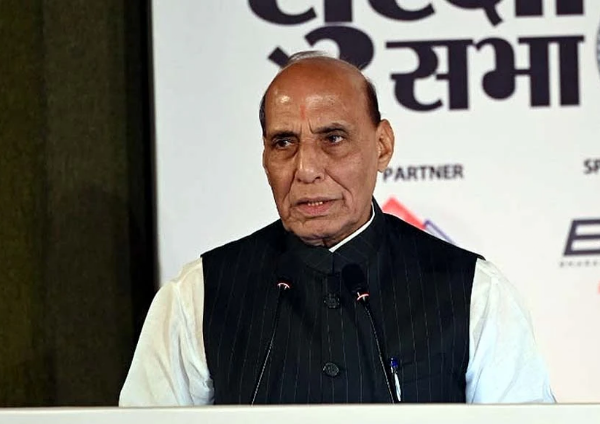
Addressing an event in New Delhi on September 7, Singh drew a clear distinction between peace and weakness, stating that India does not seek war or the territory of another country, but will not accept terrorism as an instrument of state policy. The message is significant for a military establishment operating in an increasingly contested strategic environment.
Singh pointed to Surgical Strikes, the Balakot Airstrike and Operation Sindoor as examples of the shift towards a more proactive counter-terrorism doctrine. He also highlighted the suspension of the Indus Waters Treaty, arguing that India had demonstrated that conventional diplomatic and economic instruments could accompany military responses when national security is threatened.
For the Armed Forces, however, the larger transformation extends beyond kinetic operations. Singh identified space and cyberspace, alongside the traditional domains of land, sea and air, as increasingly important theatres of conflict. Artificial intelligence, autonomous systems, drones and precision weapons are changing battlefield dynamics, making indigenous technological capability a strategic necessity rather than merely an industrial-policy objective.
💠“The defence forces have been handed both freedom and resources to respond decisively to threats, including striking adversaries inside their own territory,” Raksha Mantri @rajnathsingh said at an event in New Delhi
— PIB India (@PIB_India) September 8, 2026
💠The Minister stated that efforts were made by the… pic.twitter.com/RTdjvDsIeO
That transformation is reflected in the growing domestic defence ecosystem. Defence production has risen from around ₹40,000 crore before 2014 to approximately ₹1.80 lakh crore, while defence exports have crossed ₹38,000 crore. More than 16,000 MSMEs and over 2,000 defence start-ups are now part of the ecosystem, according to the Defence Minister.
The list of indigenous systems, from Akash and Akashteer to Pinaka, Astra, Prachand, Tejas, Arjun and INS Vikrant, illustrates the direction of travel, from dependence on imports towards greater sovereign capability. The defence minister, thus, exuded confidence that by 2047, India will not only achieve the goal of 'Viksit Bharat', but also provide leadership to the world in technology, economy and defence.