China, Bangladesh, India, Myanmar to boost cooperation
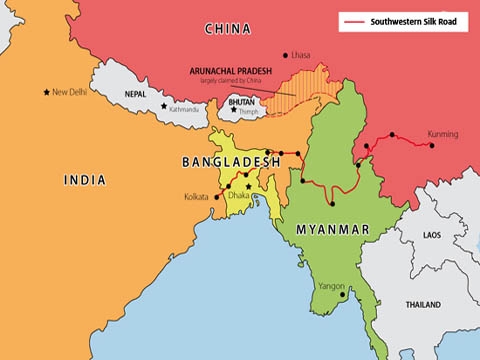 Beijing, December 20: An inter-governmental arrangement has been set up among China, Bangladesh, India and Myanmar to help boost economic cooperation, the Chinese foreign ministry said Friday.
According to Chinese foreign ministry spokeswoman Hua Chunying, the arrangement was the outcome of a two-day meeting of the Bangladesh-China-India-Myanmar (BCIM) Economic Corridor working group, which ended Thursday in Kunming, capital of China's Yunnan province, Xinhua reported.
The four parties also signed a joint research plan on the construction of the corridor, said Hua.
She said the four sides discussed priority areas relating to cooperation, and that they reached consensus on transport infrastructure, investment, trade, logistics, and culture.
China raised the proposal of building the BCIM Economic Corridor during Premier Li Keqiang's visit to India in May. Hua said the proposal was significant in deepening friendly cooperation and connecting East Asia and South Asia.
Among the initiatives proposed during their summit, both Chinese Premier Li Keqiang and Indian PM Singh agreed to further dialogues on the Bangladesh-China-India-Myanmar (BCIM) Economic Corridor, a strategic economic partnership proposed by the long-standing BCIM Forum.
As geographically connected countries, the BCIM Economic Corridor will ease the flow of goods between two of the world’s largest economies in India and China, while providing greater economic resources to the burgeoning markets of Bangladesh and Myanmar.
According to a joint press release issued yesterday by the Indian government, “India and China have each established a Study Group on the BCIM Economic Corridor. The visit of the Chinese delegation to India in this regard was noted as a positive step. Further discussions on concepts and alignment of the economic corridor are envisaged.”
The proposed corridor will cover 1.65 million square kilometers, encompassing an estimated 440 million people in China’s Yunnan Province, Bangladesh, Myanmar and Bihar in Northern India through the combination of road, rail, water and air linkages in the region. This interconnectedness would facilitate the cross-border flow of people and goods, minimize overland trade obstacles, ensure greater market access and increase multilateral trade.
Leaders hope the economic corridor will harken back to the days of the ancient Silk Road and its southwestern trade route, which represented the shortest journey between China and India and served as a highway for Chinese merchants transporting gold and silver bullion in the 12th Century.
Both China and India hope to rekindle their economic relations after bilateral trade activity fell by 12 percent in 2012. India has also expressed concern over its growing trade deficit with China, which reached US$29 billion dollars last year. As an incentive for greater capital inflows, PM Singh extended an offer to establish Chinese industrial parks within India’s industrial hot spots, which will be better served by the BCIM Economic Corridor’s enhanced connectivity.
Commenting on the economic potential of the two great nations, PM Singh said,
“first and foremost, we agreed that the prosperity and progress of 2.5 billion Indian and Chinese people will be a major factor for Asian resurgence and global prosperity and stability. We are determined to inject new dynamism to our economic relations.”
“When India and China shake hands, the world notices- I believe that my visit to China has put our relations on a path of stable and fast growth,” he further commented.