Muslim Personal Law Board moves SC against Karnataka HC verdict on hijab
29 Mar 2022 11:41:42
Bengaluru, Mar 29: Challenging the Karnataka High Court judgment over the Hijab row, the All India Muslim Personal Law Board (AIMPLB) has moved to the Supreme Court. The plea said the high court judgment while dismissing the petitions, has proceeded with erroneous reasons to address the issue.
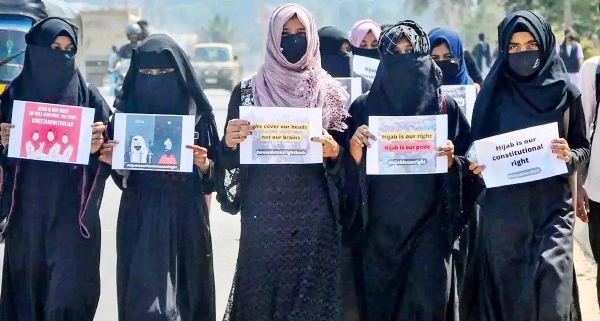
It should be noted that the Karnataka High court has upheld the ban on hijab in classrooms saying that the wearing of headscarves by Muslim women was not an essential religious practice.
In its appeal, the AIMPLB said, “The judgment legitimizes “Hijab ban” in educational institutions in the state which goes against the very basic structure of secularism.” The plea contended that laying too much emphasis on bringing "uniformity" in the uniform without accommodating a person of one religion 'to cover her hair with a piece of cloth' is travesty of justice, and the judgment also ignores the doctrine of reasonable accommodation.
“It is submitted that the judgment will lead to grave encroachment on the children of the Muslim community and shall lead to a situation where a large section of Muslim girls will be deprived from the stream of general education leading them to remain in vulnerability,” claimed the petition filed by the AIMPLB and two other Muslim women who are members of the Board.
“The issues decided by the high court at Karnataka widely impacts socio-religious ethos of the Muslim community. It does not merely affect but it also throws wide open the doors of interference with the religious freedom of individuals as well as various religious denominations by the state as well as instrumentalities of the state,” stated the petition filed by advocate MR Shamshad.
The plea contended that the high court judgment “presents an erroneous understanding of the Islamic texts particularly the primary and highest source of Islamic law i.e., the Holy Quran”. “There is a consensus amongst religious scholars of all schools of thought namely, Hanafi, Maliki, Shafai, and Hambli that practice of Hijab is ‘wajib’ (mandatory), a set of obligations, which if not followed, he/she will commit “sin” or become a “sinner”,” the petition filed by the Board stated.
Last week, the Supreme Court had refused to allow an urgent hearing on a separate petition filed by a Muslim student challenging the Hijab ban judgment as she was deprived of giving her exams wearing the headscarf. A bench headed by the chief justice of India (CJI) NV Ramana while refusing to list the matter urgently asked the petitioner not to sensationalise the matter as hijab had nothing to do with holding of exams.
..
.