PM Modi arrives in Nepal; Starts his visit from Maya Devi temple and Lumbini
16 May 2022 15:06:02
New Delhi, May 16: Prime Minister Narendra Modi arrived in Nepal today morning (May 16) on official visit to Nepal. PM Modi's one day visit to Nepal coincided with the auspicious occasion of Buddha Jayanti. On arrival at Lumbini, Prime Minister was warmly received by the Prime Minister of Nepal Sher Bahadur Deuba and several Ministers from the govt of Nepal. As Prime Minister, this is his fifth visit to Nepal and first to Lumbini.
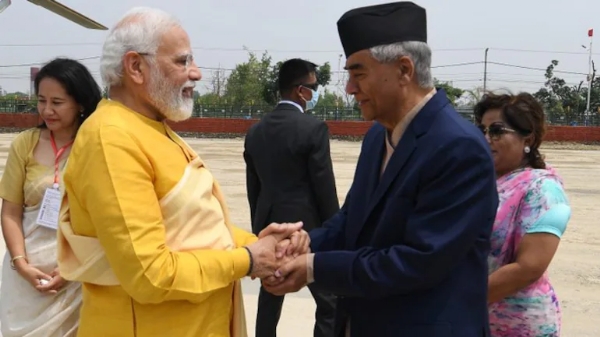
Prime Minister Narendra Modi started his one day visit to Nepal from the Mayadevi Temple in Lumbini as the first stop. He was accompanied by the Nepal PM Deuba and his spouse Dr. Arzu Rana Deuba. Both the Leaders paid their respects at the 'Marker Stone' inside the temple premises, which pinpoints the exact birth spot of Bhagwan Buddha. The two attended pooja on the occasion conducted as per Buddhist rituals. The two Prime Ministers also lit lamps near the Ashoka Pillar located adjacent to the temple. The pillar, which was erected by Emperor Ashoka in 249 BC, bears the first epigraphic evidence of Lumbini being the birthplace of Bhagwan Buddha. Thereafter, the two Prime Ministers also watered the Bodhi tree sapling from Bodh Gaya which was gifted by PM Modi to Lumbini in 2014.
At the same time, Prime Minister Narendra Modi and Prime Minister Sher Bahadur Deuba performed the Shilanyaas ceremony and laid the foundation stone of the construction of India International Centre for Buddhist Culture and Heritage in the Lumbini Monastic Zone. The Centre will be constructed by the International Buddhist Confederation (IBC), New Delhi, on a plot allocated by the Lumbini Development Trust (LDT), under an agreement between IBC and LDT signed in Mar 2022. After the Shilanyaas ceremony, which was performed by monks belonging to three major Buddhist traditions, Theravada, Mahayana and Vajrayana, the two Prime Ministers also unveiled a model of the Centre.
According to PM Modi, once completed, the Centre will be a world-class facility welcoming Buddhist pilgrims and tourists from all over the world to enjoy the essence of spiritual aspects of Buddhism. It will be a modern building, Net Zero compliant in terms of energy, water and waste handling, and will house prayer halls, meditation centers, library, exhibition hall, cafeteria, offices and other amenities.
Besides, the two leaders held bilateral discussions leading to several agreements between the two neighbours. The agreements signed and exchanged include MoU between Indian Council of Cultural Relations (ICCR) and Lumbini Buddhist University on the establishment of Dr. Ambedkar Chair for Buddhist Studies, MoU between Indian Council of Cultural Relations (ICCR) and CNAS, Tribhuvan University on the establishment of ICCR Chair of Indian Studies, MoU between Indian Council of Cultural Relations (ICCR) and Kathmandu University (KU) on the establishment of the ICCR Chair of Indian Studies, MoU in collaboration between Kathmandu University (KU), Nepal and Indian Institute of Technology Madras (IIT-M), Letter of Agreement (LoA) between Kathmandu University (KU), Nepal and Indian Institute of Technology (IITM) for Joint degree program at Master’s level and an agreement between SJVN Ltd and Nepal Electricity Authority (NEA) for Development and implementation of Arun 4 Project.