Not mandatory: Supreme Court upholds ED's power to arrest under PMLA
27 Jul 2022 15:24:31
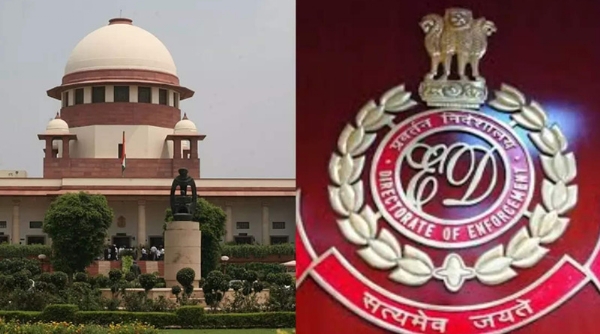
New Delhi, July 27: The Supreme Court on Wednesday upheld the Enforcement Directorate’s power to arrest and attach property under the Prevention of Money Laundering Act, 2002 (PMLA).
A three-judge bench of the Supreme Court, headed by Justice AM Khanwilkar, Wednesday read out the operative part of the verdict on a clutch of petitions challenging the law. Prominent names like Karti Chidambaram and former Jammu and Kashmir Chief Minister Mehbooba Mufti were among the petitioners in the case.
Their petitions raised multiple issues including the absence of a procedure to commence investigation and summoning, while the accused was not made aware of the contents of the Enforcement Case Information Report (ECIR).
It should be noted that Section 45 deals with offences to be cognizable and non-bailable. Section 50 of the PMLA empowers the 'authority' i.e. officers of the Enforcement Directorate, to summon any person to give evidence or produce records. All persons summoned are bound to answer questions put to them, and to produce the documents as required by the ED officers, failing which they can be penalised under the PMLA.
Also Read: Ram Sethu to be declared heritage? Supreme Court to hear case next week
The court said according to PMLA both indirect and direct proceeds of a crime will come under the ambit of money laundering. “Projecting a property as tainted property would constitute money laundering on its own,” the court said.
The court held the proceeds of the crime under PMLA include money laundering, generation, possession, and concealment of tainted money, and the ED is not required to prove whether it is legitimate money or not. Saying that the Act provides a balancing act and shows how proceeds of crime can be traced, the court held that there are enough safeguards for the accused under the Act.
However, the Centre had justified the constitutional validity of the provisions of PMLA. The Centre has apprised the court that around 4,700 cases are being investigated by the Directorate of Enforcement.
Also Read: Uddhav camp moves SC, seeks stay on EC proceedings on ‘real' Shiv Sena plea
The Centre said that PMLA is not a conventional penal statute but is a statute which is aimed at necessarily preventing money laundering, regulating certain activities relatable to money laundering, aims at confiscating the "proceeds of crime" and the property derived.
The Centre submitted that India, and its version of the Prevention of Money Laundering Act, 2002, is merely a cog in this international vehicle. It submitted that India, as a signatory to the treaties and an important participant in the international process and the fight against money-laundering, is bound legally and morally, to adopt the global best practices and respond to the changing needs of the times.