NB Twitter Scan | There is more to Bengaluru than Traffic and IT: Check out these diverse collection of trees that bloom all year-
Did you know Bengaluru has a diverse collection of trees that bloom all year? When the city was planned aeons ago, the trees were chosen in such a way that when one tree ceased blooming, another tree took its place. Bengaluru"s seasons are a floral symphony.
Total Views |


This article is based on twitter thread by @Neelavanam
Bengaluru, which is referred to as the "Silicon Valley of India" due to its thriving IT industry, often gets trolled for its traffic issues. The traffic situation in Bengaluru has become so severe that it is often referred to as one of the worst in the country. However, due to its traffic issues reputation, we sometimes forgot to look at the beautiful things.
Apart from traffic, Bengaluru is also known for its beautiful parks, gardens, and tree-lined streets. It is referred to as the "Garden City of India" and is home to a wide variety of flowering trees that bloom throughout the year. Bengaluru is also home to other flowering trees such as the Purple Orchid Tree, Crepe Myrtle, Queen's Flower, Honge Tree, and Indian Cork Tree, among others.
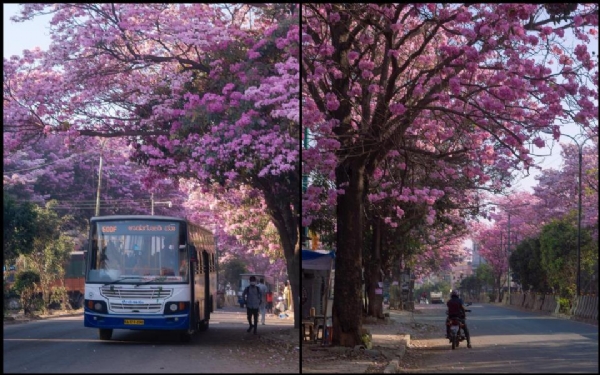
Did you know Bengaluru has a diverse collection of trees that bloom all year? When the city was planned aeons ago, the trees were chosen in such a way that when one tree ceased blooming, another tree took its place. Bengaluru's seasons are a floral symphony.
Even during the rainiest months, there is a tree that's adorned with blossoms. Apart from seasonal trees, there are perennial ones that blossom all year, filling in the tiny gaps in the flowering season. Bengaluru's air is always fragrant, hence its moniker, The Garden City. Recently, social media was abuzz with pictures of the pink Tabebuia Rosea flowers over the last month. These eye-catching blooms have been dubbed Bengaluru’s cherry blossoms.
Aside from the pink Tabebuias, there is also the beautiful yellow Tabebuia Argentea, which is another show stopper. The city's purple-blue jacaranda blooms are a shade darker compared to those in other cities. Bengaluru is also showered with the flowers of mango, neem, mahogany, Honge mara (Pongamia), false ashoka tree (Polyalthia longifolia), pride of India (Lagerstroemia speciosa), umbrella or Octopus tree (Schefflera actinophylla), Silk cotton (Bombax Ceiba), Rain tree (albizia saman) during the first three months of the year.
When the flowering season concludes, there is a burst of yellow from the copper pods (Peltophorum pterocarpum) until September. April, May, June & July belongs to Delonix Regia, the Gulmohar tree. Clusters of red flowers crown the trees and give a red carpet welcome to the monsoon rain.
The Kenjige/Ratnagandhi (Caesalpinia pulcherrima) with its multitudes of colours bloom in this season through July. The Sausage tree, Kigelia Pinata, drops the tired flowers to the floor early in the morning, while the white and deep red Plumerias never slumber.
ಇದು ಬೆಂಗಳೂರು ಮತ್ತು ಅದರ ಮರಗಳ ಬಗೆಗಿನ ಆಸಕ್ತಿದಾಯಕ ವಿಷಯವಾಗಿದೆ. ಬೆಂಗಳೂರು ನಗರವು ಮರಗಳು ಮತ್ತು ಕೆರೆಗಳು ಸೇರಿದಂತೆ ಪ್ರಕೃತಿಯೊಂದಿಗೆ ಬಹಳ ಗಾಢವಾದ
— Narendra Modi (@narendramodi) April 1, 2023
ಬಾಂಧವ್ಯವನ್ನು ಹೊಂದಿದೆ.
ತಮ್ಮ ಪಟ್ಟಣಗಳು ಮತ್ತು ನಗರಗಳ ಬಗೆಗಿನ ಇಂತಹ ಅಂಶಗಳನ್ನು ಪ್ರಚುರಪಡಿಸುವಂತೆ ನಾನು ಇತರರನ್ನು ಒತ್ತಾಯಿಸುತ್ತೇನೆ. https://t.co/OiM7DBR8E9
In August, when summer has faded, the scent of Sampige (Magnolia Champaca) takes over. In September and October, Akasha mallige (Millingtonia Hortenesis) competes by cleansing the morning moist air with its sweet scent.
The orangish crimson blooms of the African tulip, Neeru kaayi (Spathodea campanulata), begin to bloom in August and continue until December.
November brings back another stunning variety of Tabebuia. Tabebuia impetiginosa sheds its leaves, revealing clusters of deep pink blooms. Many of these trees can be found in Cubbon Park and the surrounding areas, and they really stand out in the winter. Around this time, some Jacarandas also tend to bloom.
The leaves of the almond tree (Terminalia catappa) turn reddish pink, then yellow, lending drama to the cold season.
The city's Perennial flowering trees include the Nagalinga flower (Couroupita guianensis), Nile Tulip tree( golden blooms with wavy seedpods), Portia tree, and the orange Geiger flowers.
The pattern continues into the next year, and the trees that have withstood the test of time continue to bloom. These are some of Bangalore's most prevalent avenue trees. I may have missed some names, but you get the idea.
It is a joy when residents enjoy the city's flora and fauna and talk about it. That is exactly what the finest horticulturists desired. The horticulturists Cameron, Krumbigel, Javaraya, and Mari Gowda designed this metropolis to be fragrant and colourful.
As the Greek proverb goes, "A society grows great when old men plant trees in the shade of which they may never sit." They planted trees in the hope that they would be protected and honoured.
You might be shocked to learn that many people who have lived here for a long time are unaware of the trees in their neighbourhood. The act of writing about local trees raises consciousness. And raising awareness helps to safeguard the trees.
While some of you may dislike my city, despise its people, curse its traffic, or even sneer at the sweet sambhar, I assure you there is always an eye-catching flower that will make you fall in love with Bangalore.
.
.