Maharashtra’s first ‘cluster school’ at Panshet covers 16 villages
The establishment of cluster schools aligns with Clause 7 of the National Education Policy 2020, which advocates for the consolidation of small schools into larger ones to ensure quality education.
Total Views |


Varasgaon, a small hamlet nestled in the Sahyadri Mountains, has witnessed a significant development in its education system. Pune’s Zilla Parishad, in adherence to the Right to Education Act of 2009, operates a primary school in the hamlet.
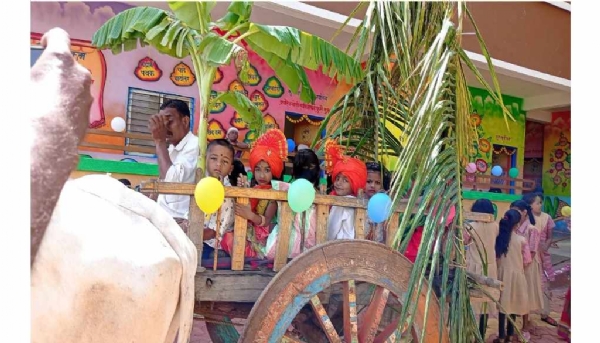
However, with just eight students enrolled from grades 1 to 5 and two teachers, the school faced challenges in providing a comprehensive education. Recognizing the need for quality education, Pune’s Zilla Parishad has established a Cluster School in Panshet, where 210 students from 13 public schools within a 10-kilometre radius are expected to study.
Today was the first day of the Cluster School. Students, attired in colorful uniforms, arrived at the school. It was a cheerful atmosphere, and parents from nearby villages, especially parents from PVTG (Particularly Vulnerable Tribal Groups), were also present. They were delighted to see their children enrolled in such a large and well-equipped school.
Popat Nalawade, Block Education Officer, Amol Nalawade, Ex-ZP member, Pankaj Patil, Mahatma Gandhi National fellow and Cluster School Coordinator, Anil Bhandari, Janki Devi Bajaj Gram Sanstha, Sameer More, beat-in-charge, teachers, parents were present on the occasion.
“For now, 132 students are enrolled to date, and hoping others will get enrolled in the next few days”, said Patil.
The establishment of cluster schools aligns with Clause 7 of the National Education Policy 2020, which advocates for the consolidation of small schools into larger ones to ensure quality education. Pune Zilla Parishad operates 3,638 primary schools, of which 403 schools have an enrollment of 150 or more students. These schools collectively educate 50% of the district’s 2.30 lakh students. To ensure adequate infrastructure for these 403 schools, a scheme was introduced, estimated to cost Rs 96 crores.
However, the estimated cost per child in smaller schools is approximately Rs 6.4 lakhs, compared to Rs 90,000/- in larger schools. The discrepancy arises due to fixed costs such as eLearning resources, which remain the same regardless of the number of students. To address this issue, it is imperative to invest in cluster schools that can provide the necessary infrastructure and educational resources as per the National Education Policy.
To assess the educational outcomes, Pune Zilla Parishad conducted the Fundamental Literacy and Numeracy (FLN) test, evaluating language proficiency and mathematics skills for classes 1 to 5. The data collected indicated that students from smaller schools generally exhibited lower levels of language and mathematics skills compared to their counterparts in larger schools. This disparity was particularly evident at level 1, where students from small schools struggled with literacy and numeracy.
Moreover, a smaller number of students from these schools reached level 3 in language skills, indicating a lower level of mastery compared to students from larger schools. These findings highlight the disadvantages faced by students in smaller schools, hindering their learning outcomes and overall development.