US Supreme Court Ends Affirmative action in the US Universities
30 Jun 2023 13:15:16
Washington D.C., Jun30: Public universities can no longer consider race in admissions, a practice known as affirmative action, following a 6-3 decision released by the U.S. Supreme Court on Thursday morning. In an opinion delivered by Chief Justice John Roberts, the Court cited precedent cases such as Regents of the University of California v. Bakke, Grutter v. Bollinger, and Fisher v. University of Texas at Austin. This decision overturns the precedent set by Regents of the University of California v. Bakke.
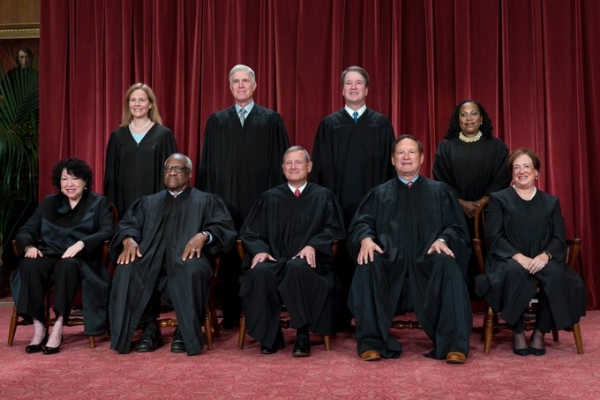
The admissions policies also were unconstitutional under the Equal Protection Clause of the Fourteenth Amendment, Roberts wrote, because they require race to be used as a "negative." Harvard's policies, he wrote, have resulted in fewer admissions for Asian American students. Roberts also wrote that the policies were unconstitutional because they require stereotyping. He wrote the universities assumed that students of the same race "think alike." "Accordingly, as this Court’s early decisions interpreting the Equal Protection Clause explained, the Fourteenth Amendment guaranteed 'that the law in the States shall be the same for the black as for the white; that all persons, whether colored or white, shall stand equal before the laws of the States,'” he wrote.
I strongly disagree with @RobertKennedyJr that affirmative action is about “letting in those who have been left out in the cold.” That’s wrong. The majority of black students at Harvard are not descendants of slaves but descendants of immigrants. Giving special preferences to… https://t.co/OkrgxzGXay
— Vivek Ramaswamy (@VivekGRamaswamy) June 29, 2023
Roberts also wrote that the universities' policies lack a "logical endpoint." The universities argued that "the end of race-based admissions programs will occur once meaningful representation and diversity are achieved on college campuses," but he wrote that "outright racial balancing" is "patently unconstitutional." "Many universities have for too long wrongly concluded that the touchstone of an individual’s identity is not challenged bested, skills built, or lessons learned, but the color of their skin," he wrote. "This Nation’s constitutional history does not tolerate that choice." The Court heard oral arguments on Oct. 31 between UNC and Students for Fair Admissions, an anti-affirmative action nonprofit. The Court also ruled against Harvard College, a case originally consolidated against UNC, but separated in July after Justice Ketanji Brown Jackson recused herself for previous involvement at Harvard. Because affirmative action is related to a government entity and the consideration of race, it is subject to strict scrutiny, the tightest level of review to prove constitutionality. Thus, in order for the Court to view the practice as constitutional, it must have been proven to reflect a compelling government interest and be narrowly tailored to that interest. Roberts wrote that affirmative action fails strict scrutiny because the goals the universities presented were not judicially meaningful and because the universities' admissions programs didn't demonstrate a meaningful connection between the "means they employ and the goals they pursue." Under a more than 20-year precedent first set in the 1978 case Regents of the University of California v. Bakke, colleges could consider race in their admissions processes as long as it was only an individualized, informal “plus” for an applicant, rather than part of a numeric quota for diversity.
This precedent, first confirmed in 2003, acknowledged affirmative action as a necessary, corrective system to racial inequality in higher education. The establishing case, however, recommended a 25-year limit on affirmative action — a limit that would have theoretically expired in five years. During oral arguments, multiple justices questioned the University’s lack of a clear, quantitative off-ramp from race-conscious admissions, though UNC’s counsel argued that abiding by a sunset quota may be risky. The lawsuit against the University was originally filed in November 2014, alleging that the University's admissions processes were in violation of the equal protection clause of the Fourteenth Amendment as well as Title VI of the Civil Rights Act of 1964. Some experts have argued that racial minority enrollment in higher education will plummet as a result of this decision. Some states have outlawed race-conscious admissions for years — including Arizona, California, Florida, Georgia, Michigan, Nebraska, New Hampshire, Oklahoma, and Washington. These pilot states have yielded various results in terms of diverse enrollment. "Court’s settled law that the Equal Protection Clause of the Fourteenth Amendment authorizes a limited use of race in college admissions in service of the educational benefits that flow from a diverse student body," Justice Sonia Sotomayor wrote in the dissent. "From Brown to Fisher, this Court’s cases have sought to equalize educational opportunity in a society structured by racial segregation and to advance the Fourteenth Amendment’s vision of an America where racially integrated schools guarantee students of all races the equal protection of the laws."