Remembering Sant Gadge Maharaj who rooted India’s Swachchta Abhiyaan Mission decades ago
Total Views |


While India is striving on its mission to achieve the #SwachchataAbhiyaan goal, the soul who started this road towards cleanliness decades ago was none other than the great Sant Gadge Maharaj. The man who not only worked for the poor but he also worked for the whole society.
Sant Gadge Maharaj was a hero of the 19th century who ‘fed the hungry’, ‘gave shelter to the needy’, and ‘protected the environment’.
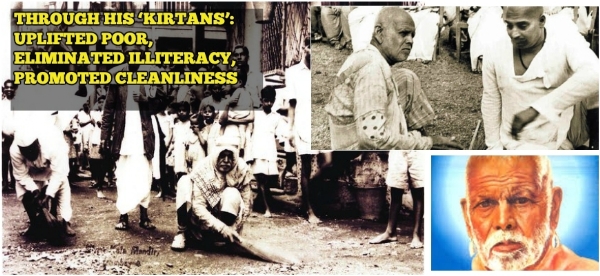
Sant Gadge Maharaj was a great saintly reformist who strived for the material as well as spiritual upliftment of the poor and to eliminate superstition, illiteracy, and unsanitary conditions.
Maharaj was born in Shedgaon village in Amravati District of Maharashtra in a washerman's family. A public teacher, he traveled from one place to another wearing his food pan upturned on his head and carrying his trademark broom. When he entered a village, he would instantly start cleaning the gutters and roads of the village. He also told the citizens of the village that their congratulations would have to wait until his work was done. In return, the villagers gave him money. With this money, Maharaj built educational institutions, dharmasalas, hospitals, and animal shelters. He conducted his discourses in the form of "Kirtans" in which he would emphasize values like service to humanity and compassion. During his kirtans he would educate people against blind faiths and rituals. He would use Dohas by Saint Kabir in his discourses.
He tried to embody the values that he preached: hard work, simple living, and selfless service to the poor. He abandoned his family (wife and 3 children) to pursue this path. Maharaj met the spiritual teacher Mehar Baba several times. Mehar Baba indicated that Maharaj was one of his favorite saints and that Maharaj was on the sixth plane of consciousness. Maharaj invited Mehar Baba to Pandharpur, India, and on 6 November 1954 thousands of people had Maharaj and Mehar Baba’s darshan.
He devoted his entire life to eradicating ignorance, blind faith, innocent beliefs and improper traditions from society. He used the media of Kirtan towards this goal. In his Kirtan, he would question the audience to make them aware of their ignorance, bad qualities, and behavioral traits. His sermons would be simple. His sermons would include simple lessons like don’t steal, don’t take loans from moneylenders, don’t become addicts, don’t kill animals in the name of god and religion, don’t follow caste differentiation, and social quarantining. He tried to imprint on the common man’s mind that God was in human beings and not in a stone idol. He considered Saint Tukaram Maharaj as his Guru. At the same time he would proclaim that he was not a Guru to anyone, nor did he have any disciples. To get his message across to the common man, he would use the colloquial language, especially the Vidharba dialect. He made ample use of Saint Tukaram’s Abhanga (devotional songs) in his Kirtan. Prabodhankar Thackeray, who wrote Gadge Baba’s biography, had this to say - "He would entrance people from all walks of life, from the village ignoramus to the slick urbanites, and convince them of his ideology. I find myself incapable of accurately describing his Kirtan".
On December 20th, 1956 the Great Saint left this mortal world. Even though many years have passed since his departure there is a lot of following for him. The government of Maharashtra state also runs a village cleanliness program named after him. The University of Amravati was renamed Sant Gadge Baba University.