Crimson Crescent: Movie delved into human psychology of destruction and mass killing due to terrorism
NewsBharati 29-Oct-2025 13:22:47 PM
Total Views |


Crimson Cresent is a Picture released at the Press Club of India and now streaming across platforms such as Jihad Watch, Sangam Talks, Politically Incorrect, Upword, India Speaks Daily, Hindu Post, Sanatan Prabhat, Sudarshan News, Qvive Tv and You tube- easy to access content. The film has already stirred millions on YouTube, social media and private screenings. Written and Directed by a maverick activist cum film /media professional; Mayank Jain. This brilliant piece of research is of 107 minutes chilling discourse of how the entire world is suffering at the hands of fanatics. Motivated by an idea- war is of ideas, religious ideologies of crusades and jihad and not only of bullets. Ideas manifest into destruction by human bombs, suicidal attacks and rampant firing. A quasi-documentary is a piece of informative art at the level of any top products created by National Geographic. One can give full marks for the research, the message and compiling effort to Mayank.
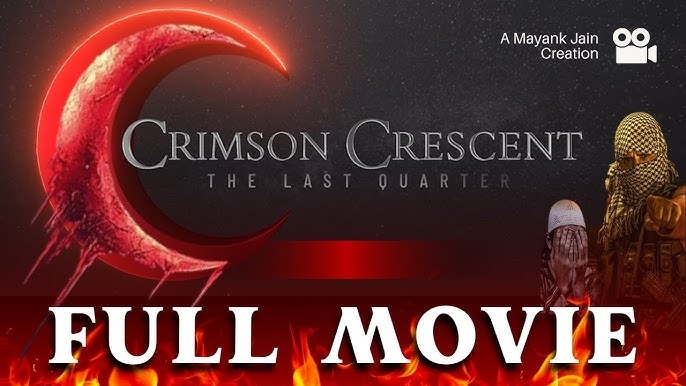
This film is full of real-life interviews of important influential people in power or the helms of affair, media reports and depicts the way the world is moving rapidly today – seemingly rudderless and ruthless destruction by man with mass killings because of terrorism and political patronage of non-state actors. Terrorism is like climate change- ‘everyone knows about it but no one is seriously doing anything about it.’
Why humans kill?
It starts brilliantly by differentiating the mentality of an animal in the jungle and a ‘civilised’ man/woman who calls himself a social animal. It says that a predator like a lion, tiger or leopard chases and kills his pray for two simple reasons- first, if it hungry and second if he is attacked or senses a danger! Yet, historically, man has killed a man for power and influence as well as warped ego and ideology most of the time, impossible to decipher.
An animal kills a prey and once his stomach is full, he does not go on a rampant carnage by killing thousand more goats- therefore the killing is need based. There is no factor of a superiority or hatred towards his pray for a predator.
As per definition a predator is an organism, usually an animal, that hunts, kills, and eats other organisms for food. In a biological context, predators are essential for maintaining ecosystem balance, as they keep populations of their prey in check.
Nothing like this is true for a man- he kills out of vengeance, hatred, pleasure and several other deranged ways of thoughts he generates in his head, and thereafter there is no role of the heart.
Mayank brilliantly and painstakingly has collected, collated, corroborated and compiled a piece of art, which tells the world that it is time we wake up and smell the coffee. We collectively have to do ‘atma chintan’ or introspection about what we are doing to each other. We have advanced in medicine, comfort providing goods and yet there is so much of suffering. He quantifies the loss because of terrorism and it amounts to shaving off trillions of dollars of GDP of nations.
Hitler did this to entire Europe and battered the word for six long years, in particular his hatred for Jews was palpable and he with his Nazi fanatics killed six million Jews systematically. World War II caused an estimated 50 to 85 million deaths, making it the deadliest conflict in human history.
Historical perspective
Mayank clearly sets the tone by giving several instances of avoidable warfare and destruction from the history.
World War I began in July 1914 in central Europe. The war stopped on 11 November, 1918, it took several months before a peace treaty, and ‘Treaty of Versailles’ could be signed, on 28th June 1919. British, French, Italy and US that mostly negotiated and decided the terms of the supposedly very harsh treaty. Germany was not allowed to participate in the negotiation process as they had lost the war. Treaty blamed Germany and held it fully responsible to start the war and cause destruction.
After the treaty was signed, the rest of the Europe was in the mood of ‘And they lived happily ever after’. No one wanted to have war again, public and politicians both across Europe and even America.
Was the blue print of death conveniently ignored? Yes, it was.
On July 18, 1925, Volume One of Adolf Hitler’s philosophical autobiography, Mein Kamph, is published. It was a blueprint of his agenda for a Third Reich and a clear exposition of the nightmare that will envelope Europe from 1939 to 1945. The book sold a total of just 9,473 copies in its first year. For Hitler, the state was not an economic entity, but a ‘racial’ one. He had given a blow-by-blow account of things to come including his hatred for the Jews.
It was not until 1933, the first year of Hitler’s tenure as chancellor of Germany that sales soared to over 1 million. Its popularity reached the point where it became a ritual to give a newly married couple a copy (Much like terrorist created motivation booklets given out for radicalization and becoming a terrorist). It became the Bible of Germany for freedom and destruction of the world. The message was loud and clear, ‘we will kill, exterminate all Jews and we will rule the world’. No ifs and buts and Germany were fully radicalised.
As for leadership, Hitler’s Third Reich would mimic the Prussian ideal of absolute authoritarian rule. “There must be no majority decisions, but only responsible persons… Surely every man will have advisers… but the decision will be made by one man.” Very much so in terrorist organizations today.
He beautifully links it to terror organizations today which are fuelled and funded by politicians and clerics. For politicians it is an army of non-state actors and for clerics it is control- control of minds for a higher purpose. The film depicts through various interviews how radicalization of youth is done through Madrassas. Interviews of Muslim scholars, men and women, senior police officers, intellects all point towards these starkly visible fault lines.
The film reveals that only China has taken strict action against Muslim Uigurs and none of the Islamic nations have raised concerns.
In the late summer of 2018, the United Nations revealed that at least a million Uighurs had been detained in “counter-extremism centres” in China’s Xinjiang province, thrusting the treatment of a once-obscure mostly Muslim ethnic group into the spotlight.
The report also revealed that a further two million Uighurs had been “forced into so-called re-education camps for political and cultural indoctrination” beginning in the middle of 2017. These are large numbers, and Chinese government is the only government that has taken a high handed yet pragmatic approach. The film depicts Muslim terrorist attacks in Europe, especially France and UK. The French are taking action and so is Italy through stricter laws.
Economic loss to India
India as a nation state has suffered at the hands of cross border Jihadist terror and raised this issue with UN all along. The pain has been both physical and economical. While thousands perished at the hands of terrorists the loss in terms of money is no less.
• The 2008 Mumbai attacks cost India $100 billion (₹9 lakh crore), including $20 billion in lost foreign investment
• In 2017 alone, terrorism and communal violence drained 9 per cent of India’s GDP — nearly $1 trillion in PPP terms
• In 2020, the loss stood at $646 billion (₹56.23 lakh crore)
Winds of change
USSR was an Iron curtain through second world war and the cold war. It was a strict repressive police state under the communist regime.
Mikhail Gorbachev was praised for his role in ending the Cold War, introducing new political and economic freedoms in the Soviet Union, and tolerating both the fall of Marxist–Leninist administrations in eastern and central Europe.
The two Russian words most famously attached to Mikhail Gorbachev are glasnost ("openness") and perestroika ("restructuring"). These were his signature policies, which aimed to reform the Soviet Union's political and economic systems. Change is possible albeit in a bloodless way if top leadership wants.
Mecca and Medina are the two holiest cities in Islam, located in Saudi Arabia – a very conservative nation. Recently Prince Muhamad Bin Salman (MBS) their ruler, realising that the nation needs to progress, has made all out efforts to rapidly loosen the tight reigns, yet more is required. His own brother is a vegan. The driving force is that they being dependent on their oil produce are now beginning to realise that petrol dollars will not be available to keep pushing radicalization, an expensive activity; and they better start focussing on progress than ideology.
Earlier they poured billions into radical terrorism. Mayank Jain raises a sharper question; if Saudi Arabia has truly ended the export of Wahhabi ideology, does its moral responsibility also end? For decades, billions in petrodollars financed radicalisation, terror networks and ideological subversion from South Asia to Europe. The damage runs into lives, livelihoods and national security. Shouldn’t a nation that once sponsored this global extremism now offer reparations—not merely apologies—to those who paid the price in blood and stability?
Iran today
Eighty percent of Iranians want democracy and want to lead a normal life. Internet is also a big leveller- it answers questions for which youth is looking for answers and radical clerics refuse to give.
Technology gives problems and solutions too. Artificial Intelligence now writes sermons and produces propaganda videos. But it also fuels reform. Platforms like ex-believer YouTube channels reach millions, offering safe exits from fear.
In various articles and discussions following the film’s release, Mayank Jain has extended this argument — suggesting that digital platforms now challenge clerical monopolies over belief, much like Gutenberg’s invention once disrupted ecclesiastical control. The Internet, he argues, is not just a tool of propaganda. It is also a gateway to dissent, dialogue and de-radicalisation
Education as Weapon is an important expose. One of the film’s most arresting segments unfolds in Delhi’s Sundarnagari. Jain approaches a madrasa to conduct interviews. Within minutes, a crowd gathers, tempers flare and the shoot is aborted. The message is clear. Some questions must not be asked.
President Donald Trump has in no uncertain terms has said on the Saudi soil that Islamic terror must end. At Arab and Muslim leaders’ summit President Donald Trump implored Saudi Arabia and other Middle Eastern countries to extinguish “Islamic extremism” emanating from the region, describing a “battle between good and evil” rather than a clash between the West and Islam.
The Hindu Mandir in Abu Dhabi is a remarkable achievement of cultural harmony, architectural excellence, and spiritual significance. It is the first traditional Hindu stone temple in the Middle East, and a symbol of the UAE’s commitment to tolerance and diversity.
India faces a big challenge from Pakistan which has become a terror factory and now Bangladesh liberated by India has also come in the grip of Islamic Jihadi groups.
Describing the seriousness of the problem
This film depicts how the terror tentacles have spread in the entire Europe because of the continent allowing refuge to the Muslims who escaped their war-torn nations. They were expecting them to merge into the society, but have now realised that the migrants want to still live in their own way. The film talks of ‘grooming gangs’ in UK and rise in crimes because of these migrants. It also talks about ‘love jihad’ a version of grooming gangs in India. A totally peaceful nation like New Zealand is also now suffering because of Islamic terror. Mayank describes the mindset of the ideology in great detail and dwells on radicalization through madrassas, clerics and political patronage- power and control being at the centre of it.
Nazi party under Adolf Hitler also spread death and destruction following a philosophy of superior Aryan race and so is the present and clear danger posed by radicalisation of masses by clerics supported by the left leaning political parties. In the Second World War, you had one enemy causing devastation- the Axis power lead by Germany, but in the case of terrorism through religious indoctrination-based radicalization, it is more like the ghost who walks. The perpetrator is almost everywhere.
Though it gives all the details, the solution to this complex problem has not been presented- probably the creator wanted to showcase only the present and clear danger to the entire world and it should apply its mind to the problem ASAP before it is too late.
Today though national leaders are acting- but it seems- too little too late?
The way out is top down and bottom-up approach to be taken and executed simultaneously. Top leaders of nations have to get the ball rolling as done by Saudi Arabia. The Muslim community needs to rethink about their ideology. Many have abandoned their faith and want to move on with life in the direction of progress. At the society level initiatives need to be taken collectively by all faiths to address the problem in a holistic way. To get detailed feel of the issue in three dimensions, one must watch the movie.
This film is full of real-life interviews of important influential people in power or the helms of affair, media reports and depicts the way the world is moving rapidly today – seemingly rudderless and ruthless destruction by man with mass killings because of terrorism and political patronage of non-state actors. Terrorism is like climate change- ‘everyone knows about it but no one is seriously doing anything about it.’
Why humans kill?
It starts brilliantly by differentiating the mentality of an animal in the jungle and a ‘civilised’ man/woman who calls himself a social animal. It says that a predator like a lion, tiger or leopard chases and kills his pray for two simple reasons- first, if it hungry and second if he is attacked or senses a danger! Yet, historically, man has killed a man for power and influence as well as warped ego and ideology most of the time, impossible to decipher.
An animal kills a prey and once his stomach is full, he does not go on a rampant carnage by killing thousand more goats- therefore the killing is need based. There is no factor of a superiority or hatred towards his pray for a predator.
As per definition a predator is an organism, usually an animal, that hunts, kills, and eats other organisms for food. In a biological context, predators are essential for maintaining ecosystem balance, as they keep populations of their prey in check.
Nothing like this is true for a man- he kills out of vengeance, hatred, pleasure and several other deranged ways of thoughts he generates in his head, and thereafter there is no role of the heart.
Mayank brilliantly and painstakingly has collected, collated, corroborated and compiled a piece of art, which tells the world that it is time we wake up and smell the coffee. We collectively have to do ‘atma chintan’ or introspection about what we are doing to each other. We have advanced in medicine, comfort providing goods and yet there is so much of suffering. He quantifies the loss because of terrorism and it amounts to shaving off trillions of dollars of GDP of nations.
Hitler did this to entire Europe and battered the word for six long years, in particular his hatred for Jews was palpable and he with his Nazi fanatics killed six million Jews systematically. World War II caused an estimated 50 to 85 million deaths, making it the deadliest conflict in human history.
Historical perspective
Mayank clearly sets the tone by giving several instances of avoidable warfare and destruction from the history.
World War I began in July 1914 in central Europe. The war stopped on 11 November, 1918, it took several months before a peace treaty, and ‘Treaty of Versailles’ could be signed, on 28th June 1919. British, French, Italy and US that mostly negotiated and decided the terms of the supposedly very harsh treaty. Germany was not allowed to participate in the negotiation process as they had lost the war. Treaty blamed Germany and held it fully responsible to start the war and cause destruction.
After the treaty was signed, the rest of the Europe was in the mood of ‘And they lived happily ever after’. No one wanted to have war again, public and politicians both across Europe and even America.
Was the blue print of death conveniently ignored? Yes, it was.
On July 18, 1925, Volume One of Adolf Hitler’s philosophical autobiography, Mein Kamph, is published. It was a blueprint of his agenda for a Third Reich and a clear exposition of the nightmare that will envelope Europe from 1939 to 1945. The book sold a total of just 9,473 copies in its first year. For Hitler, the state was not an economic entity, but a ‘racial’ one. He had given a blow-by-blow account of things to come including his hatred for the Jews.
It was not until 1933, the first year of Hitler’s tenure as chancellor of Germany that sales soared to over 1 million. Its popularity reached the point where it became a ritual to give a newly married couple a copy (Much like terrorist created motivation booklets given out for radicalization and becoming a terrorist). It became the Bible of Germany for freedom and destruction of the world. The message was loud and clear, ‘we will kill, exterminate all Jews and we will rule the world’. No ifs and buts and Germany were fully radicalised.
He beautifully links it to terror organizations today which are fuelled and funded by politicians and clerics. For politicians it is an army of non-state actors and for clerics it is control- control of minds for a higher purpose. The film depicts through various interviews how radicalization of youth is done through Madrassas. Interviews of Muslim scholars, men and women, senior police officers, intellects all point towards these starkly visible fault lines.
The film reveals that only China has taken strict action against Muslim Uigurs and none of the Islamic nations have raised concerns.
In the late summer of 2018, the United Nations revealed that at least a million Uighurs had been detained in “counter-extremism centres” in China’s Xinjiang province, thrusting the treatment of a once-obscure mostly Muslim ethnic group into the spotlight.
The report also revealed that a further two million Uighurs had been “forced into so-called re-education camps for political and cultural indoctrination” beginning in the middle of 2017. These are large numbers, and Chinese government is the only government that has taken a high handed yet pragmatic approach. The film depicts Muslim terrorist attacks in Europe, especially France and UK. The French are taking action and so is Italy through stricter laws.
Economic loss to India
India as a nation state has suffered at the hands of cross border Jihadist terror and raised this issue with UN all along. The pain has been both physical and economical. While thousands perished at the hands of terrorists the loss in terms of money is no less.
• The 2008 Mumbai attacks cost India $100 billion (₹9 lakh crore), including $20 billion in lost foreign investment
• In 2017 alone, terrorism and communal violence drained 9 per cent of India’s GDP — nearly $1 trillion in PPP terms
• In 2020, the loss stood at $646 billion (₹56.23 lakh crore)
Winds of change
USSR was an Iron curtain through second world war and the cold war. It was a strict repressive police state under the communist regime.
Mikhail Gorbachev was praised for his role in ending the Cold War, introducing new political and economic freedoms in the Soviet Union, and tolerating both the fall of Marxist–Leninist administrations in eastern and central Europe.
The two Russian words most famously attached to Mikhail Gorbachev are glasnost ("openness") and perestroika ("restructuring"). These were his signature policies, which aimed to reform the Soviet Union's political and economic systems. Change is possible albeit in a bloodless way if top leadership wants.
Mecca and Medina are the two holiest cities in Islam, located in Saudi Arabia – a very conservative nation. Recently Prince Muhamad Bin Salman (MBS) their ruler, realising that the nation needs to progress, has made all out efforts to rapidly loosen the tight reigns, yet more is required. His own brother is a vegan. The driving force is that they being dependent on their oil produce are now beginning to realise that petrol dollars will not be available to keep pushing radicalization, an expensive activity; and they better start focussing on progress than ideology.
Earlier they poured billions into radical terrorism. Mayank Jain raises a sharper question; if Saudi Arabia has truly ended the export of Wahhabi ideology, does its moral responsibility also end? For decades, billions in petrodollars financed radicalisation, terror networks and ideological subversion from South Asia to Europe. The damage runs into lives, livelihoods and national security. Shouldn’t a nation that once sponsored this global extremism now offer reparations—not merely apologies—to those who paid the price in blood and stability?
Iran today
Eighty percent of Iranians want democracy and want to lead a normal life. Internet is also a big leveller- it answers questions for which youth is looking for answers and radical clerics refuse to give.
Technology gives problems and solutions too. Artificial Intelligence now writes sermons and produces propaganda videos. But it also fuels reform. Platforms like ex-believer YouTube channels reach millions, offering safe exits from fear.
In various articles and discussions following the film’s release, Mayank Jain has extended this argument — suggesting that digital platforms now challenge clerical monopolies over belief, much like Gutenberg’s invention once disrupted ecclesiastical control. The Internet, he argues, is not just a tool of propaganda. It is also a gateway to dissent, dialogue and de-radicalisation
Education as Weapon is an important expose. One of the film’s most arresting segments unfolds in Delhi’s Sundarnagari. Jain approaches a madrasa to conduct interviews. Within minutes, a crowd gathers, tempers flare and the shoot is aborted. The message is clear. Some questions must not be asked.
President Donald Trump has in no uncertain terms has said on the Saudi soil that Islamic terror must end. At Arab and Muslim leaders’ summit President Donald Trump implored Saudi Arabia and other Middle Eastern countries to extinguish “Islamic extremism” emanating from the region, describing a “battle between good and evil” rather than a clash between the West and Islam.
The Hindu Mandir in Abu Dhabi is a remarkable achievement of cultural harmony, architectural excellence, and spiritual significance. It is the first traditional Hindu stone temple in the Middle East, and a symbol of the UAE’s commitment to tolerance and diversity.
India faces a big challenge from Pakistan which has become a terror factory and now Bangladesh liberated by India has also come in the grip of Islamic Jihadi groups.
Describing the seriousness of the problem
This film depicts how the terror tentacles have spread in the entire Europe because of the continent allowing refuge to the Muslims who escaped their war-torn nations. They were expecting them to merge into the society, but have now realised that the migrants want to still live in their own way. The film talks of ‘grooming gangs’ in UK and rise in crimes because of these migrants. It also talks about ‘love jihad’ a version of grooming gangs in India. A totally peaceful nation like New Zealand is also now suffering because of Islamic terror. Mayank describes the mindset of the ideology in great detail and dwells on radicalization through madrassas, clerics and political patronage- power and control being at the centre of it.
Nazi party under Adolf Hitler also spread death and destruction following a philosophy of superior Aryan race and so is the present and clear danger posed by radicalisation of masses by clerics supported by the left leaning political parties. In the Second World War, you had one enemy causing devastation- the Axis power lead by Germany, but in the case of terrorism through religious indoctrination-based radicalization, it is more like the ghost who walks. The perpetrator is almost everywhere.
Though it gives all the details, the solution to this complex problem has not been presented- probably the creator wanted to showcase only the present and clear danger to the entire world and it should apply its mind to the problem ASAP before it is too late.
Today though national leaders are acting- but it seems- too little too late?
The way out is top down and bottom-up approach to be taken and executed simultaneously. Top leaders of nations have to get the ball rolling as done by Saudi Arabia. The Muslim community needs to rethink about their ideology. Many have abandoned their faith and want to move on with life in the direction of progress. At the society level initiatives need to be taken collectively by all faiths to address the problem in a holistic way. To get detailed feel of the issue in three dimensions, one must watch the movie.
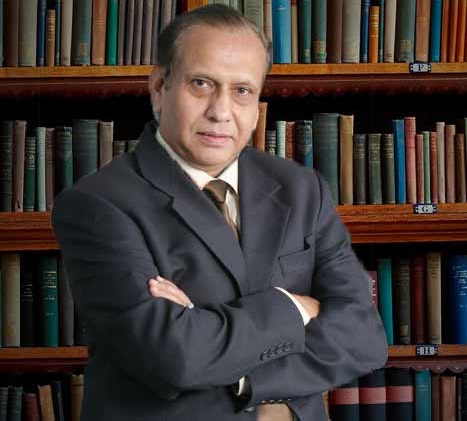
Virender Kapoor
A thinker, educationist and an inspirational guru. Kapoor is an Indian who wears many hats. An educationist of repute, he was the Director of a prestigious management Institute under the Symbiosis umbrella. He has emerged as a leading think tank in human behavior, motivation and success. As a celebrity author, his name appears with the likes of Thomas Friedman and Dale Carnegie. He has authored more than 30 books as of now which are on Amazon worldwide and several of his books are in the pipeline.