Sonam Wangchuk hits headlines, thanks to fuelling unrest in Ladakh
03 Oct 2025 14:44:51
Once hailed as India’s “Crown Jewel” for its monasteries and glaciers, Ladakh now finds itself scarred by violence and disillusionment. The region, long synonymous with serenity, recently witnessed its darkest day. The streets of Leh erupted in flames, anger, and loss. At the epicentre stands Sonam Wangchuk, the engineer-innovator once celebrated as Ladakh’s conscience, who is now detained under the National Security Act and accused of inciting unrest.
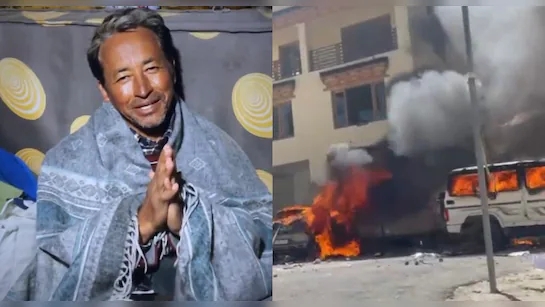
The Day Leh Burned
On 24 September 2025, a bandh demanding statehood and Sixth Schedule protections spiralled into chaos. Protesters stormed government buildings and BJP offices, torched vehicles, and clashed with police. By evening, four lives were lost, dozens were injured, and a CRPF van narrowly escaped being set ablaze. Curfew was declared as mobs targeted police stations and public property. A shocking image for a land once defined by prayer flags and peace.
Authorities insist the violence was not spontaneous but the culmination of sustained mobilisation, amplified by political actors exploiting local anxieties.
The Reinvention of Sonam Wangchuk
Wangchuk’s public image was carefully built — an education reformer, an environmental crusader, even the inspiration behind a Bollywood icon. Yet his critics note an ideological drift that mirrors shifting political winds.
In 2019, when Article 370 was revoked and Ladakh became a Union Territory, Wangchuk publicly rejoiced:
“Thank you, Prime Minister! Ladakh’s 30-year dream of UT status is fulfilled.”
Today, that jubilation has turned to accusation. His new demand — statehood with Sixth Schedule autonomy — is portrayed by detractors as opportunism, though admirers call it the voice of Ladakh’s evolving aspirations.
The Phyang Flashpoint
The spark, insiders say, was administrative rather than ideological. On 21 August 2025, the Leh Deputy Commissioner cancelled the 40-year lease on 135 acres in Phyang, granted in 2018 for Wangchuk’s Himalayan Institute of Alternative Learning (HIAL).
Officials cited six years of inaction — no university affiliation, negligible construction, and crores in unpaid dues — alongside local complaints of encroachment. The order repossessed the land and demanded settlement of arrears.
Wangchuk denounced the move as political vendetta and soon launched a 35-day hunger strike, fusing his personal grievance with a broader autonomy campaign. Supporters saw moral resistance; sceptics saw deflection after a major setback.
Funding Under Scrutiny
The troubles deepened when his NGO, the Students’ Educational and Cultural Movement of Ladakh (SECMOL), lost its FCRA licence over alleged violations — fund diversion, opaque reporting, and spending beyond sanctioned purposes.
Such concerns, records show, pre-date the present government. In 2007, under the UPA, local authorities accused SECMOL of occupying government land, misusing foreign grants, and pressuring the Hill Council. Intelligence inputs even flagged questionable foreign linkages. The pattern, officials argue, reveals continuity of irregularities rather than selective targeting.
From Fast to Arrest
Wrapped in blankets amid sub-zero winds, Wangchuk’s fasting image spread worldwide — a solitary reformer confronting state apathy. He warned, “Sonam Wangchuk in jail is more dangerous than outside.”
The prophecy proved swift. After the Leh riots, he was detained on 25 September under the National Security Act. To critics, this marked the law catching up with an instigator; to followers, it symbolised repression of conscience.
Political Undercurrents
Investigations suggest opposition-linked networks amplified the agitation online, styling Wangchuk as a “modern Gandhi.” Hashtag campaigns echoed tactics seen in previous pan-India protests, prompting suspicion of orchestration beyond Ladakh.
Government sources warn that unrest in a border-sensitive zone risks national security. Supporters counter that branding dissent as “foreign-inspired” undermines democratic dialogue.
Why Ladakh Matters
Ladakh is not just a landscape of glaciers; it is India’s frontier bastion — abutting China, rich in rare-earth minerals, and hosting key Army deployments. Prolonged instability could imperil both strategic readiness and resource policy.
Hence, Wangchuk’s allusions to the Arab Spring, Sri Lanka’s collapse, or Bangladesh’s street violence have unsettled policymakers. His remarks hinting at potential dissent within Ladakh Scouts or criticism of Agnipath are now parsed as signals that stretch beyond civil protest.
Beyond One Man
This saga transcends a single personality. It encapsulates Ladakh’s search for identity, the tension between activism and accountability, and the perennial test of freedom versus order in India’s margins.
What remains undeniable is the cost — four dead, dozens injured, public faith shaken. A land famed for silence now echoes with mistrust.
As Ladakh stands at a crossroads, Sonam Wangchuk’s legacy hangs in balance: visionary reformer or volatile provocateur? History will judge not by hashtags but by harmony restored.
For now, the question looms large — can the land of lamas reclaim its calm, or will a crusader’s contradictions redefine India’s northern frontier?