Saudi–Pakistan Defence Agreement: Implications and the Way Forward
07 Oct 2025 12:09:57
Pakistan’s Internal and External Conflicts
The Pakistan Air Force on 21 Sept 25 bombed its own citizens in the Khyber Pakhtunkhwa province bordering Afghanistan. On Sunday, Pakistani JF-17 fighter jets carried out airstrikes in this region, dropping eight LS-6 bombs, manufactured by China, on the Pashtun-majority Matre Dara village. These bombs are designed for precision attacks. The strike killed 30 people, including women and children, and injured 20 others. Pakistan claimed the attack was aimed at targeting Tehrik-e-Taliban Pakistan (TTP) bases in the area.
Currently, 50% of Pakistan’s military is tied up in domestic security problems, with complete failure in containing internal violence.
In 2025, violence has increased both within Pakistan and along the Pakistan-Afghanistan border. According to recent reports, there have been 759 incidents of violence, resulting in a total of 2,629 deaths.
The breakdown of the casualties is 469 civilians, 859 security forces, 1,301 terrorists, insurgents, extremists, or freedom fighters, totalling 2629 dead. Number seriously injured is at least four times more.
Despite this dire situation, Pakistan continues its efforts to increase its relevance internationally, particularly among Muslim nations. With its weak economy, Islamabad hopes that offering to provide security to other nations could attract financial aid from these Muslim countries.
Saudi Arabia–Pakistan “Strategic Mutual Defence Agreement”
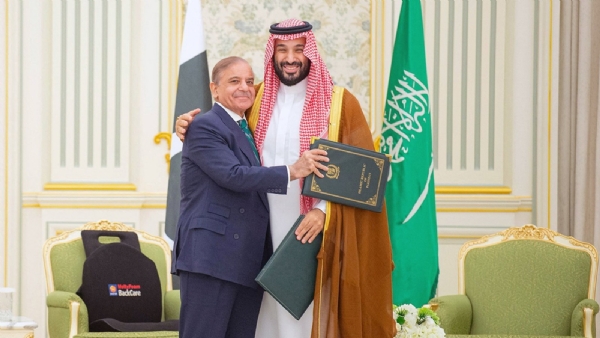
In August 2025, Saudi Arabia and Pakistan signed a “Strategic Mutual Defence Agreement” which explicitly states that “an attack on one country will be considered an attack on both.” This clause alone is a cause of concern for India.
Over the past decade, India had made significant progress with Saudi Arabia in the areas of energy, trade, and investment. In 2023–24, bilateral trade between the two countries touched $52 billion, while more than 2.5 million Indians live in Saudi Arabia. Against this backdrop, the Saudi–Pakistan defence pact could directly impact India’s interests.
Background of Saudi–Pakistan Relations
Since the 1960s, Saudi Arabia has provided Pakistan with large loans, oil subsidies, and aid. In 2023, Saudi Arabia granted Pakistan a $3 billion loan and $1.2 billion in oil subsidies.
In the 1980s, Pakistan trained Saudi forces.
In 2015, during the Yemen conflict, Saudi Arabia even demanded Pakistani troop deployment.
Pakistan projects itself as a protector of the Islamic Ummah, which aligns with Saudi Arabia’s own ambitions of leading the Islamic world.
Saudi Arabia’s Shift in Security Policy
Earlier, Saudi Arabia relied on the U.S. for its security. However, under Donald Trump’s presidency, this policy underwent a shift, leaving Riyadh to seek new allies.
Following the 2019 Abqaiq oil refinery attack, the U.S. did not provide strong support to Saudi Arabia. This made Riyadh realize the need for alternative security partners.
With Iran’s growing nuclear capabilities, Saudi Arabia views Pakistan as an indirect source of “nuclear protection.”
Ongoing wars in Yemen, Syria, and Gaza have only heightened Saudi Arabia’s sense of insecurity.
Pakistan’s Interests
Pakistan’s fragile economy is on the verge of collapse, with foreign exchange reserves falling below $9 billion. Saudi loans, investments, and oil subsidies provide it a lifeline.
With Saudi backing, Pakistan could take a more aggressive stance on Kashmir.
This agreement allows Pakistan to position itself as a key security provider in the Muslim world.
Analysis of Defence Agreement
Nature of the Agreement: So far, information about the pact comes mainly from Pakistani newspapers and some Middle Eastern outlets. Saudi Arabia has already informed India, clarifying that the agreement is not directed against New Delhi. Its stated purpose is to ensure Saudi security in case of attacks, such as from Israel (similar to Yemen).
Pakistani Spin: Pakistani media and its defence minister project the deal as if Saudi Arabia would come to Pakistan’s aid if it were attacked—implying that in the event of another Indian counter-terrorism operation like Operation Sindoor, Saudi might support Pakistan.
Israel’s Concerns: Israel has warned that if any nuclear-armed country acts against it, Israel would pre-emptively strike to neutralize their nuclear capabilities, as it attempted with Iran. This makes Pakistan a direct focus of Israeli scrutiny. India should actively share intelligence with Israel on this matter.
Regional Competition: The Muslim world is divided between Shia (Iran) and Sunni (Saudi-led) blocs. If Iran attacks Saudi Arabia, Pakistan’s actual stance remains questionable. Egypt and Turkey have also expressed willingness to defend Arab nations, creating competition among them for leadership in the Islamic world’s security architecture.
Global Diplomacy: Pakistan seeks to elevate its global standing by strengthening ties with the U.S. (especially Donald Trump) and China. However, these efforts are faltering: Washington offers promises without action, while China has reduced its investments in the CPEC (China-Pakistan Economic Corridor).
Implications for India
Military and Security Challenges
Pakistan’s nuclear technology could indirectly benefit Saudi Arabia. Saudi funding could modernize Pakistan’s air force, missile systems, and drone capabilities.
Foreign Policy Pressure
India’s growing energy, investment, and counter-terrorism cooperation with Saudi Arabia could be undermined.Saudi backing for Pakistan could reflect in anti-India rhetoric at platforms like the OIC (Organisation of Islamic Cooperation).India risks losing influence in Gulf countries.
Policy Recommendations for India
Sustain High-Level Dialogue: India must continue top-level engagement with Saudi Arabia, highlighting that long-term energy and economic interests with India outweigh ties with Pakistan.
Leverage Economic and Energy Cooperation: Saudi Arabia is India’s second-largest crude oil supplier. India should push ahead with projects in renewable energy, green hydrogen, and natural gas.
Use the Indian Diaspora: With over 2.5 million Indians in Saudi Arabia, New Delhi must emphasize their importance in bilateral relations.
Strengthen Cultural and Educational Diplomacy: To improve India’s image in Muslim-majority countries.
Assert at International Platforms: India must be proactive at the OIC and other global stages to safeguard its position.
Final Word
The Saudi–Pakistan defence pact may give Pakistan temporary economic relief and weapons supplies from Riyadh, but it is unlikely to bring about major geopolitical shifts. Instead, it adds another layer of complexity to the already chaotic Middle East, while also sharpening the strategic challenge for India.
The Saudi–Pakistan defence agreement disrupts the delicate balance of power in South Asia. However, it also presents India with an opportunity to refine its foreign policy, modernize military capabilities, and strengthen regional partnerships. By carefully balancing Hard Power and Soft Power, India can turn this challenge into a strategic advantage.
--