Strategic Surrender: Why the U.S. Can’t Afford to Oppose India Anymore
NewsBharati 05-Nov-2025 10:25:11 AM
Total Views |


-Chintan Mokashi
Tulsi Gabbard, now U.S. Director of National Intelligence, has officially declared the end of America's decades-long “regime change” strategy, marking a dramatic shift in U.S. foreign policy under President Donald Trump. This announcement has reignited global debate about the consequences of past interventions and the future of geopolitical alignments, especially for India.
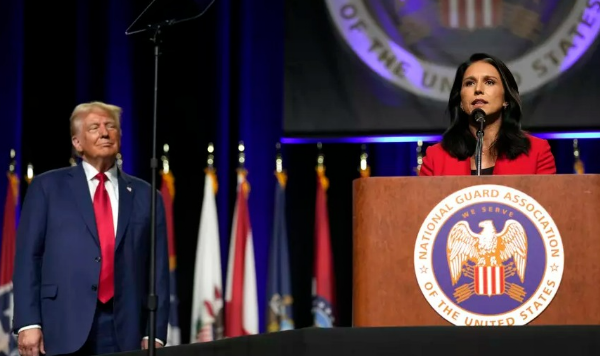
Tulsi Gabbard stated at the Manama Dialogue in Bahrain that “for decades, our foreign policy has been trapped in a counterproductive and endless cycle of regime change or nation building”. She emphasised that this approach often led to “more enemies than allies”, with trillions spent and countless lives affected. This is an official policy declaration from the Trump administration, signaling a strategic pivot away from ideological warfare.
The USA has a long history of forcing regime change from Iran to Libya. Way back in 1953 CIA-backed coup ousted Prime Minister Mossadegh, sowing seeds of anti-American sentiment in Iran. In Chile U.S. supported Pinochet’s military coup, leading to decades of dictatorship. In 2003 U.S. invaded Iraq on the false claims of having Weapons of Mass Destruction (WMD), which destabilised the region and empowered the extremist groups. In 2011, the NATO-led intervention led to civil war in Libya and caused a failed state. These interventions often backfired, creating long-term instability and humanitarian crises.
When Soros Is Under Investigation and Trump Is Confessing
In a stunning geopolitical twist, as investigations begin into George Soros’s global influence networks, President Donald Trump himself has openly admitted to America's long-standing regime change operations. And now, Tulsi Gabbard, once a vocal critic of U.S. foreign policy and now Director of National Intelligence, has declared that the campaign to unseat Prime Minister Modi is officially over.
She didn’t just hint at it. She admitted it openly: the U.S. pursued regime change for decades, paid a massive price for it, and will not repeat those mistakes. America, too, has suffered. So have the nations it intervened in. This signals a tectonic shift: what was once inevitable is now being reversed. The 70-year-old doctrine of regime change is being dismantled. And in a surprising endorsement, Gabbard acknowledged that India’s foreign policy model is the best in the world—and America now intends to follow it.
You might wonder: why would Tulsi Gabbard, sitting beside Donald Trump, make such a confession? The answer lies in cold, hard geopolitics. America can no longer afford to go against India—nor will it. The U.S. needs India in the Indo-Pacific to counter China’s growing dominance. Promoting democracy worldwide is no longer just a slogan. It’s a strategic necessity. And to do that, Washington needs New Delhi.
In geopolitics, relationships are forged not by sentiment, but by necessity. America cannot afford to antagonize India. It needs access to Indian markets. It needs India to balance China. That’s why Washington is now speaking in India’s favor.
Sure, they might posture, threaten tariffs, hint at economic pressure, claim they’ll bring India to its knees. Remember when Trump said Modi would come crawling in 10 days? It’s been 120 days. Modi didn’t kneel. Instead, America is now bending toward India. That’s geopolitics in action.
Trishul, Chess Moves, and the Long Game
India hasn’t even paused Exercise Trishul. In fact, the next phase has already been announced—this time in Gujarat. This is what it means to play the long game. For 10 days, Pakistan’s entire air traffic has been paralysed. This is strategic chess. And Modi knows: the longer the game, the more pressure builds on Pakistan. The U.S., once Pakistan’s patron, is growing nervous.
Meanwhile, India is drawing closer to China and Russia. For Washington, that’s a death warrant. The U.S. has now been forced to admit: yes, they tried to unseat Modi. But that mission is over. No more regime change in India. Now, they’re saying: Let’s be friends again. That’s the new American language.
Bottom Line: This is India’s moment. With the U.S. stepping back from regime change and ideological warfare, India has a rare opportunity to redefine its global role. But vigilance is key—America’s strategic recalibrations have historically been fluid. Can India trust this new doctrine, or should it prepare for another twist in the great power game?
Tulsi Gabbard, now U.S. Director of National Intelligence, has officially declared the end of America's decades-long “regime change” strategy, marking a dramatic shift in U.S. foreign policy under President Donald Trump. This announcement has reignited global debate about the consequences of past interventions and the future of geopolitical alignments, especially for India.
Tulsi Gabbard stated at the Manama Dialogue in Bahrain that “for decades, our foreign policy has been trapped in a counterproductive and endless cycle of regime change or nation building”. She emphasised that this approach often led to “more enemies than allies”, with trillions spent and countless lives affected. This is an official policy declaration from the Trump administration, signaling a strategic pivot away from ideological warfare.
The USA has a long history of forcing regime change from Iran to Libya. Way back in 1953 CIA-backed coup ousted Prime Minister Mossadegh, sowing seeds of anti-American sentiment in Iran. In Chile U.S. supported Pinochet’s military coup, leading to decades of dictatorship. In 2003 U.S. invaded Iraq on the false claims of having Weapons of Mass Destruction (WMD), which destabilised the region and empowered the extremist groups. In 2011, the NATO-led intervention led to civil war in Libya and caused a failed state. These interventions often backfired, creating long-term instability and humanitarian crises.
When Soros Is Under Investigation and Trump Is Confessing
In a stunning geopolitical twist, as investigations begin into George Soros’s global influence networks, President Donald Trump himself has openly admitted to America's long-standing regime change operations. And now, Tulsi Gabbard, once a vocal critic of U.S. foreign policy and now Director of National Intelligence, has declared that the campaign to unseat Prime Minister Modi is officially over.
She didn’t just hint at it. She admitted it openly: the U.S. pursued regime change for decades, paid a massive price for it, and will not repeat those mistakes. America, too, has suffered. So have the nations it intervened in. This signals a tectonic shift: what was once inevitable is now being reversed. The 70-year-old doctrine of regime change is being dismantled. And in a surprising endorsement, Gabbard acknowledged that India’s foreign policy model is the best in the world—and America now intends to follow it.
You might wonder: why would Tulsi Gabbard, sitting beside Donald Trump, make such a confession? The answer lies in cold, hard geopolitics. America can no longer afford to go against India—nor will it. The U.S. needs India in the Indo-Pacific to counter China’s growing dominance. Promoting democracy worldwide is no longer just a slogan. It’s a strategic necessity. And to do that, Washington needs New Delhi.
In geopolitics, relationships are forged not by sentiment, but by necessity. America cannot afford to antagonize India. It needs access to Indian markets. It needs India to balance China. That’s why Washington is now speaking in India’s favor.
Sure, they might posture, threaten tariffs, hint at economic pressure, claim they’ll bring India to its knees. Remember when Trump said Modi would come crawling in 10 days? It’s been 120 days. Modi didn’t kneel. Instead, America is now bending toward India. That’s geopolitics in action.
Trishul, Chess Moves, and the Long Game
India hasn’t even paused Exercise Trishul. In fact, the next phase has already been announced—this time in Gujarat. This is what it means to play the long game. For 10 days, Pakistan’s entire air traffic has been paralysed. This is strategic chess. And Modi knows: the longer the game, the more pressure builds on Pakistan. The U.S., once Pakistan’s patron, is growing nervous.
Meanwhile, India is drawing closer to China and Russia. For Washington, that’s a death warrant. The U.S. has now been forced to admit: yes, they tried to unseat Modi. But that mission is over. No more regime change in India. Now, they’re saying: Let’s be friends again. That’s the new American language.
Bottom Line: This is India’s moment. With the U.S. stepping back from regime change and ideological warfare, India has a rare opportunity to redefine its global role. But vigilance is key—America’s strategic recalibrations have historically been fluid. Can India trust this new doctrine, or should it prepare for another twist in the great power game?

Chintan Mokashi
Chintan Mokashi is a Pune-based writer, journalist, and researcher. He specialises in cinema, world history, human rights, and corporate fraud examination. With a postgraduate degree in journalism and extensive experience in writing across diverse subjects, his work blends analytical depth with cultural insight. Fluent in Marathi and English, Chintan’s writing bridges historical context with contemporary relevance, offering readers a thoughtful and engaging perspective.